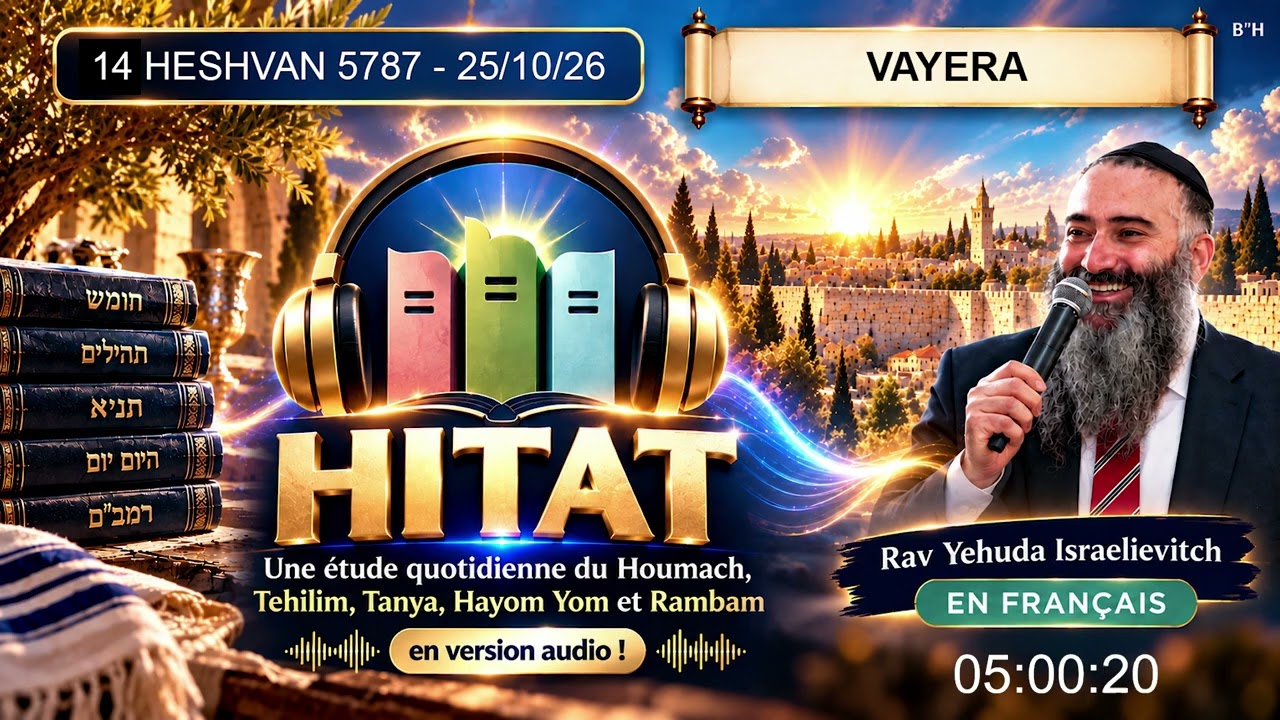
PARACHAT VAYERA (4) - HITAT DU JOUR 17 HESHVAN 5787 - 28 Octobre 2026
Paracha
Retrouvez nous sur notre site www.israeltorah.com Merci de vous abonner à nos vidéos sur YouTube et de partager un Max ! IMPORTANT Soyez un des partenaires de la diffusion de la Torah dans le monde et associez-vous à nos Mitsvot ! Vous pouvez donner votre Maasser... Et sachez que nous réussirons toujours avec l’aide énorme d’Hachem grâce à vous ! Lien pour Donner http://www.israeltorah.com/dons-et-bilan/
Extrait du cours
Welcome to our daily appointment for studying the day's text. Today is Wednesday, the day of Parashat Vayeira, 17 Marheshvan 5784. How can we prepare for the coming of Mashiach? The Lubavitcher Rebbe teaches us that the best way to prepare is to start practicing right now. We should perform our actions today just as we will perform them when Mashiach arrives. When he comes, the entire world will recognize God, Hakadosh Baruch Hu. Every human being, every element will realize that Hashem is the true King of the entire universe and that everything is part of Him. Thus, the Rebbe asks us to prepare for his arrival by working hard.
Transcription1553 mots
Transcription automatique — peut contenir des erreurs.
Boker tov to everyone. Hello to one and all. Welcome to our daily appointment for studying the day's text. Today is Wednesday, the day of Parashat Vayeira, 17 Marheshvan 5784.
How can we prepare for the coming of Mashiach? The Lubavitcher Rebbe teaches us that the best way to prepare is to start practicing right now. We should perform our actions today just as we will perform them when Mashiach arrives. When he comes, the entire world will recognize God, Hakadosh Baruch Hu.
Every human being, every element will realize that Hashem is the true King of the entire universe and that everything is part of Him. Thus, the Rebbe asks us to prepare for his arrival by working hard. Spread the Torah, spread the mitzvot, perform more and more mitzvot, and help others to perform them as well . Our goal must be Kiddush Hashem, the sanctification of the name of the Holy One, in our behavior, our vision, and in how we explain, view, and share the world's events.
The Holy One is there in every moment of our existence. We just need to live at that pace to already perceive what we will experience when Mashiach arrives mamash . Mamash. We begin with Lot, who flees from Sodom before it is destroyed.
The angel allows him to take refuge in the small city of Bela, which is renamed Tzoar because it was newer and had fewer sins. The Holy One then rains fire upon Sodom and Gomorrah and overturns the cities. Lot's wife, who has the misfortune of looking back while leaving despite the prohibition, is turned into a pillar of salt. A punishment of measure for measure, middah k'neged middah, because she had refused to give salt to her guests in the past.
At the same moment, Abraham rises to pray Shacharit. It is he who initiated this morning prayer that we still perform today. Looking into the distance, he sees smoke rising from the ancient cities of Sodom. For his part, Lot leaves Tzoar out of fear and goes to live in a cave with his daughters.
Believing the entire world has been destroyed as in the Flood, the mabbul, his daughters decide to make him drunk in order to have children by him and save humanity. From this, Moav and Ben-Ammi will be born. Abraham, meanwhile, decides to move closer to other people and settles near Gerar. As in Egypt, he presents Sarah as his sister to protect himself.
There, King Avimelech has her brought to his home. But Hashem stops him by making him very ill and warns him during the night in a dream. Avimelech returns her to Abraham , rebuking him for hiding the fact that she was his wife. Abraham answers him that he was afraid.
He felt that the inhabitants of that place had no fear of God and that they would have killed him to take Sarah. Avimelech understands. He apologizes and offers him gifts. And Abraham prays for him at that moment, and the king is healed.
And here is the most powerful moment of the parsha, taking care of others. Hashem remembers the prayer and the need of Abraham Avinu, since Abraham prayed for someone else. Hashem will first grant his request. At Passover, the following year, Sarah gives birth to a baby boy.
And to put an end to any doubt, Hashem makes it so that Yitzchak looks exactly like Abraham. Abraham calls him Yitzchak and performs his brit milah at 8 days old, exactly as Hashem had asked him. Today, we read from 83 to 87 of chapter 83 to 87. And in chapter 84, we find a very special verse that we studied: "Ki shemesh umagen Elokim." It is a verse that we often find in Chassidut, because the name of Hashem and the name of Elokim are a sun and a shield.
It is a parable , a mashal, which represents Hashem as the sun shining with immense strength. And if the sun shone on us with all its power, it would make the world much too hot and unlivable. Hashem has therefore placed a screen, a shield before the sun so that all its light does not pour onto the world. Thanks to this, we can live in the world comfortably and enjoy the light of the sun.
The same goes for Hakadosh Baruch Hu, for Hashem. The vitality that emanates from the name of Havaye is a vitality so intense that we could not feel we exist in a distinct way. The force and power of His presence would mean that no one could exist. But the name of Elokim is there precisely for that.
Elokim veils the name of Havaye, so that the world can continue to exist as a world, while enjoying the vitality, the presence of Hakadosh Baruch Hu, for Hashem Elokim is a sun and a shield. This is what allows us to live according to the rhythm of the presence of Hakadosh Baruch Hu here on earth, while being what we are, that is to say, human beings, limited creatures with our needs, our physical and material limits , gashmiut. That is the force of nature , Elokim, but also this transcendence, the same from the name of Hashem of Hakadosh Baruch Hu. Baruch.
Tanya, Iggeret HaKodesh, Siman 5: This new letter was written to comfort the Rabbi of Berditchev after the passing of his son, Rabbi Nachum. He relates that when the Torah tells us of the passing of Miriam, it places it right next to the passage where we study the laws of the Parah Adumah, the red heifer. The Sages explain that just as the Parah Adumah can purify a person even from the most severe impurity, the greatest tumah, likewise, when a Tzaddik leaves this world, it brings an atonement, a kapparah, for the most serious sins committed by the Jewish people. First, the Alter Rebbe explains to us what occurs on a spiritual level when the Parah Adumah was offered.
The commandment of the Parah Adumah involves very many details, and when we fulfill this mitzvah according to the details prescribed by the Torah, it draws a very great vitality from Hashem into the world. This vitality is capable of bringing taharah, purification, even to the strongest impurity. It is a level far higher than what occurs with, for example, ordinary sacrifices. Tomorrow, Be'ezrat Hashem, we will learn what happens when a Tzaddik leaves this world and why these two events are similar.
Again. A person might say, "What does it matter if I fail to study Torah today or to fulfill my mission?" Tomorrow is another day. Be'ezrat Hashem, Hashem will grant me a long life with very many years, Be'ezrat Hashem, and there will always be other opportunities. And here, the Rebbe tells us today in the Hayom Yom: This is not how a Jew should think.
We must be very careful not to waste our time. We must use every opportunity, every second at our disposal for Torah and mitzvot. And why is this important? Because every second in time is only present at that precise moment.
The Rebbe tells us, "This parcel of Divine vitality that is there and exists at this precise moment will not happen again." It is a parcel of life, of Divine vitality, that we must use for good. Our existence will only be complete if we employ all this time and every instant for what is appropriate, that is, to make this world a dwelling place for Hashem. And we finish with our Rambam of the day, Hilchot Mechira. In today's Rambam, we continue the study of how to conduct business according to the Torah.
In this chapter , the Rambam teaches in which cases we can return an item and get our money back. A rule states that if we buy a cow, for example, and the seller doesn't disclose that it has no teeth, and it cannot feed itself and dies, we can return the dead cow and get all of our money back. In chapter 16, the Rambam explains the case where the Torah considers a sale to be unfair, allowing us to return what we bought and receive a refund of our money. When we sell an item, we must strictly tell the truth about what it is and its actual quality.
And finally, in chapter 18, the Rambam teaches us about the prohibition against deceiving people during a sale. It is forbidden to repaint an old car to make it look new or to place nice-looking apples on top of a bag containing spoiled apples to entice someone to buy them. On the other hand, we are allowed to distribute items or gifts to people who come into our shop, for example, to encourage them to return. That is what the Rambam tells us here.
That was the daily Halacha. I hope you had a good time. Remember to share it with as many people as possible so that more and more of us can study the Halacha. And I invite you to send us your dedications at +33 6 21 37 24 52 via WhatsApp.
I will see you very soon. We have studied the Mitzvah. Agreed. Agreed.