The Torah Podcast

Cours de Torah — disponibles sur vos plateformes favorites

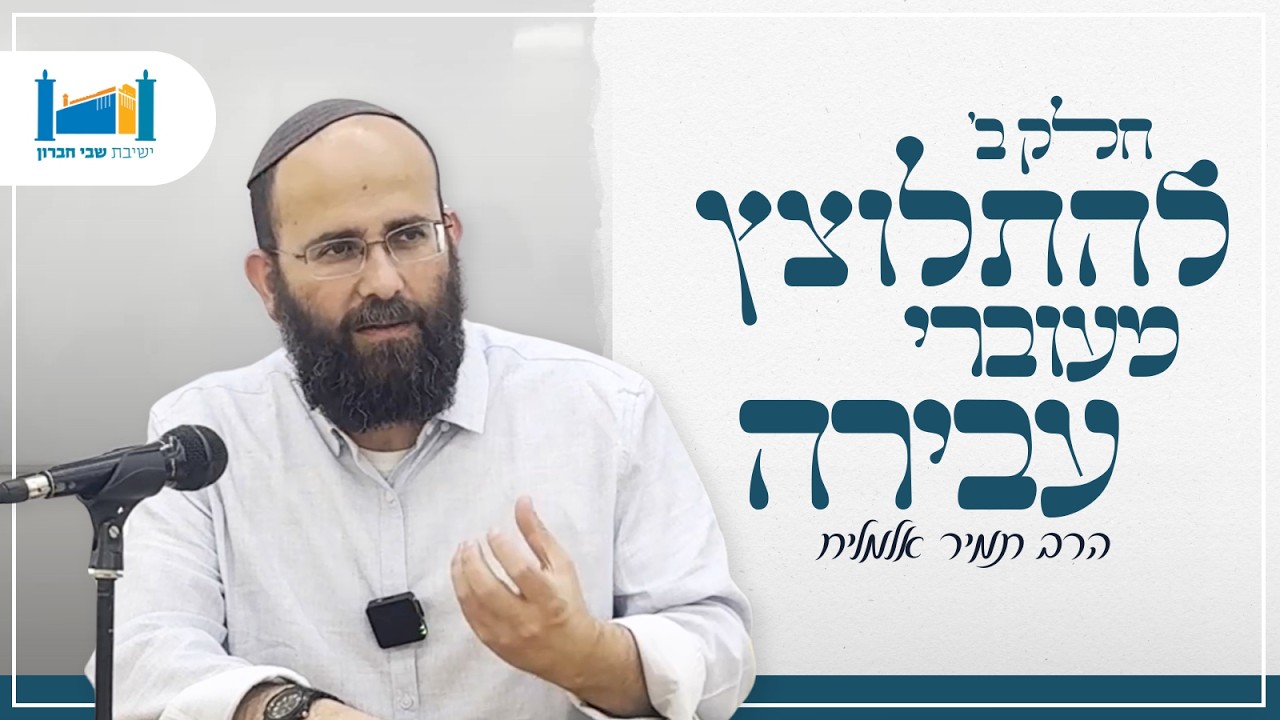
להתלוצץ מעוברי עבירה - חלק ב' | הרב תמיר אלמליח | שובבי"ם | תשפ''ו

להתלוצץ מעוברי עבירה - חלק ב' | הרב תמיר אלמליח | שובבי"ם | תשפ''ו

ישיבת שבי חברון ·

Téchouva Moussar
Vitesse :

מוזמנים להיכנס לאתר ישיבת שבי חברון החדש עם מגוון שיעורים רחב בשלל נושאים, זמנים וכו' https://shaveihevron.org/

Transcription
Kind: captions Language: en Let's try a brief recap of what we saw last time. okay? Until the public arrives. Can you hear here? Yes, great. Good afternoon. We saw last time we learned about Rabbi Meir and Rabbi Akiva that the Gemara teaches that the evil inclination will drive them away and it was very successful. And the wicked ones proclaimed in the sky that Rabbi Meir would shine in his Torah. Rabbi Akiva in his Torah. So it would have ended badly. We learned from Rabbi Meir and Rabbi Akiva's way of joking about transgressors. It was their way of saying that it needed study, it needed clarification. What is this thing? To joke about past offenses. And we saw in the name of Rav Zadok that when a person jokes about a transgression, when a great scholar jokes about a transgression, it is a good thing. Because the evil inclination in this world often seems to be very evil, present in this world, and when we encounter evil in this world, its presence is threatening, it is difficult, and when a great scholar comes and jokes about it and says, if we just want it, everything will pass, everything will be fine, then there is something in that that gives a lot of power through the Sages to educate us to joke about idolatry. An explicit Shulchan Aruch. We saw in Rachel and the Predators how she makes her house joke about idolatry. Laban is a very talented person. And before she leaves home, she must make her children understand that Laban is not that perfect. Although on the surface it seems very good and very significant. She makes him run from tent to tent to seek his God. There is room for laughter in the face of something that must be overcome, in the face of something that must be defeated. This is real, this is true. But we have seen that this thing, as true as it is, is not true about work, about incest, about the lion instinct. Why is it because when the animal instinct is brought to appear in a person's life, it appears in the form of an argument, it suggests, it appears with a statement? In a certain way, he not only appears in a place of exposure of low desires, it is certain that he also has such a style, but such a style, someone who does not want to be on stage, someone who does not want to live life in a very, very low way, in a very, very low layman, then it is very, very difficult for him to buy this argument. The urge appears in the life of a great man. He suggests that it appears from completely different arguments. We saw in the Haggadah that he disguises himself. He puts the woman in two places. One is across the river and the other is at the top of the palm tree. And in both of them, the Maharlika says that these places are special. He did not just choose these places. Look, the Maharlika, I think we did not read him, but we talked about him. He appears here at the bottom. Stand on the right page. On the right side, Rabbi Meir Idemnikit. You are standing on the other side of the stream. Rabbi Akiva is standing in the tree. Because you have to know that the evil inclination in man is because man lacks two things and everything is lacking and longs to make up for its lack. The evil inclination comes into man's life. It speaks to the missing sides in him. With some kind of longing that is in him. And when you understand, there are two expansions here. One expansion in width and the other in height. And it is The expansion of the sides where the power of the evil inclination is strong passes through because it comes out of the middle. So we talked about it a little without the Maharal himself, but by the power of the Maharal. The inclination reaches people who yearn, people who lack. This is how it builds its claims, its statements. Crossing the river, beyond the river is such a reality that it is beyond the limits of man. A river is a natural limit. And when the inclination appears in a person's life, it tells him, "Come break boundaries with me." Breaking boundaries is a forbidden thing, but every renewal, every renewal in life has a kind of breaking boundaries. When a person goes to a new place that he has not been to, to a new place, to a new level that he has not been to, he somewhat agrees that the place he was before no longer suits him, no longer feels comfortable for him, is not right for him. He is the one who takes the inclination and claims to a person that he is able to take him to a place that is beyond his natural personal powers, took him to a new place. The top of the palm tree is also a very, very unique place. It is not easy to climb a palm tree. There are trees that are easy to climb, but the head of the palm tree has Such thorns all along the way to climb for the sake of it. Children might be able to do it. An adult must have a very, very hard time doing it. But when a person rises high, he suddenly sees spaces. He is not stuck in his own place on a high mountain. On you, Zion heralds. This is the claim: "Go up high, look at the spaces. You have hoped for salvation." It demands height. It demands loftiness. And the Maharal teaches that the urge appears in a person's life. So it appears between these two claims. It suggests to a person, "Come be broad, come spread out, come expand, come grow, come renew my ways." That's how it suggests, "Come reach the realms that in your own personal humanity, you cannot reach alone. And in your natural, gradual growth, you cannot reach either height or breadth. These are completely different claims from claims of lowliness. And if a person prepares himself for the whole war, we talked about this, the whole war against the urge, against the sur, such a soup of truth. So when the urge dresses in these claims, in claims of creation, of blessed doing, of progress, then a person One cannot lose focus in guarding and then find the instinct very close to it. Why? Because it thinks it is growing, not because it thinks it is developing. The instinct cannot be joked about. We talked about hypocrisy that is uprooted because it has roots. It is not for nothing that it resembles a mountain. It can really take a person to climb a mountain with it in a corrected life of holiness, of purity, of gentleness, of marriage. A person really breaks out together with this instinct into new spaces. Eternity, children, family, in general. Such a reality that a person comes out of his private fences and experiences an encounter with very, very large worlds. The instinct knows how to paint such a state of expansion and growth because at the root, at the root at the root yes, he really is a partner in the basin of these places. But what he is lying about, what he is imagining and painting to a person is some kind of picture as if the perfection in his hands is a very, very subtle perfection, very, very low and that it comes before its time and that a person does not diminish it, that a person does not, oh, oh, grow properly Towards it, then it destroys him, then it consumes him. We saw in the vision books about a great man who conquers all the forces of the instinct, which is a great thing, something very, very special on the one hand, but one thing he forgot to do, what did he not build new aspirations of progress, of renewal, of growth of the ascensions? And then the Rabbi says, he falls into the beasts, why? Because a war on the instinct cannot be only by suppressing it, it cannot only be by stopping the forces of life. Whoever wants to, wants to manage the instincts. Whoever wants to win the war on the instinct, to win the war on the instinct is also to bend and stop and be a spiritual hero who leads his life in a real way, but also to win over the forces of creation. This means that he must develop a space of creation, a real space in which he encounters all his renewal and growth and movement to a new life. And then when the instinct comes, he does not meet a hungry person, he does not meet a lacking person, as this Gemara teaches, the instinct itself cannot be joked about. And because you joke, then it performs very difficult actions under holy conditions. These. Very, very hard, but he can't bring them down. Why? Because it is written that it will shine in the sky. They proclaim in the sky that they will shine in Rabbi Meir and Rabbi Akiva in their Torah. The Torah of Rabbi Meir and Rabbi Akiva protects them, protects them. How does the Torah protect? So of course there is a special dimension here, a special grace that elevates the students of the right way to protect them, and of course it also protects on the special side on the simple side, but I think that the Torah protects from desire because the Torah makes a person full, full of creation, full of life movements. The students of the Sages are called overflowing, full of abundance, and this is where we stopped if I remember correctly. This is where we stopped last time, when people joke about the evil inclination and think that it is nothing, then suddenly it penetrates life in a very, very significant way because the inclination comes to move life forward. How does the inclination say to these holy conditions, if they had not proclaimed in the sky that you have Torah, I would have shed your blood like two hundred times. We talked about blood, which is blood, which is money, which is ambition. A person who has ambitions will encounter desires. Every great person seeks expansion, seeks a world of renewal, of progress. It is his choice as a spiritual person to choose how he is renewed, his responsibility to choose from what he is renewed. Does he renew himself and create great works, significant works? Does it belong to a large, healthy enterprise like this, where we are constantly moving forward, where we are constantly making progress, where we are constantly building good on top of good, on top of good? And then when the urge comes into his life, there is no justice to enter, because he is overflowing with goodness, because he is not hungry. Then there is no suggestion of such low-quality works. And low-key words, sorry, such low-key words don't speak to him because he is full of blessings. What is this dedication to the blessing? What is this about? What an abundance Torah is. Torah is not just a virtue. Torah creates a complete person, a well-rounded person. This has a lot of implications for us, the people of the Beit Midrash. There is also a lot of nefekmin here for an encounter with Torah. According to this understanding, the encounter with Torah cannot end with a person becoming a hero and returning to a chair to sit in a Beit Midrash. There are times like these, there are days like these, not every moment is a man in the clouds and that's okay, that's really okay. But in the end, in a person's aspiration, the Torah should fill him, act upon him in such a way that he is full, he is overflowing with an abundance of goodness, he creates, he labors in such a way that the Torah makes him happy. And then in such a world, suggestions of low renewal are not at all in discourse, not in speech. So to expand on this, this is why we met for another lesson to expand on this abundance of Torah. There are a few sources here that I wanted to study together. Okay, so far, things are clear. Beautiful. Look at the Marel between the boxes of the world in brief. Through the lights of the Torah, through the dimensions of vision. And finally, at the end, Rabbi Harlap. How is he really, really precise about this thing in relation to us? Ishbi Beit Midrash. The rabbi writes, "The Maharal writes like this in the Gemara, in the chapter of the flute, it is written about the evil inclination that he hates and is the enemy of man. And as Solomon said, "Call it hate," as it is said, "If you are hungry, I will feed you. If you are fasting, I will give you food and water. And the Lord will repay you. Do not repay you, but rather make you whole. The evil inclination is called hate, and he hates hunger. And whoever succeeds in dealing with the evil inclination is called hate, and he hates hunger. And whoever succeeds in dealing with the evil inclination is because he knows how to satisfy it. What does this mean? Eating is bread? There is in man a certain happiness through which he is able to satisfy lower desires. There is a certain blessing in it. What does this mean? What is this that King Solomon is talking about in this explanation? Because Solomon called the evil inclination a hate, as explained next, and said, "If you are hungry, your son, the evil inclination incites him to evil." Eating is the bread of Torah, and if they fast, give them water. The evil inclination, in its slander, tells a person that it has something to give him, to give him, to satisfy him. Conversely, a person needs a way to encounter Torah, says the Maharal, to satisfy this hater called the evil inclination. What does that mean? And the one who said if a nobleman harms you, he will be taken to the Beit Midrash. The evil inclination is called a noble one because this evil inclination is the narrowness that clings to man. And accordingly he is called a nobleman. And if a nobleman offends you, he will be taken to the study hall, because the inclination is not only due to the weakness inherent in man. Whereas the Torah is perfect without any flaw. And there is no disadvantage on the part of the Torah at all. Accordingly, whatever a person has a connection to the Torah from this side, the evil inclination does not control the person. All the control of the evil inclination over a person is because the person, in his mental picture, in his view of himself and in his inner experience, is lacking, and because he is lacking, because this reality within him, he walks in a conduct and experience of such a lack of emptiness, then the inclination that comes to influence a person to bestow, to fill his lack, has a place for it. But in truth, the evil inclination is noble. He is a liar. From noble it is something very less, very vile. How does a person fill their life? How does a person fill out and select their own works? The Beit Midrash creates whole people. It means whole. In every world within our world, there is training. Perfection is far away, but the intention is that Torah enables a person to recognize the true creative powers within him, the inner blessing within him. Torah is revealed through verses, through conclusions, through issues, through paragraphs. But Torah ultimately turns a person into a worshiper of God. A person serves God, meaning that he has a mission. Whose life forces are enslaved to a great purpose. Yeshiva teaches a lot of Torah, but at its peak it transforms a person into a great person who thinks greatness. By the way, growth in every field. Certainly in learning. It all starts with learning. It all starts with three principles of faith. It all starts from there. certainly. But through the encounter with Torah, this greatness is revealed in all forms of his life. How he does things, how he acts, what his house looks like, what his relationship with the children looks like. What does the relationship between the children look like? What does his relationship with his community look like with his neighbors? He is a full man, full of abundance. And every rehabilitation that comes to him has something to give, he certainly also has something to receive, and he also has a way to be a partner in the existing creation. He is full of dreams, he is full of ambitions, he is full of entrepreneurship. He doesn't know how to sit idle. Scholars have no rest. The Hamran says, not in this world, not in the next. It doesn't mean they are exhausted. When you see them, you see such a tired, exhausted face, with nowhere to go. The Maharl explains, they are not happy with rest, they do not want rest. They have such big dreams that their power is very, very small compared to forgiveness. In practice, it is very, very small compared to the dreams and the power that they believe is possible to get out of here. And so they are constantly working, they are constantly traveling, they live a life of fullness. This is Torah. And he said it day and night. During the day, everyone works, everyone is present during the day. Every work is part of the day, but Torah, its novelty, is that it protects people at night, and the exception is grace drawn to those who study Torah at night. Of course, with the simple health of sleeping and eating to be strong enough to accomplish this task. Zahrosh is power, real practical power. But Torah leaves people in pain at night because Torah turns people into willful people, upwardly mobile people full of aspirations, full of dreams. And in a world like this, if someone offers you some works that are low, that are small for a person, then it's not surprising at all. So it's not at all very, very difficult to penetrate into a world where one feels fullness, where one feels blessed, where one feels a role, a greatness. So this curse of the instinct is that it is very difficult for him to pass through barriers. When does the urge make a person climb trees and pass by girls in the form of fear? The moment he disdains it, that he says, "Oh, it's like idolatry," we will uproot it, just as we uprooted that. The evil inclination does not go away. The lion's inclination is not going to pass from the world. It is going to be here. And if someone thinks that the war will be just a war of crushing, then the evil inclination will take him in two minutes. If someone thinks that studying in a yeshiva is just doing the right thing, filling the branches of the louse with loads from morning to evening of hard work, that is certainly great, that is excellent. But giving Torah a place in your life is to be full of meeting with Torah, full of the joy of mothers, full of abundance, full of such a reality of correction, of benefit, of blessing. So that life is not dangerous, someone tells you, "Come, I will gird up the false life on the way to the sake of The lowly Rabbi says that the Torah is a general medicine for all flesh. When a person learns Torah from a true place, his flesh and blood change. The reality is the lowest, the most vile. She is sanctified, she is exalted. And we are not talking about the great ones of the Supreme Being. Voodoo is certainly practiced by the great masters of this higher realm in an open form. You can recognize it. With every person who studies Torah, with every person who chooses to be sanctified. This reality of Torah takes the person slowly at its own pace. Not overnight, out of a war, out of a struggle, of course. But the Torah is able to take a person and heal his entire flesh. Deeply corrects all of life. Don't tell what stories existed before the Hagel Beit Midrash. It's all nonsense. It's all nonsense. The Torah, in its power, is capable of bringing life to every person. It may be that on the way to this life that this correction will appear in life, then fears will arise, you will see worries, there will be moments when you have to make up for gaps such as those that a person chose to get there, right? Anything is possible, but she is able to fix everything. The process is a process, but it has this power. What is the power? It's not purple. The Maharlika says, it is perfection. integrity. Every person desires perfection. Every person wants to renew, wants to develop. And if desire comes to an idle person, to a lacking person, to a person who is standing still or to a person who has not achieved perfection, but he longs for perfection and is offered such perfection, then this reality of perfection devours him, it comes to him. He wasn't able to overturn these conditions just because the joke was half-hearted. Their Torah saved them. The Torah saved not only from the physical dimension. The Torah saved because it contains fullness, it contains blessing. Through the culture of the Torah and its light of life, man and the entire world are elevated. These are not empty words, this is elevation, this is progress. What does it mean that a person ascends and the entire world ascends with him? You have a responsibility for this world and you are connected in general, connected in the community, connected in the world, and when you transcend, the entire world transcends with you. And the Torah is capable of elevating man. Without the light of Torah, with all the multitude of visions and feelings of awe and prayer, evil can be placed and pervaded in the world. This is a very, very important sentence. I see you have no pages. I will read it slowly. Sorry, I didn't notice. Without the light of Torah, with all the many visions and feelings of awe and prayer, it is not just to study Torah, it is to take the light of Torah with all the visions. Visions come from the word vision, dreams, aspirations, feelings of awe, emotion. Not just a future desire, but also an emotion. A healthy sense of Torah. Not only Torah in the intellectual dimension, but also reverence, prayer, and work of the heart, in which a person takes his life, his God, and his world to encounter Torah and seeks to encounter Torah with all the instruments of the soul. Not just wars of retreat of Surmara, but also good deeds of correction, of action. Action that stems from learning that descends into the act of kindness of good qualities and is later detailed from a detail in general action that a person dreams only these dreams then he corrects then he acts without it says the Rabbi can evil be placed and strives in the world raises its own and its back without that the Torah reaches everywhere then in this world there is no emptiness there is no emptiness in this world a person must choose either he lives a great life or he ascends up and up blessed is the people of Israel or you ascend up and up or descend down and down that this reality of Torah that a person opens to the heart encounters it in life from the word from a setting then it turns him into a creator it turns him into a painting that raises the reality that advances it then he is on a mission so he is in such great life in the firmament that those who proclaim will shine in his Torah what is the meaning of proclaiming in the firmament this is. Why in the sky? So in the creation of the world, the Seferno explains that the firmament is not the sky. There is heaven and there is earth. And the sky is the place where heaven and earth connect. The Seferno says this is the place through which the land is seen. The firmament is the point of connection between heaven and earth. simply. And there are people who, when adversity endangers them, come to crush them, come to harm them. So whoever fights for them, whoever tries to save them, is the sky itself. This is the connection point between heaven and earth. Now people like this who know their role so well, are so quick, Rabbi Meir, Rabbi Akiva, the embodiment of the Oral Torah, are so significant to this world that when someone messes with them, then in the sky they say, "Stop." We, the sky, need these people. Their Torah is the author of heaven and earth. Their Torah is world-correcting. This is what the Torah creates. This is what the Torah does in our son. The ability to study Torah from recognizing the Torah as something that fills life with blessing. Now it's not easy. There is a Gemara, there is a Haramit, there is a whole day, there is an easier issue, there is a more difficult issue, there are nicer additions, there are even better additions . It changes. There are us too. We too grow within this space of Torah, we grow in it. It's a consequence of the size, it's a journey, but this reality of Torah transforms a person into a living person, a person full of abundance. And then in such a reality, the claim of low creation does not come through expression. It does not come through expression. Not that there aren't wars, certainly there aren't wars, but there is a place from which one can decide, a place from which one can win. Look at the rabbi with the dimensions of vision. In fact, I created the evil inclination. I created a spice for him. There is an evil inclination and Torah is a spice. A spice that is supposed to sweeten it. A spice is not the food itself. Spice is what sweetens the food. And there is an evil inclination and the Torah does not prevent it, it ends it, cuts it off, accepts it. What does that mean? The Rabbi says that in general, this concept also includes the content that the will is not purified in its purity, because if by the influence of the Torah a healthy person is a person, aspirations are still desires, they are still dreams, but a will, a great will, a significant will is created by the influence of the Torah. What is the meaning ? The Rabbi says that the words of the Sages say that the Torah immersings the evil inclination. What is the meaning of this? It does not make it disappear. It transforms a person who encounters the Torah into a person with firm desires, who has a destiny, who has a goal, whose life is part of a great, true, supreme blessing. So in any case, it is impossible to deceive him. It is impossible to offer him neither a palm tree that can be climbed, nor a river that can be crossed. It is impossible. These conditions are survivors of the evil inclination. Why? Because there is a real blessing in them that is close at hand. We do not need to paint them lowly pictures through which they will reach some kind of correction. They are people whose will is their blessing and who want, they do, they act. It is not a statement of will that the next day is revealed. Like a shvodnasha. I want But he doesn't succeed. So maybe something doesn't want enough. So maybe we need to be precise about this concept of desire. Torah turns a person into a living person and a living person is a person with a will and an aspiration. And if we see, says the Rabbi, strong things, he will see heaven without Torah. There are people who are connected to heaven but have not yet learned Torah. The Rabbi says, we will know that his will is not strong. He has a fear of heaven but there is no firmness of will in him. Therefore, his correction in this world is weak. He has not been able to create, to correct important things in this world. He will act according to his own strength. A weak correction. Torah takes a person and makes him powerful, full of life. If he studies it in such a way that it is full of life, if he marks, the whole world enters yeshivahs, then we enter too. We need to touch here somewhere on some goal of a few years, to put in the biography, fell in yeshivah. Something like that, then it will not grow, but when a person opens his heart to the Torah, to the works of the Torah, then these works are sown in him in the form of a strong will and according to the power of Torah, he grows. The courage of the will, and if this is what transcends holiness and this is the supreme elevation that operates in the world, it is possible that there are more willing people in the world with good will, then the will is renewed, and the will is exalted, and not just any willful spirit that immediately sweeps you away and takes you somewhere. A person lives a life of questioning. A person still lives a life of clarification. Is it great or not great? Is it real or not real? This is the life that I belong to. But as long as a person has not encountered greatness and as long as a person has not encountered blessing and is offered to reach very high places that in practice cannot be reduced. In the will, there is a real root. Rav Amram Hasidic, who is attacked by the will, takes the ladder of the minister alone, and this is not because he is a bully, because in reality, in the encounter with the will, there is an ability, there is an ability, as he calls Rabbi Meir to cross the river on some palm tree, on some dangerous beam, as he tells Rabbi Akiva when he climbs the top of the palm tree, it is not a river, Rabbi Akiva, that it happens to him, the will brings out of the person some kind of renewal, in practice there is some movement, there is some renewal outwardly, but it is a movement. This error is so low, it comes from the lowest place of man, but this renewal rests on people who do not have the encounter with Torah, which allows a person to recognize the blessing in it, the value in it, and therefore it is very, very difficult to deceive them. This is what Rabbi Meir and Rabbi Akiva call this instinctive reality. It meets a person before, in our generation, in the meantime, before there is a lot of Torah in him, before he is filled with Torah, what will the river do and not drown him? Where will the river take these creative forces? And the rivers look like this. A healthy river looks like this. A person who is coping correctly, volunteering and guiding and doing from place to place, one moment he cannot be, he cannot be at home. There are those who are shocked by this. Rest, relax. He is not allowed to rest now in any way. He is not allowed to rest. He now has to be constantly in the factory because that is how he fills his life. It is either a creation like this, of doing good, of kindness, of blessing, or, God forbid, one moment he will stay in the place and whatever happens to him and whatever falls into him, there is no Torah in him, but that a person encounters Torah in a Beit Midrash and the Melen, Torah encounters are conditions upon them. The prophecy in the sky is not in a day or two when a person encounters Torah, he encounters a space of correction, he encounters some kind of real movement through which one can correct, through which one can move, one can advance because he learns to encounter some kind of fullness of life, then there will be even greater creations, with God's help, through these tools, of course. But right now, he is already creating, for a moment, he is currently working, he is creating, in that he fills the people of Israel with the contents of holiness, nourishes them with spiritual powers, he is a messenger, he is not concerned with himself, he is full of desires for correction of movement, anyway, when he encounters such content that is elevated in the mind, then this content is from the mind that passes to the heart and creates desires and aspirations and good virtues and a good way of life, and then he is a working man, he is a worker of God, and this perfection, the encounter with this perfection, is a future encounter. War always exists, because the greater a person is, the greater his inclination is. This is what the marshal says. This gemara is true. Who does the inclination reach, and who does the inclination hurt the most? People who want to live great lives, people who are truly great, who have aspirations like this. He comes to them, imagines them and tells them, "Come to my aspirations for my renewal, my, come, I will move with you girls, I will take you up to the palm trees, I will meet with you spaces and worlds that you will never reach alone." And the more a person wants a great life, then this reality of instinct is true. It is a greater struggle. It hurts because we would say that the greater a person is, then there are no more instincts. So he corrected it . No. The more a person encounters a greater Torah, the more powerful he is, the more right. So the encounter with the tree will be a struggle. It will be a war. That's why we don't move anywhere from the Shulchan Aruch table. That's why the definitions of the Shulchan Aruch are not a recommendation. They are the A'b that lock our lives. It doesn't matter how much Torah there is in you. And if there is some great wise fool who suddenly, in front of the Shulchan Aruch, makes stellar assumptions for himself, then you have to run away from it like from a fire. Because the greater a person is, the greater his responsibility, the greater his creation. He knows the role, the essence for which he lives. Yes. These things are explained to us. Questions about these things. Yes, Rabbi, if you say that the sin of the great desire is repeated, then it is this feeling that you are in a higher place. There are more things. Yes, exalted in this. As if all the time I advance, it is more, always more, A person fights 7:24 with the help of God all his life for his level of life . It is not the same war all his life. Yes, it is not the same struggle. But yes, a person constantly has to choose to be renewed from the right place, from the great place. Being old no longer speaks, but being old also does not make him relevant to anything. Losing the power of life then he is also irrelevant. In the end, in old age everyone will reach the Holy One. But but it is such a Holy One that the encounter with it is completely different. Blessed is the man who fears God. The Rabbi says in the light of repentance, for whoever does what, whoever makes repentance, that he is a man, everyone will make repentance. The powers of this world will reject him, he will recognize. An old man is wise here. He will recognize the true wisdom in life because there is no longer any coping. Because there is no longer any. But but the Shia of repentance is not in old age. An old man is not answered in court because he does not know the powers of life. He does not know how to rule in law. He does not know how to recognize the coping of the one standing before him. A man who makes repentance is a man. The meaning is that he takes all His personality, all his powers, all the powers of his life, these are for holiness, for the Torah. Right? You're right? It's war. This is what the instinct says to these conditions. Were it not for the Torah that made you so full that I can no longer influence you. So what? I would shed about two thousand of your blood, about two hundred, all your longings, all your dreams, all your desire to be renewed. I would use it for evil, but what the Torah took him to a good place, the Torah renewed him. I have a few minutes left. I'm reading Rabbi Harlev and coming back to you, Akiva. Okay, a minute. Because I want to end with Rabbi Harlev's words. Rabbi Harlev is speaking here for Israeli life. A. about the role that holy people have, and he writes in such a clear way, in the manner of Rabbi Harlev, that when a person does not recognize his role, that a person does not hold his role, then all the spiritual complexity that appears at all, not necessarily in the instincts, appears at all, comes from the fact that there is no recognition of the role, there is no recognition of who you are, what your role is. Look, and we also know this vision. Yes, in the nation as a whole, a struggle within itself will bring a huge strength and demand. To fulfill its role and certificate, to reach the height of its perfection. This nation wants to live a great life, to reach perfection. And as long as it does not fulfill its duty, as long as it has not reached this perfection. Then it has very difficult labor pains . It wanders and wanders and does not find a kingdom for its soul, let alone its soul. There is a desire in a person to live a great life. If he manages to reach this greatness, what is the good? If not, he lives in tremendous pain for not having put his greatness into practice. This is true in particular and it is true in a nation. And when the demand and the search are not at the true source of the nation, where does a person take this demand and search ? The nation. If there is no clarity of Torah, if we do not go to the places that are corrected, then we go to broken places. Then a person goes to drink in the clarity of strangers who do not at all fit his spiritual DNA, his growth, but he is thirsty and there is nothing to give him. And then what does he bring? More To greater apostasy, to more extreme distances from the central role. He distances himself from all self-knowledge, from the central role. This is the essence. His aspiration is perfection. It stems from the fact that he has a role, he did not name his role, so he is in pain, he is restless, he wavers, he tries to satisfy his hungers from all sorts of broken places, which is why the immersion in the role also increases in comparison with this with more faction. And then precisely in these painful moments where there is a lack and there is a lack of recognition of the path and the elaboration of the path and the apostasy is where a person misses his true role the most and when we stand on the nature of our matter we deduce that the sources of heresy are the very requirements of the role, the rabbi says why is there heresy in the world why are there passions in the world why are there sobs in the world because all of these demand that we recognize our role. If hunger hates you then there is bread if you will be abundant, if you will be full of sobs, if you are a role you will recognize your role, if you will be on a mission, a spiritual mission, then from this happiness, from this place, you will be able to give, you will be able To give, you can really build a whole life, but there is a longing for a world that is real from the side of the truth in it, but no one satisfies these longings, there are huge questions in faith. It is appointed but no one gives an answer. So the Rabbi says, heresy arises. Rabbi Harlap says, heresy arises. And this heresy does not come here to disbelieve. It does not come here to persuade. Just as the urge does not come only to overthrow. It comes so that we may awaken. All the evil in the world comes into the world so that we may recognize our role, so that we may recognize our essence. And evil encounters those in positions of power. People who know themselves, are full of blessing, full of abundance, full of abundance. So it is very difficult for him with her and the value of apostasy is according to the value of distancing oneself from the role. The more a person does not know his role, the more the Shabbat Midrash that the Torah in the land says, Rabbi Harlap does not know her role, her responsibility, both in particular. We have talked a lot here about privatization, but also in general, to fill the people of Israel with healthy spiritual forces and a healthy diet that this nation needs, then apostasy arises, and the more apostasy Then we move away from the role, which is why we are not able to know our duty to prepare ourselves to reach the pinnacle of the thought of the House of Israel. These pains, these heresies, these bites, says Rabbi Haralfa. They need to elevate a person to know his role. Why can we reveal and publish our role and our true gratitude with an explanatory face and a quick understanding and joy in a way that will be accepted into the heart and grace and good sense between God and man? This alone will dissolve like a melt that dissolves all the false heresies and they were as if they were not. All heresy is not self-centered. Evil has no power on its own. Evil appears because there is an emptiness because the good is still good . So in these places where this reality of evil appears, where the excitement appears, we need to increase good, we need to increase responsibility. This is what Rabbi Akiva and Rabbi Meir say in their language. On the day you want it, on the day this firm will happens, then there will be no evil. They can say this because Torah creates a firm will. Because Torah creates full, healthy people, not perfect people, not people who have no struggles, no striving, no Apa troposeriya. All that is greater than its companion is greater than it. It is a struggle. It is certainly a struggle, but it is a struggle from which you have where to draw strength to face it. You have where to win it because you are full. Full of what? With true resonance, with blessing, with the ability to bring this blessing to every place and crook, to learn and teach with a treasure trove of the treasures of the Torah, which are on the side of the spiritual and especially after we have come to know the essence of heresies that are the imprints of the role on us, but finding our role is already known to us. You created the evil inclination, you created the Torah as a spice for it. The essence of the evil inclination in life is to turn a person into a role holder, a creator, into such a reality through which he influences, he acts, and then anyway it is impossible to act on him, it is impossible to exploit him, it is impossible to deceive him. Good afternoon