The Torah Podcast

Cours de Torah — disponibles sur vos plateformes favorites

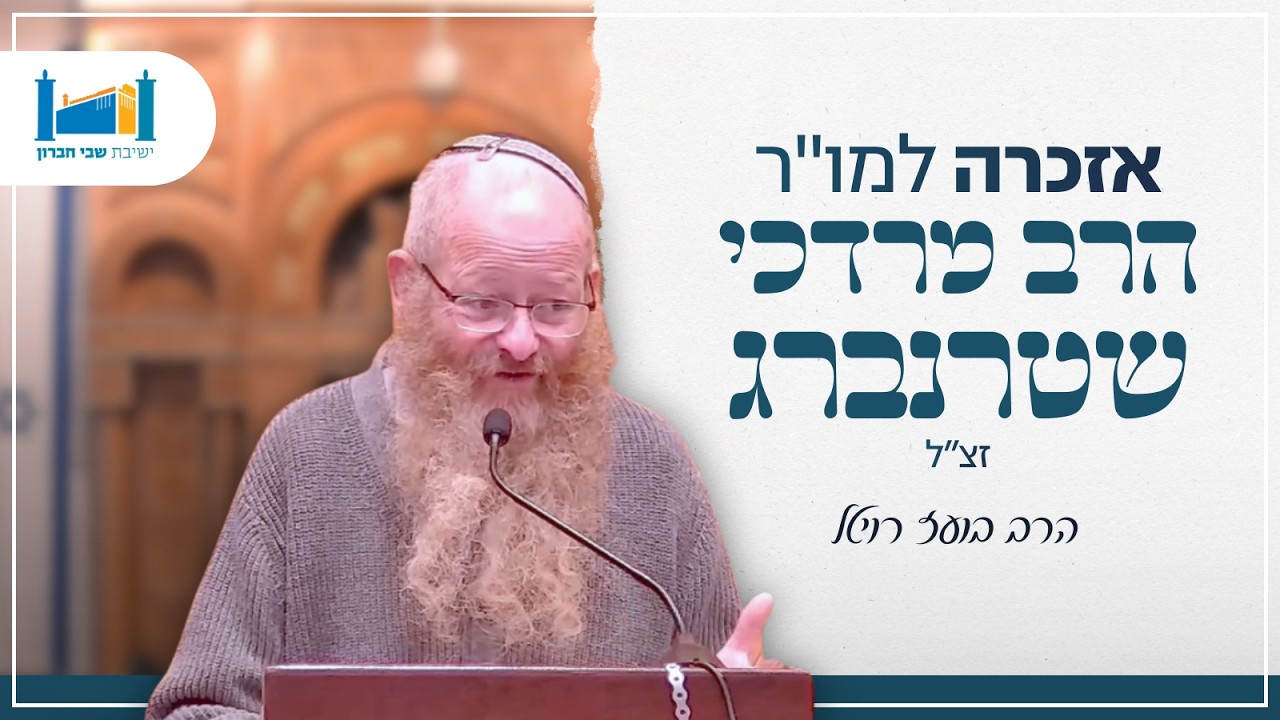
אזכרה למו"ר הרב מרדכי שטרנברג זצ"ל | הרב בעז רויטל | יב כסלו התשפ"ו

אזכרה למו"ר הרב מרדכי שטרנברג זצ"ל | הרב בעז רויטל | יב כסלו התשפ"ו

ישיבת שבי חברון ·

Histoire juive
Vitesse :

מוזמנים להיכנס לאתר ישיבת שבי חברון החדש עם מגוון שיעורים רחב בשלל נושאים, זמנים וכו' https://shaveihevron.org/

Transcription
Kind: captions Language: en Good afternoon and blessings. What was determined by the yeshiva that we did, we will speak, with the help of God, in memory of our teacher and rabbi, our teacher and rabbi, Rabbi Mordechai Sternberg. Now I am aware that there is some issue here because in the end, many of today's students of the Beit Midrash, students of today's Beit Midrash, did not get to know him except through books or from the mouth of a witness, that is, from the mouth of a witness, from all kinds of people who knew him. So it is really a different matter. A little different from the remembrance than from a person who knows everyone. We will try in a few words that I will say right now to share with you a few things that seem significant to me in the Torah that he teaches and that are also significant in many Beit Midrash that belong to what is called the religious Zionist circles or between the gates between them. I think also in our Beit Midrash that many of the Ramim were privileged to keep him and that his Torah has an impact. I think also in this Beit Midrash in a significant way from the head of the yeshiva and more Ramims and so on. So a few things I thought about today, mainly to concentrate on this, in my opinion, that as I see the things in his Torah, there was a lot of reconciliation of things that seem seemingly contradictory. Both of which at first glance seem to contradict each other, and in his special way, in his special study of the teachings of the Land of Israel, it seemed to me that he was truly busy resolving these contradictions. So the first thing I wanted to talk about was the form of study, the special way in which he seemed to approach how one should approach the Gemara, approach Torah study. Now this is of course a very, very long topic so it will be difficult for me. It's not in two or a few sentences, but something small to touch on a certain point, a point that he made very prominent in his way of teaching, and a contradictory thing and the reconciliation between them. So, something that I think very, very much in Blythe was the almost absolute need to be devoted to the Torah, which is not only him, there are many others who spoke in such language. That is, when you approach the Torah, don't approach it from some prejudices that you have and you already make some assumptions, and according to the assumptions that you have, thank you very much, according to the assumptions that you have, thank you, according to the assumptions that you have, you also build the form of your view of the Gemara. Come with a clean page, try to come with a clean page, let the Torah build, let the Torah build your personality. There's a story I like to tell, and I told it to the rabbi himself when he was alive, and he also really enjoyed it because it illustrated what he often wants to say. And I've had the opportunity to tell this story a few times, I think . Maybe here too, I think here too, he was there once when we were in a class years ago at the Rabbi Center and we were studying in Bekama and then he talked about the concept of intending to harm and he took the approach that it wasn't necessarily intending to harm but intending to do a strange action. It's also called harming. This is what he took in the study. And there was one of us from, I don't know if he was from a kibbutz or a moshav, and he was like, "He raised his hand and said to him, 'But the rabbi, the bull in the moshav doesn't behave like the rabbi says in the class, because the bull in my moshav really intends to harm, attacks. If the rabbi had seen the bull in the moshav, he might have said something different. So he answered him like this a little bit in his own way, but he told him, 'You need to study the bull in your moshav.' I mean, I think he had some kind of approach. Look at the Torah, examine reality. Don't look at reality. Examine the Torah. Sometimes there are very unusual things. And here he wants to say, 'Many times, come to the Torah. Try to come to a certain page. Try to come in a way that the Torah will guide you. Show me why. I just said that there is something here and its opposite, because in the form of study, he usually taught us to try to think about what We used to say before the Gemara, what did the Gemara teach us to think? And then why did it change our understanding that we understood? So it's like no one should come, actually come. What would you think? What would you say? What would you say? When an animal says, "With me is a stone," and "With me are the shapes," you would say, "No, we will not enter like this." But the Gemara says, "Why does the Gemara say something else?" So it's not a matter of opinion. So he himself said that there is a kind of contradiction in his words. And it seems to me that the settlement he lived in was to come to a page of text. This is not the intention. Come to a page of text without thinking. Think a lot about studying. Think a lot. Clarify a lot about studying. And your clarifications should come precisely from the fact that you are building, building things within yourself. What would you think, except for what the Gemara said? After that, you build what you have, what the Gemara has renewed for you . But I do try to see how things have shaped you. And how things have built you up is what you would have thought before and what the Torah has miraculously built up. Yes, built strongly into your personality. So coming to the Gemara Daf Chalak, coming to the Torah, just letting the Torah build your personality, but seeing how it builds your personality, right? What if when you study in Bekaa, what would you say first about the injuries of an ox and the injuries to a person, and what do you say after? After the words were spoken. So since we were dealing with clarifications of settlements and contradictions in the form of study, today I wanted to address a few points regarding this matter of supposed contradictions. And the way he said that things needed to be settled seemed special to me. We learn from Baba Kama, and in Baba Kama, Rabbi Mordechai also emphasized in a very, very strong way the responsibility. The responsibility that a person should have in matters of tort is for the ox and the pit and for being responsible not to harm his friend. That's a special definition he had. Your money is not damaged because you did not save it, but because you are responsible for your money. With all the various missions it has. yes. For this special definition that I am responsible for my finances, yes, it is something like that in between. Many times he had such intermediate definitions. It is not really because my finances were damaged automatically. I owe and not really because I did not keep it. But because of something in between, I am responsible for my finances anyway. In certain cases, when I did not keep it, I also have to pay until the end. But we will not go into the matter in the book, even in personal training. I think he taught a lot about responsibility. Responsibility for the people of Israel. Responsibility for learning. And this was a very, very, very strong foundation. And many times when he came out in personal conversations, he sat and he talked a lot about the fact that you sit in a yeshiva, for example, you are in Hebron. You have a huge responsibility. Responsibility for the entire people of Israel. Responsibility for your soul. To increase Torah, the Torah appears in the people of Israel. What was interesting was that there was something here and in my eyes, sometimes it seemed almost the opposite. But he had a wonderful return, both in his personality, in what he was and in what he radiated to others. Many times he told me that he needs responsibility. He needs responsibility. And then many times I told him, Rabbi, I don't know if we should say that when I teach useful things to useless people or when I do That's how it worked, it didn't work, he said, from this tirade, a person should be a slave, he said responsibility, it means I do what the Lord of the world wanted me to do, but beyond that, the Lord of the world is responsible, so it was a very interesting thing because in my opinion, sometimes in the Torah of the Land of Israel, he educated people to be responsible to the end, enormous responsibility, and morning, noon, and evening, and you will study, and what are the results of what you tried? I don't know. He said about it, the Lord of the world is after us, not us. So this concept of responsibility always took its place. In my opinion, here and there, you will be a very, very responsible person. On the other hand, don't test yourself in light of the results of what you did. The results, the Lord of the world is after us. And I think about the subject of study, I said, and also on this subject, sometimes it seemed like two contradictory things. You could consult with him. He said, of course, and you will do it. And you need to increase the nurses. You need to take responsibility. And sometimes, in another conversation or in other sentences, he says, listen, but now, this is it. So, this is the Lord of the world, it's not you. You made an effort. You were studying Torah, or you tried, and you went and made an effort in the army. But how did things work out? That they got it right, he said, this is this, no, it's not under you at all, yes, it's under the Lord of the world. So these are two concepts that I wanted to show. I wanted to show them in more things. I'll say that I experienced them in a personal way, and not always. To this day, I even understood what he answered me. And I'll share with you. There was a time when, unfortunately, I had to be in a hospital, I had to be in the court for a certain period of time. And it was very interesting to me because I told him that what should be done in such a period is probably to do a soul search. And I told him, Rabbi, I'm trying. And that's when he told me that he almost seemed to be getting complacent. It's a bit interesting, like a soul search. I said, but I didn't understand. It's written in the Gemara. I told him, "He also searches through his actions and uses them in his actions." It's written that a person mainly comes to him, "May God save him." Saws. A person needs to search through his actions. He tells me something. I attribute it to a special matter of the Torah of the Land of Israel. He told me that it's true that the Gemara says that he searches through his actions. But he told me, Chazal didn't mean for a person to be beaten. Shupuf and Kupuf in Tractate Bonmar Chazal meant that through difficulties, through torment, the Lord of the World educates man. The Lord of the World leads man forward, so he should do it with joy. The Lord says, "The heart is not a soul's reckoning." I always understood and still find it difficult for me to do so, as the Gemara simply states, "The meaning of soul's reckoning is, wow, this is so difficult in life." Understand why the rabbi there hit you, why did he hit you? Why is it difficult for you? I tell him that the meaning of the Sovereign of the Soul is that the suffering and difficulties actually led you to the place where the Sovereign of the World is educating you now. If now the Lord of the world speaks to you through this thing, you should be happy. Hello, how are you doing? How does this move you forward? So I wanted, these are three issues I wanted to raise about learning, to be passive about learning but active in learning. On the one hand, I also said this thing about responsibility, you take responsibility, but also that the Lord of the world is responsible, and I said, thirdly, regarding the difficulties, and I wanted to add a few more things to that. So one thing I heard with a Jew, not from me, was a good, important Jew that I knew in Tel Aviv. He passed away since then, and he heard in America, let's not say the name of one of the great men in America. One of the great Torah men in America was privileged to hear from him for several years. I think for several years. He was also close to him in some way. And then he heard him. He told me that one of the wonderful things that that great man had, and I heard this from others as well, was that when he didn't understand what that great man was in the Gemara, in a lesson, it would seem like darkness in a room. There is no darkness in a room. Darkness in the world, you can't see anything. And then when he understood something, when he did, things became clear to him, and he understood. Then suddenly the world, he said, seemed really bright. So he said, it was a wonderful thing to see that, but what would he say in lessons? You saw on his face and you saw the way he conveyed it, it was until we didn't understand, he would say, very nervous, he was so nervous in class, we didn't understand, we didn't understand, he was nervous, he said, "Oh, here, bring a cup of tea." He told me that that great man brought a cup of milk every time because the milk calmed his stomach a little. So he would drink a cup of milk and relax every now and then in a really stressed class. So he was that Jew who came here to Israel and then to Mati Ma'ale Eliyahu, he would come to hear the occasional Harmer in the Ma'ale Eliyahu yeshiva. He said, "Look, the difference between him and that great man outside of Israel was that he, Rabbi Mordechai, was also under a lot of stress." He says, in fact, in terms of tension, he even achieves this great one . He says, it's not just about stress and propaganda , it's about almost every word he says. You see he's punctual, responsible, financially, that's how it is, a lesson in moderation . But he said, "It surprises me with such tension and such a smile on my face." That's what he told me. He told me, this is the blessing of the Land of Israel. Blessing of the Land of Israel. The enormous tension that we are in, tension in learning and responsibility, we talked about, and the enormous responsibility to really put into practice all the wonderful things that we are receiving here in the Land of Israel, yes, the special Torah of the Land of Israel that we have received here with the great world of faith and the great world of Gemara, so it is a very, very wonderful thing that we have received here, but he said, come alone, you can be with a smile on your face, you can be happy, you can be happy here, responsibility makes you happy, responsibility makes you a happy person, you say, how beautiful, so even outside, what is difficult outside, the Holy One, blessed be He, has nothing but the image of Halacha, the image of Halacha, it presses life, it moves life in the Land of Israel, the world, the image has expanded, you can be happy, you can feel really happy, it is a responsibility, very, very happy with responsibility, but a responsibility that is really, really full of joy, so I wanted to share something else because I mentioned something in learning Gemara and I want to show this difference, he said, interesting in learning Gemara and learning Faith, to go back a little on the first ones, and then share a few more things that I think there were two things that seemed to contradict each other, you know what, maybe first we'll mention something more. On such contradictions and then we'll go back to the Gemara for a moment. In my opinion, it was a wonderful thing. Maybe some will say that it wasn't new to them. For me, it was always new. I'll say that in Bennoff, there was a period when I was a real follower of his, not just a real follower, and then he wouldn't pray in the yeshiva. He usually prayed in Zofnik, which is about fifteen minutes from the Rabbi's center, 10 minutes away. So I would almost intentionally get up late after the hour. He would usually pray there in Zofnik and I would be there for him to see him pray. The truth is, I didn't introduce him to him. I didn't ask him. I came to see him pray. He would pray with great devotion. So you can tell me what the novelty is here. The truth is, in my opinion, it was new. I'll say why in my opinion, it was new. Because usually, for me, it was a pity at least that the great intellectuals were less outstanding. I'll say this in the world of prayer. It was a mitzvah that they did for the sake of heaven, not out of some kind of excessive feeling and emotion, but out of the sake of heaven. And by the way, I've also heard, of course, without any mention of his name, some great ones, who were clearly Theirs was really only for the sake of heaven because for themselves they didn't enjoy this prayer but it was for them. Someone once told me that there is one commandment that you have to fulfill at least one commandment you have to fulfill without enjoying it for the sake of heaven. So sometimes it's the commandment of prayer. Sometimes a person with a great mind, his whole emotional world is like that. So always with me. So it may be that in your eyes things will no longer be a novelty today. But in my eyes, what was the great novelty? I said that my mind was powerful and as if in prayer, the mind disappeared. Everything was filled with just looking innocently with emotion like a son before his father. So underneath before his father, what was the intellectual calculation that he grasped? I don't know. Later in the books, he wrote a little about the subject of prayer. What's interesting is that he also told us. So maybe I'll just throw in a sentence about the subject of prayer. He told us something interesting. He said that he thought that the difficulties in life were not meant for us to pray to the end of them. It's not the simplicity of prayer. Prayer comes to save us from all kinds of difficulties. He said that the difficulties were born so that we could pray like that. He said that the difficulties were born in the world so that we could be close to Hashem. So one of the wonderful ways to be close. To Hashem is that we pray before Him, but what will it be like the engine that we pray before Him when we understand that only Hashem and the closeness of Hashem is the only solution? He once told me that he is very reluctant to let people say, well, there are many, many problems in the world. Let's pray to Hashem as if the Holy One, blessed be He, is our place. He came to save us from this and to ours from this and to take care of our children. The Holy One, blessed be He, came to take care of everything when we are close to Him, and this is prayer. So all the problems that our place is, that we draw near to Him, we draw near to Him. This is the real solution to everything. But I went back to the subject of prayer. You saw the tremendous power of emotion. Now, these tremendous powers of emotion were not only in prayer, but they were also expressed in other things. You saw that he had one mind, one mind, one emotion. Where did I meet his emotion? It was interesting. Yes, but I met a person whose emotion I think that every time I got in my head, I always called him, and he loves and is busy. And then I got him once. He called me because he heard that our son had a miscarriage. So he called me. He was so full of emotion. He said, "What a beautiful miscarriage, wow." And then he said, "What a beautiful miscarriage, wow." Blessings and blessings, this is the only time, the only time I think I remember him calling on his own initiative. He said, "Listen, I couldn't." He almost apologized. He said, "I couldn't help myself." I called, but I was so excited. I wanted to be a partner with you. So that was the first time. I remember him calling in other situations. I came. We came. We brought him a child to his place. We brought him a child. In the form of children. So I saw his emotional world very strongly. It was really important to him to rejoice and make others happy with the blessing. It was as if he had momentarily disconnected the intellectual side and was completely immersed in a world of emotion. Completely immersed in a world of emotion. Because we were talking about contradictions, I heard one more thing. One more kind of contradiction that he was talking about. And then I said, "Because we started studying, maybe we'll get back to the subject of studying. There's something terribly interesting about us, always between the general and the particular. What should we emphasize? The world of the general or the world of the particular? And it was terribly painful. Once I asked him, I told him, Rabbi, I want to know how we should educate people. You are connected to the Shavei Hebron yeshiva and you are Shavei Hebron and you don't want to say no. Another yeshiva, but you are Shavei Hebron and the special one is equal. Hebron and the connection between the Torah and life in Hebron I told him that we shouldn't put it on the back burner, we should say, we learn Torah from within the Jewish community, okay, you're doing very well in Hebron, and the answer really surprised me. He told me, look, each tribe had its own flag. He said, " His flag is only Reuben's flag." And apparently Reuben's scholars educated them to believe in the flag of the tribe of Reuben and that he said that a person must have a flag. This is not natural. He said a man who has no flag. There is a flag for the family, there is a flag for the yeshiva, what do you need? You are excellent. He even gave an example from the army, where there are Golanis and paratroopers. He says, "I live in Hebron and this and this." He said, "It must be natural. It is true for a person." He says, "Remember, there is a Mishkan in the middle." Yes, there is a Shechinah. There is a Mishkan. There is a Mishkan that unites everyone. So I always enjoyed this wonderful answer that the world of the individual is not a superfluous world. As if it weren't for us, we don't have a superfluous individual world, and we need to detach ourselves from it. Then we will be with the Mishkan and we will be here. The individual world is a very significant and very important world. It is important to express the general. He once gave me such an expression to express the general. But through the individual, it is important to believe in the soul that is in you. The soul of the Torah. It is important to believe that you are in a particular family and not by chance. You can believe that you are in a particular tribe and not by chance. And all of this is within the whole of Israel. So I said, and I wanted to emphasize today the combinations that seem contradictory, yes, but complement each other in the world of study, between contemplation and idleness, and in the world of emotion, as we talked about in the world of joy. I want to return for a moment to the world of study, and not for a moment do I want to return to the world of study. And with this we may be close to finishing. It was very interesting to me because I once asked him if in the world of faith, as in the Gemara, he is also a guide to learning what I would say without Rabbi Kook saying it. And here Rabbi Kook renewed for me this way what I would say without it. So here he said no. He said interesting, but why did he say a big difference? It was only when I was a young man. But he said a big difference. He said the world of faith and the world of the Gemara are very different. What is different? It was very interesting. He said the world of the Gemara is a world that comes from God to man. This is the beauty in which he said the beauty in the world of the Gemara is that every world of concepts in its own right deals with what a person already knows. He knows an ox, he knows a pit, he knows the coming Torah says, "I am for you and want to elevate your perceptions. Now you will know the ox better or the actions, the pit, this world you will recognize in holiness, on the side of the lofty holiness in it." So this is what he said to the revealed world. He said the world of faith, the inner world, is a world we need to come to. A very special world of concepts, it does not belong to our simple world. So he said that there needs to be a lot, a lot more, yes, to be distracted by things, but really in the world of the Gemara there is such a point that the Lord of the world comes to us, and after he comes to us and is found and reaches us, we need to ascend and be lifted up together with him, but to be lifted up together with him is to see how we are lifted up together with him, yes, what would we think and what is it, and to do all this calculation, so let's just finish now, we will finish with something that I always use to repeat because I heard it from him, I really, really enjoyed it, he says, it is written in the Book of Psalms, "A pure heart created for God, and a new right spirit is within me." I want to help with this. He said, "These things complement each other." He said, "In the spiritual world, there is right and wrong, we need to learn, and this is the main thing we do in the yeshiva, right and wrong, true and untrue. We need to examine this belief, right and wrong. But he said, "A pure heart created for God, in the soul, it doesn't have to be like that. The soul is one, one alone. The soul does n't inquire. So a person sometimes needs to know how to live on two levels, on a level that is very, very, very delicate, and he was so sharp and tries to bless every belief. Until the end, the end is right and wrong, it seems to us and it does n't seem to us, but it must never come at the expense of it, it always has to be together, in tandem with it, a pure heart, free from entertainment, always has to be, if it is a soul that you gave in turn in our prayers and in other places that we have the opportunity, a person must always remember that there is a world where everything is one, everything is full of unity, everything is full of one organic beauty, yes, and the clarifications, right and wrong, are only to help us connect to a pure heart, the owners of God, but we must always remember in the pure heart, in a certain sense, everything is right. There are things that are more correct, according to the law, there are things that are only fatherly, trustworthy, there are things that are really fatherly, really trustworthy. Yes, but all of this is not related to the soul in the soul, everything is right, what is the meaning? Everything is right, everything is right, sometimes as a fatherly, but sometimes as a conclusion, but sometimes, but we must always come to the Torah from within, so that I am going to clarify things to the end, but I also know that I actually live in a certain sense, internally, who is such a complete one with God, which is expressed in my prayers. There, in my prayers, I also want to live a pure heart in God, yes, purity, holiness in its most unified, most complete sense. From it I clarify things, yes from it I do, I do in the right spirit. I think this also influenced his way of studying, generally to try to at least be in the opinions of the Gemara and not to make huge distinctions. Things are closer to each other because in the end the purified heart also influences the right spirit. Yes in the end there is unity in the world of Torah. There is harmony even for different opinions in the world of Torah. But yes, in a certain sense they saw how the different paths that emerge from the pure heart emerge into the right spirit. Well, I want to end with the truth, and with God's help, things will of course be for the betterment of his soul. And I said, many from here, what are the yeshivahs? I start with what I finish what I started. Many from here, the yeshivahs, did not get to know him, certainly not face to face. So I pray, I hope for all of us. Of course, today, when he is not with us, we will see through the books and through things to get to know him. I saw people in the language of truth, as he said, the departure of a righteous man from the place makes an impression. He said, the departure of a righteous man from the place records within us what the righteous man did, what the righteous man acted. So we do not remember that the righteous man is with us, that a great scholar is with us sometimes. Unfortunately, but this is the time when it makes an impression within us, that is, it makes a head within us. We need to write within us. So some write things down, maybe in all kinds of books, all kinds of books. In the way of Israel, we learn, but to also write the things within us, to internalize the things within us. And that is how we are blessed, with the help of God, from the wisdom of the scholars that we received from them, the rabbis here, the Rosh Yeshiva here, the rabbis here, received from them, to write within us, I think, wonderful and important things that belong deep within the Torah of the Land of Israel. What we were blessed to receive is in a few words. I have coaxed a little bit from them, also to convey to you good things.