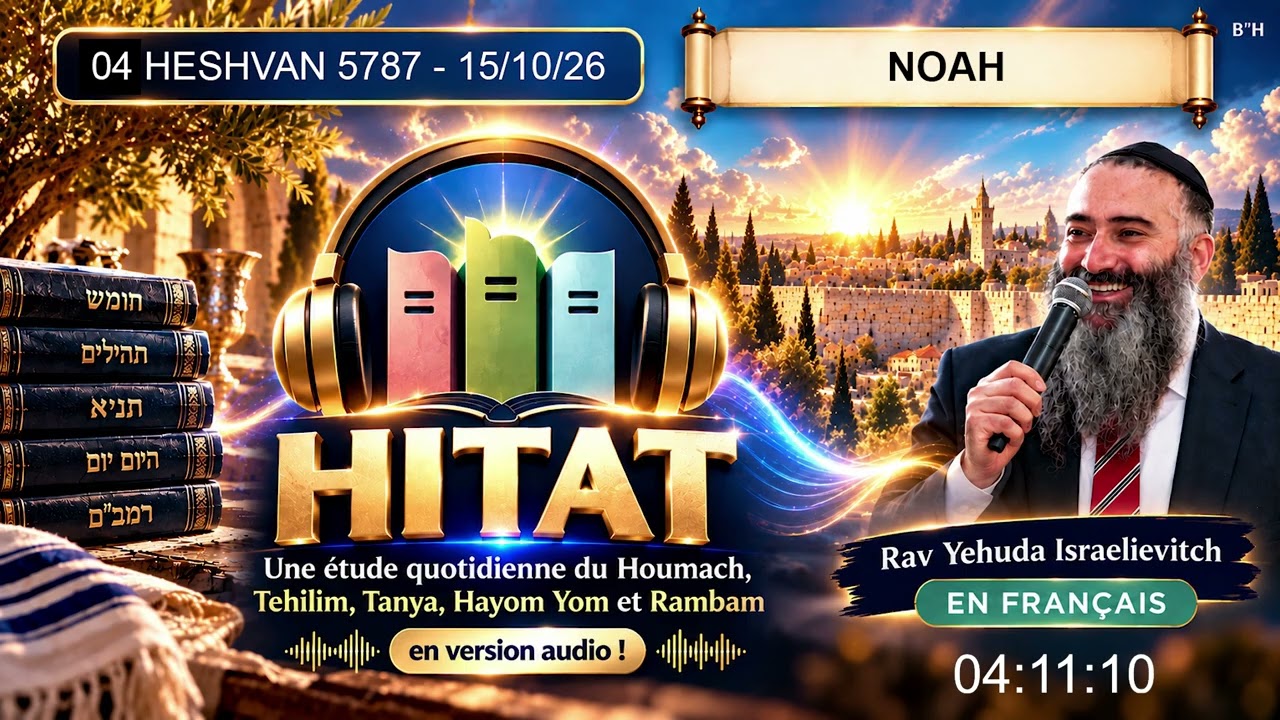
PARACHAT NOAH (2) - HITAT DU JOUR 05 HASHVAN 5787 - 06 Octobre 2026
Paracha
Retrouvez nous sur notre site www.israeltorah.com Merci de vous abonner à nos vidéos sur YouTube et de partager un Max ! IMPORTANT Soyez un des partenaires de la diffusion de la Torah dans le monde et associez-vous à nos Mitsvot ! Vous pouvez donner votre Maasser... Et sachez que nous réussirons toujours avec l’aide énorme d’Hachem grâce à vous ! Lien pour Donner http://www.israeltorah.com/dons-et-bilan/
Extrait du cours
Hello everyone and welcome to our daily meeting for the study of the Hayom Yom. Today is Erev Shabbat Kodesh of Parshat Noach, 5784. Inside the Ark, the animals lived in the manner of the era of Moshiach. Even animals that usually fight and try to devour each other lived side by side in peace. But it was not only inside the Ark that they lived in the time of Moshiach. This was also the case outside the Ark. The Rebbe teaches us that when Moshiach comes, the world will also be flooded. But not with ordinary water, rather with the Torah, which is also compared to water.
Transcription1517 mots
Transcription automatique — peut contenir des erreurs.
Hello everyone and welcome to our daily meeting for the study of the Hayom Yom. Today is Erev Shabbat Kodesh of Parshat Noach, 5784. Inside the Ark, the animals lived in the manner of the era of Moshiach. Even animals that usually fight and try to devour each other lived side by side in peace.
But it was not only inside the Ark that they lived in the time of Moshiach. This was also the case outside the Ark. The Rebbe teaches us that when Moshiach comes, the world will also be flooded. But not with ordinary water, rather with the Torah, which is also compared to water.
As the Prophet says in the words: The earth will be filled with the knowledge of Hashem as the waters cover the sea. Although the flood did not last very long, this period constituted a strengthening of power, something that helps us for the future. The fact that we have already experienced this aspect once in our life as a people, as a nation, makes it easier to bring it about again. But this time, it will be forever.
By accomplishing our mission, our shlichut, each and every one of us, in our part of the world. We will hasten the coming of Moshiach, B'ezrat Hashem, very quickly, and we will live in that era where the world will be flooded with the knowledge of Hakadosh Baruch Hu. Parshat Noach continues. Once the flood was over, the world needed to be repopulated with men and animals.
We learned at the beginning of the Parsha of Noach that he was a tzadik. Tzadik b'dorotav, a righteous man in his generation. And one of the ways Rashi explains that Noach was a tzadik is that he is compared to all those who lived at that time, but that everything he did was not worthy of a tzadik as we understand it today. Noach should have realized the immense responsibility that now fell upon him.
The world needed to be filled again with men, plants, and animals, and they needed to plant food, raise animals, and build cities. But the Torah tells us today, "Vayachel Noach." Noach became profane. Lashon chol. Chol, free to relax.
Instead of planting wheat, Noach first planted vineyards. When the grapes were ripe, he made wine and drank far more of this wine than he should have. In fact, Noach got drunk to the point of barely knowing what he was doing. He ended up falling asleep in his tent without respecting the rules of Tzniut.
Canaan, the son of Ham , entered Noah's tent. He saw his grandfather lying in that state and went to tell his father. His father Ham went inside. Instead of covering his father, he ran excitedly to warn his brothers so they would come and see.
Shem and Japheth did not share his eagerness. They were shocked by Ham's behavior. They took a blanket and walked in backward to cover their father without looking at him in that indecent situation. Upon waking, Noah realized what had happened.
He cursed Canaan, the son of Ham, declaring that his descendants would be slaves to the children of Shem. He blessed Shem, announcing that the Jews would descend from him, and he blessed Japheth, wishing for his family to become very wealthy. Today we also begin to conclude our Parsha by studying the 70 nations descended from Noah, and we learn the name of each one as well as some details about a few. For example, Nimrod, who tried to oppose Hashem.
His name evokes rebellion, "Mored," and Peleg lived during the generation of the dispersion, the "Dore Haflagah," whose name recalls the division, "Peg." Tehillim: today is Yom, and we are reading from 29 to 34. Rabbi Yitzchak once told the following story. When the Admor was 7 or 8 years old, he prayed longer than usual. He prayed fervently and thoroughly.
Once his prayer was finished, someone asked him why it had taken him so long. He replied that he had stopped to meditate on a passage in the prayer. That is what had drawn it out. And which passage was it?
A verse taken from today's Tehillim, chapter 30 , verse 3; we recite this chapter every day before. "Hashem my God, I cried out to You and You healed me." The Admor meditated on the word "viterfani," and You healed me. He thought of the resemblance between this word and the word "rifion," which means to weaken something. The verse could therefore mean: "I cried out to You, Hashem, and You weakened my evil inclination, the Yetzer Hara." He was reflecting on how Hashem helps us triumph over our Yetzer Hara.
Very soon, when Mashiach comes, Hashem will completely extirpate our Yetzer Hara. We will have won the battle against the evil inclination. And until then, Hashem helps us weaken it so that we may act in accordance with His will. Tanya, Iggeret HaKodesh: in this Iggeret HaKodesh, Rabbi Schneur Zalman comments on a passage from the Ra'aya Meheimna, a part of the Zohar in Parshat Nasso, which reveals the specificity of the study of.
Pnimiut HaTorah, the inner dimension of the Torah, as well as the difference between our study during the Exile and that of the era of redemption, the Geulah. Reading this Zohar, one might think at first glance that it announces that when Mashiach comes, we will no longer study the Nigleh, the literal and legal plane of the Torah, but only the Pnimiut HaTorah. And here, the Rebbe Rayatz demonstrates that it absolutely cannot be about that for two reasons. Firstly, in the Gemara, it is written on numerous occasions "Teiku." This means that we do not decide certain halachot, but that Elijah the Prophet himself will explain them when Mashiach comes.
If Elijah the Prophet can explain them to us, it goes without saying that we will study them. Secondly, the subjects treated by these laws concern realities that will still exist under the reign of Mashiach. We will continue to consume kosher meat. We will need to know all the laws that relate to shechita, for example.
Therefore, the Torah will continue to be studied. Today. A few years ago, road signs and GPS did not exist. To find one's way, one had to ask passersby or observe the sun in order to orient oneself.
But what did night travelers do? At first glance, the stars form a multitude of points, but by looking closer, one realizes they form constellations. There are figures or groups of stars visible every night in the sky. And in the past, men used these constellations as a compass to guide themselves.
Thus, even on a very dark night devoid of signage and light, it was enough to look up at the sky to identify one's direction and not get lost. The world can sometimes turn out to be a dark, confusing place. People get absorbed in trivialities, losing sight of what they should be accomplishing. Yes, we are not here on earth to possess.
We are here like passersby who use the physical material data that Hashem gives us to transform them and create means for our spirituality and our closeness to Hashem. Jews are compared to the stars. The Rebbe tells us that each of us possesses the strength to shine as an example, what we call "dugma chaya," a living example. Our good conduct shows others the path to follow and helps them walk on the path of Torah and mitzvot.
Jews are similar to stars that prevent others from going astray in the darkness of exile. Rambam! Today, we are learning the Hilchot Chovel U'Mazik . Chapter Aleph here teaches us that there are five types of damages for which an aggressor can be held financially responsible, and the Rambam details their nature.
He also specifies the scenario where each of these compensations will apply. In the second chapter, the pere bet, the Rambam explains the calculation method for each category of damage. And one of the fundamental rules is that the Beit Din can only compel an individual to pay if there was actual physical contact. If he only frightened someone without touching them, the court cannot civilly oblige him, but he remains accountable before Heaven.
And chapter guimel here determines the indemnities for damage to honor or the humiliation of another person. There are fixed scales, what are called knassim, depending on the offense. If someone humiliates a talmid chacham through mere words, he is required to pay 25 gold dinars. The Rambam specifies that this rule applies even outside of Eretz Israel and that he witnessed it many times during his stay in Spain.
And it is with these words that we conclude our study of the day, wishing a Shabbat Shalom, an excellent, serene, peaceful, and joyful Shabbat to the whole Am Israel. May we very quickly find ourselves in Jerusalem with the Third Beit HaMikdash ; we have been studying L'ilui Nishmat Avraham ben Khalifa. See you very soon.