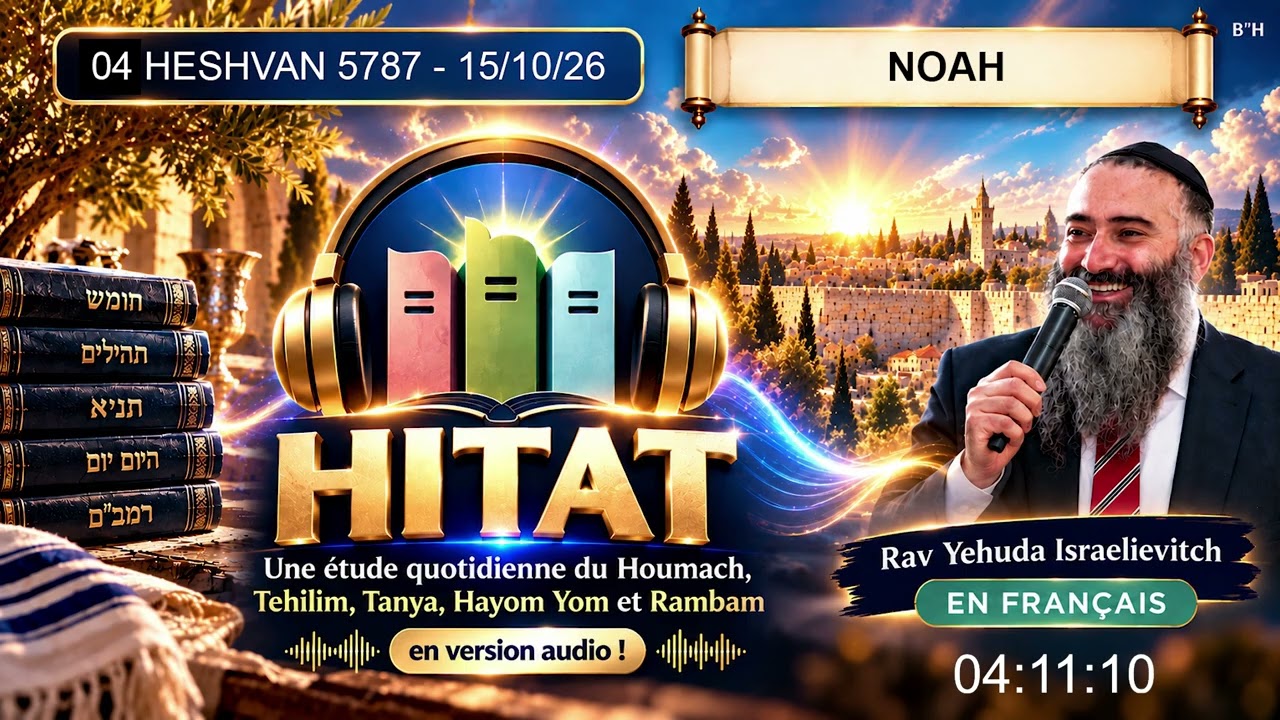
PARACHAT LEH LEHA (3) - HITAT DU JOUR 07 HESHVAN 5787 - 18 Octobre 2026
Paracha
Retrouvez nous sur notre site www.israeltorah.com Merci de vous abonner à nos vidéos sur YouTube et de partager un Max ! IMPORTANT Soyez un des partenaires de la diffusion de la Torah dans le monde et associez-vous à nos Mitsvot ! Vous pouvez donner votre Maasser... Et sachez que nous réussirons toujours avec l’aide énorme d’Hachem grâce à vous ! Lien pour Donner http://www.israeltorah.com/dons-et-bilan/
Extrait du cours
Hello everyone, welcome to our daily appointment, the study of the Daily Chitas. Today is the 7th of Cheshvan 5784, the first day of the week for Parshat Lech Lecha. One of the particularities of the 7th of Cheshvan is that on this date, every Jew would have returned home after spending Yom Tov at the Beit HaMikdash. Everyone was then able to put into practice in their own home the inspiration received during Yom Tov. The 7th of Cheshvan, the Rebbe teaches us, possesses a specific strength to help us make use every day of everything we acquired during the month of Tishrei. What does this mean? Well, all the Yamim Tovim of Tishrei are different. They each have their own spiritual climate, their own Avodah; on Rosh Hashanah.
Transcription1917 mots
Transcription automatique — peut contenir des erreurs.
Hello everyone, welcome to our daily appointment, the study of the Daily Chitas. Today is the 7th of Cheshvan 5784, the first day of the week for Parshat Lech Lecha. One of the particularities of the 7th of Cheshvan is that on this date, every Jew would have returned home after spending Yom Tov at the Beit HaMikdash. Everyone was then able to put into practice in their own home the inspiration received during Yom Tov.
The 7th of Cheshvan, the Rebbe teaches us, possesses a specific strength to help us make use every day of everything we acquired during the month of Tishrei. What does this mean? Well, all the Yamim Tovim of Tishrei are different. They each have their own spiritual climate, their own Avodah; on Rosh Hashanah.
We were filled with a great solemnity. We became aware that we wanted Hashem to be the King of the entire universe. We wanted to prove to Him that we were ready to accomplish everything He desires. On Yom Kippur, we felt similar to the Malachim, the angels.
We spent the whole day in a feeling of deep proximity with Hakadosh Baruch Hu. How? Well, we set aside our usual bodily occupations and we created this direct bond with Hakadosh Baruch Hu. Thanks to this Teshuvah that we succeeded in creating.
During the holiday of Sukkot, we felt wrapped, protected by the Sukkah, the embrace of Hakadosh Baruch Hu. In that way, we expressed our union with Him on Simchat Torah. It was joy, the joy of having received this precious gift from Hashem, the Torah. Once the holidays are over, we carry with us into our homes all these strengths that we have gathered.
When we pray each day, we must think of the One to whom we are addressing. We remember our state of mind on Rosh Hashanah. When the evil inclination, the Yetzer Hara, tries to push us to commit a sin during the day, we must remember Yom Kippur and this Kappara, this Teshuvah that we made. When we get irritated with a friend, a brother, a sister, a loved one, we can think of the intense joy, the happiness that we felt while dancing with each other in this Ahavat Yisrael during the holiday of Simchat Torah.
We can remember how happy we were to be together. That joy must accompany us; the 7th of Cheshvan, the Rebbe tells us, holds this specific strength that allows us to mobilize all the days of Tishrei in order to elevate our Avodat Hashem, our divine service, to its highest level. Today we are studying Leilui Nishmat Nissim Ben Khalifa. Do not hesitate to also send your dedication by WhatsApp at +33 6 21 37 24 52.
Parshat Lech Lecha, today we are learning the Rishon. Hashem spoke to Avraham for the first time when he was 75 years old. In fact, Hashem would later give him the name Avraham, with an extra letter. But at this stage, the Torah refers to him by his original name, Abram.
He said to him: "You have already left your native land with your father to go to Haran? Now, go even further. Leave your father, Terah. Go to the land that I will show you." The texts tell us that although Terah believed in Hashem, he pretended to practice idolatry, or avodah zarah, for fear of others.
Hashem wanted Abraham to distance himself from this hypocrisy as well. He did not reveal his destination to Abraham for two reasons. On one hand, the journey would be much more difficult, thus increasing his reward for this mitzvah. And on the other hand, the final discovery would be all the more exhilarating and special.
This would strengthen his love for Eretz Yisrael. Hashem promised Abraham multiple blessings in exchange for his journey. He assured him that he would find happiness there and would see that it was an excellent thing to make this trip. This is the very meaning of "Lech Lecha." Go for yourself; it is also good and beneficial for you.
And here are some of the berachot that Avraham would receive. He would move away from idol worship. From fear. He would have children, even though his current situation seemed to prevent it.
A great nation would descend from him. He would become wealthy. Although unknown in this new land, he would attain great fame, "Ve'agadela Shemecha," which would allow him to teach the existence of God to a greater number of people. It is a promise.
He would hold the power, the "koach," to bless another person. He would become one of the patriarchs, the Avot, who are mentioned in the Shemoneh Esrei that we recite every day in prayer three times a day. Shacharit, Mincha, Arvit; Baruch Hashem , Magen Avraham. Another berachah that Abraham would receive is that whoever blesses him will receive a blessing in return, and vice versa.
People would formulate wishes by saying, "May you be like Abraham." Abraham set off just as Hashem had commanded him. He took his wife Sarai, who would later be called Sarah, as well as his nephew Lot. He followed Hashem's instructions and arrived in Eretz Yisrael, which was then called the land of Canaan. Abraham would make a stop in Shechem, also called Elon Moreh.
It was there that he prayed for Shimon and Levi, who would later take on Shechem, and where Hashem would show him Mount Gerizim and Mount Ebal, where the Jews would commit to observing the Torah upon their entry into Eretz Yisrael. He will then build an altar to thank Hashem for the two promises received. That of having descendants and that of seeing them inherit Eretz Yisrael. He will move a little bit closer to the location where the Beit Hamikdash would be erected.
That year, a terrible famine struck Eretz Yisrael. Hashem caused this famine only in Eretz Yisrael to test the Emunah of Avraham. Would he doubt the words of Hakadosh Baruch Hu, He who had ordered him to settle in Eretz Yisrael? He will therefore choose to go down temporarily to Egypt, to Mitzrayim , where the famine had not yet struck.
Today, we are reading from Tehillim, Lamed-Aleph to Lamed-Gimel, verses 39 to 43. In today’s Tehillim, we read this verse. My tears have been my food day and night, when they say to me all day long, "Where is your God?" The Rebbe explains that this verse teaches that to feel an authentic closeness with Hashem, we must aspire to Him with fervor all the time. Our desire to be close to Him must not be limited to Shabbat, moments of prayer, or moments of holiness and Mitzvot.
No, this must extend even to the moments of our daily life. When we eat, when we work, when we run errands, no matter what, we must always remain with that desire. All day long, seeking where He is, how we can get a little bit closer to Him. Tanya, Chapter 6.
Yesterday, we emphasized that despite the extreme holiness of the laws of the Torah, the latter is qualified as Eitz HaDaat Tov V'Ra, the Tree of Knowledge of Good and Evil. And this is explained by the fact that the objects or material situations that these laws, these Halachot, deal with contain a part mixed with evil. The Rebbe Rashab explains today that, although the source of the Torah comes from Malchut of Atzilut, a very high level of Hashem’s presence, it dons the garments of the worlds. Garments, in the sense that they become means of expression for that light which descends from Hashem into lower worlds.
When it unfolds there, the materiality of this world is intertwined with good and evil, and the Torah itself seems, consequently, to take on this duality since it speaks of subjects and is in contact with subjects that are themselves made of good and evil. In reality, the original source of the Torah is totally exempt from these impurities. But for our minds to be able to grasp it, the Torah must lower itself into this form of "garment," this tool or means of expression that is made of good and evil. It descends here below within our reach so that we may connect to Hashem through its study .
Today is the 7th of Cheshvan. Many think that to approach Hashem and lead a life consistent with what a Jew should have, one must first engage in intellectual reflection to understand that the Torah is the ideal way of life and realize the benefits of the Torah. And only then would it be appropriate to discuss it with others before finally coming to the practice of the Mitzvot. That was indeed the prevailing method.
But that is no longer the case today. The Rebbe tells us this here. Before the giving of the Torah, Abraham Avinu began with thought, with Machshava. From a very young age, he reflected to understand that there must necessarily be a creator of the universe and that humans must act according to His will.
Then he moved to speech, to Dibbur, by going to teach the knowledge of God to the whole world . Finally, he accomplished the action, the Maaseh, by performing the Brit Milah, a material mitzvah that physically connected his body to Hashem . But since Hashem gave us the Torah, the Rebbe tells us, the concrete fulfillment of the Mitzvah takes precedence over the rest. That is why we now proceed in the reverse order.
We begin first with action, with the Maaseh, by performing the Brit Milah. On a very young child. And it is only later that we access study through speech, the Dibbur, the study of the Torah, and to crown it all through intellectual reflection, the Machshava, by reflecting and meditating on the reasons for our actions and how the Torah embodies the absolute truth of Jewish life. That is what the Rebbe tells us, and it is for this reason that we must always act, even when we do not immediately understand why we must do what we have to do.
Rambam, Hilchot Chovel U'Mazzik. In today's Rambam, we finish the study of the last two chapters devoted to damages and begin the laws concerning Hovel U'Mazzik. In chapter 7. Here, we study invisible damages such as rendering an object ritually impure, Tamei, without altering its physical appearance.
In chapter 8, we learn the laws governing the Moser, a person who denounces a Jew to civil authorities in order to cause harm to their person or property. It is a transgression, an Aveira. The chapter of Hilchot Rotzeach, as well as the greatest of the Mitzvot that a human can perform. Saving the life of another Jew.
The Rambam teaches us that saving a single Jew is equivalent to saving the entire world. And the Rabbi emphasizes that the same applies when you help a Jew perform a mitzvah or when you provide someone else with a good education. This is also equivalent to saving their life, which, according to the teachings of the Rambam, amounts to saving the entire world. That was the daily rita.
I invite you to share it with as many people as possible. Be blessed infinitely, materially and spiritually, with true joy. We studied for Avram Nissim Ben Khalifa Alom. See you very soon.
Send us a dedication at +336 21 37 24 52.