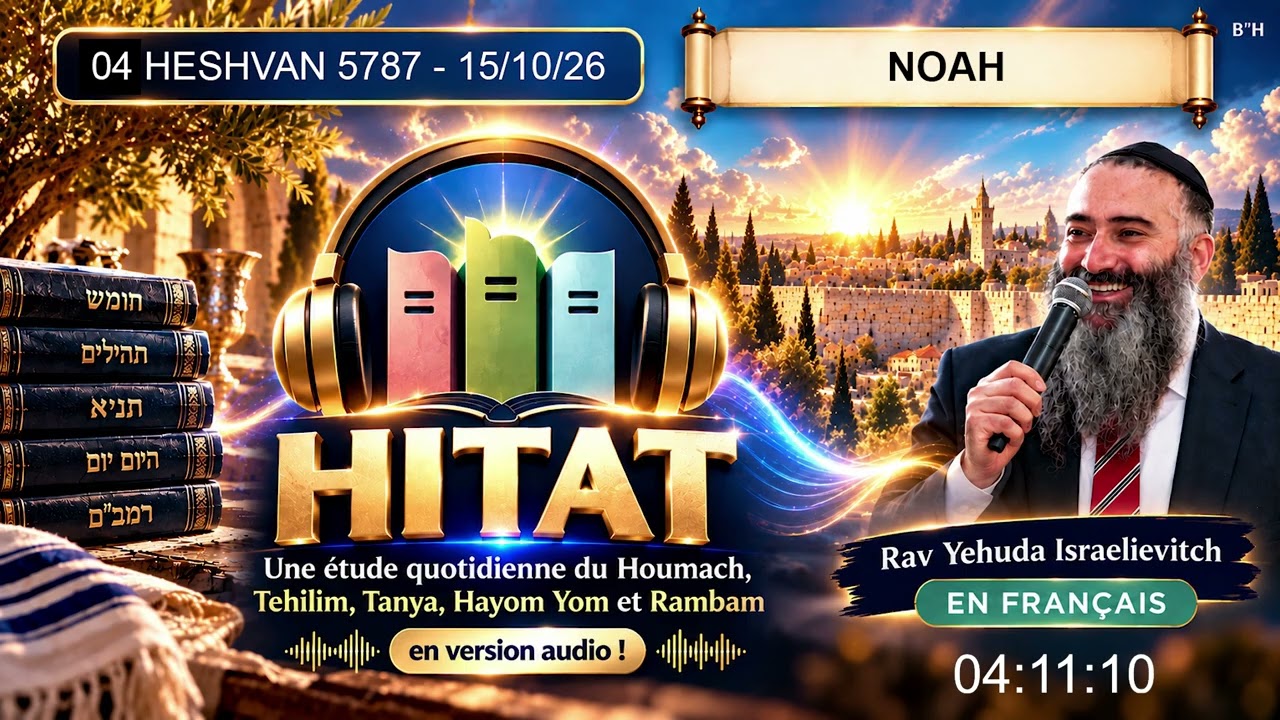

PARACHAT NOAH (2) - HITAT DU JOUR 03 HASHVAN 5787 - 14 Octobre 2026
Paracha
Retrouvez nous sur notre site www.israeltorah.com Merci de vous abonner à nos vidéos sur YouTube et de partager un Max ! IMPORTANT Soyez un des partenaires de la diffusion de la Torah dans le monde et associez-vous à nos Mitsvot ! Vous pouvez donner votre Maasser... Et sachez que nous réussirons toujours avec l’aide énorme d’Hachem grâce à vous ! Lien pour Donner http://www.israeltorah.com/dons-et-bilan/
Extrait du cours
We are so happy to be back with you to share today's ritual. Today is Gimel 3 Rvan 5787. We are the r of the parashat Noar . Please send us your dedications by WhatsApp at 0621 37 24 52. In this week's parashat, the black parashat, we learn about the maboule. The mabou, the flood of joy sent upon the world. The Torah calls the boiling water that covered the earth the best mabou, the waters of the flood. In this week's Aftara from the prophet Yeshayahu, we also hear about the mabou.
Transcription1953 mots
Transcription automatique — peut contenir des erreurs.
Bonam, welcome everyone. We are so happy to be back with you to share today's ritual. Today is Gimel 3 Rvan 5787. We are the r of the parashat Noar .
Please send us your dedications by WhatsApp at 0621 37 24 52. In this week's parashat, the black parashat, we learn about the maboule. The mabou, the flood of joy sent upon the world. The Torah calls the boiling water that covered the earth the best mabou, the waters of the flood.
In this week's Aftara from the prophet Yeshayahu, we also hear about the mabou. That Borou spoke to the prophet and revealed something about the maboule in his prophecy. Bachem does not call the water maboule, he calls it Maoar, the waters of Noar. That seems strange.
The name Noar means pleasant. So calling the water mein Noar is like saying that the mabou was nice. Why does Hashem call the mabou men black when addressing the navi? The Lubavic rabbi teaches us that when Akades bhu speaks to a nai, he entrusts him with a secret as the verse Gilodoave says to nevim.
He revealed his secret to his servants, the Nevim, the prophets. Hashem reveals to the Nevim the secret that lies behind what is happening so that the nav can see things as they are from the inside, the deep dimension of events. When Akadour spoke of the mabou aou, Hashem called him menoir because the real reason for the mabou was pleasant and that is what Ashem wanted the ship to dry. In the Torah, the Rabbi explains that Hashem did not need to send a flood if he wanted to destroy the world.
He could have simply stopped creating it, since God created the world at every moment. He sent the flood to make the world pure, like a utensil that is immersed in a migv containing 40 ca of water to become pure. Hashem covered the earth with water for 40 days to make it pure. This is what Hashem revealed to the Navi.
The secret of the mabou. His true goal was to make the world pure and meinoir. In reality, it was something pleasant. In today's cheese, we begin to study what happened right after the maboule.
Hashem told Noir that his family and all the animals must now leave the TA. They were not permitted to have children while they were in the TA. But now, they will all be permitted to do so again. Since Kadosh Babu had asked Black to bring seven kosher animals, Noar understood that Hashem wanted him to offer corbanotes, sacrifices.
Noar therefore offered a corban for each species of kosher animals and birds. This is a sacrifice that is entirely burned on the Missbard. When Hashem smelled these very special corbanotes, it brought God spiritual satisfaction, what we call the narroir. Hashem then promised never again to destroy the world that raised Adam Raminourave.
For the inclination of the heart of man is evil from his youth because human beings are not perfect, they are born with an evil inclination and they deserve compassion and compassion. During the mold, in addition to the fact that the whole world was destroyed , the mazalotes, what we call the constellations, the heavens, the shamai stopped moving. The sun no longer moved , the moon no longer moved, the stars no longer moved. There was no more day or night, and of course, there could be no seasons.
Now, HM declared that from that moment on, the world would have an order, a yield. The mazalotes would begin to move again and would continue like this forever. Each day would have a day, a night. The seasons of the year would never cease.
Lo ichbotou. The text tells us that he also speaks to black of six seasons. Yes, we probably only know four. The seasons stated by God are in the order in which they occur, beginning in the middle of the month of Tisherie.
The time of sowing, that is, zera, the cold, the body, winter, roref, the harvest, katsirin, summer, caitz and the heat, hom. Hashem gave a blessing to Noar and his family, a beautiful braha and said to them, Prou for you, be fruitful, multiply and fill the earth again. They need not fear that Hashem will destroy the world , for He promised not to do so. They also do not have to fear animals.
During the period when people began to act improperly, animals stopped being afraid of humans and instead feared the hormouilles. They no longer have to fear that it is dangerous to live in the world because the animals will once again be afraid of them. Before the mabou, humans were not allowed to eat meat. Now, a leader allows them to eat meat but with certain rules.
For example, the prohibition of eating eiver minha, that is, a limb torn off a living animal or its blood while it is alive. Another very important rule is that it is only permissible to kill animals, not human beings. A person does not even have the right to bleed himself without reason. So, if an animal kills a human, it shall be punished.
If a person kills another person, Hashem will see to it that he is punished. The human being is made peace. Tselem Elokim in the image of God. If a person is killed, it removes a part of the Tseem Elokim of the image of God on earth.
And today's parshat ends by reminding us of the mitvah that Noar and his sons receive. Prou for you . Have children, multiply. Yum Gimel.
Today we read Dubet pages 18 to 22. In the chapter Raf, chapter 20, there are special powers to help a person who is in need. The rabiak said that we should recite it every day. Usually, we say it during the fila, but not on a day when we don't say one.
You know, it's the timim that we say after the hash and after the hamida. And Leak said that this chapter is so important that if we don't say it during the fila, we should recite it after the tfila. Have you thought about subscribing to the Ritat? But only € 10 per month is a lot, but you are the force behind the spread of this € 10 per month.
Send us a short message by WhatsApp + 336 21 37 24 52 or just click on the link. Tania and Siman Raf codèche. When someone is doing the defila and a Jew tries to distract them, there's nothing we can do about it. But what we should do is think about the fact that the shrina is in exile in the words of this person who is disturbing us and that Achem is sending us a message here to pray harder with more intention, with more kabbalah.
Even though some people study Kabbalah, she did not think it was logical to say that shrina could be found in the words of a Jew who disturbs a Jew. So she was making fun of rassidut. But each of us knows that ashem is everywhere all the time. It is an emunah that every Jew possesses.
Along with this emunah, reason also explains why ashem chose to place himself in exile there, even in the home of a person who disturbs a Jew who does that. Of course, we do not understand why, but it is not surprising that a human being is not able to understand the voices of God. This was just an example here to understand the teachings of Balchemtov. If someone has further questions, the Rabbichon Alman says not to make fun but to send someone who will try to explain it to him so that there will be no more questions.
He teaches and questions the Baal Shemtov. Here we see how the Rabbi insists by saying that we do not really understand what God's plan is at that time, but Akados Baou decides it. He gives energy to everything here below on earth. His constant, permanent vitality is in every element of the world.
The world exists because God is present there, he does not withdraw. He is there, sometimes hidden, sometimes veiled. It is up to us to make it shine. It is up to us to push each event towards its quintessence, to elevate it, to reveal it.
God is there even in that which prevents us from getting closer to him. It is a mission and it is the cavada that awakens when we take this act of surpassing ourselves and seeking God in each event. Today's Yumomvan leom is a continuation of yesterday's. We learned that the Rabbi had told the Hasidim that we must live with the parshat of the week.
We should think about this during this week and find lessons for our way of life. If we live with its time, that is, the parshat, we will feel the atmosphere of what is happening in the ruach. That is why the first two weeks of the ruach are not the most completely joyful weeks, Berishit and Deir in Berishit. Even though it is joyful and exciting to think about how Hashem creates the world and is with us every moment, it is a little sad to think that people can act in a way that will provoke the madman.
And in the black parshat, although the end is so exciting when we think about the birth of Avraham Avinu, it is still sad when we think about the world destroyed by a madman. But the parshat is the first week where we think only about joyful things, about exciting events. Throughout the entire Parshat, we think of Abraham Avinu, of his self-giving, the Messiru Nefesh. We know that thanks to him, every Jew possesses this strength within his soul , his Neshama.
We learn from the example that Abraham Avinu showed us each day of the week and we will live with our time, that of the Parshat. Ambamela chapter Yudimel. The Rambam teaches us how to find the owner of an object that we have found. Outside the eruhalaim, there used to be a large rock on which people would stand to announce what they had found.
The Ramam tells us a rule of law, an alora according to which in a specific case if we find something and we cannot discover to whom it belongs, we must keep it until the prophet Eliaouv comes with the masiar and he will tell us what to do with it. Chapter You of Allet here tells us that while we are waiting to return an object, we must take care of it so that it does not deteriorate. For example, if we find a wooden object, we must be careful to use this object so that it does not rot . And finally, in the Tav chapter, the Ram teaches us the case.
We do not need to return an object. If the owner has lost the object and has lost the hope of ever finding it again, for example, what we call, well, if someone loses something in the sea or in the sand or on the beach, he really does not expect to find it again one day. So in that case, there are laws that allow us to take this object and appropriate it. >> We have studied >> today's ritat >> and we wish you an excellent day.
May the soul of Israel be blessed in all material and spiritual matters. See you soon.


