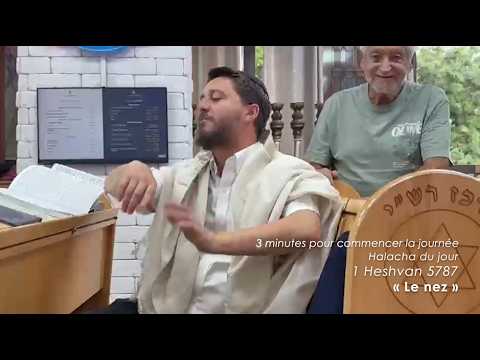
Daf hayomi HOULIN page 136
Daf Hayomi
Abonnez-vous à la chaîne YouTube du Centre Rachi pour rester informé des derniers contenus originaux. Rejoignez-nous sur notre groupe facebook : https://www.facebook.com/groups/712826445437581/ Visitez le site du Centre Rachi : http://www.centrerachi.com/ Devenez le parrain de nos activités pour continuer le développement de nos projets Torah et faire grandir toujours le nom de D… Merci à vous et que Hashem puisse vous le rendre dans le domaine que vous désirez ! http://www.centrerachi.com/index.php/dons/
Extrait du cours
Come on, we have 8 pages left. We are at the end of the topic of all the gifts for the Cohen. Yesterday, we finished with the stories of partners, two partners. Does it depend on whether the partner is Jewish or an idolater; do we still have to make the tithes or not? So, first line, page 136. Derbiatra minamin, we saw that it was a mezuzah. A mezuzah. A house of two partners. You still need to have one >> and it is on the right. Even in the tithes of fruits, it is written in the plural. This means that even partners must always do the tithes and the unless it is partnered with an idolater . The Cohen's cheek.
Transcription2182 mots
Transcription automatique — peut contenir des erreurs.
Come on, we have 8 pages left. We are at the end of the topic of all the gifts for the Cohen. Yesterday, we finished with the stories of partners, two partners. Does it depend on whether the partner is Jewish or an idolater; do we still have to make the tithes or not?
So, first line, page 136. Derbiatra minamin, we saw that it was a mezuzah. A mezuzah. A house of two partners.
You still need to have one >> and it is on the right. Even in the tithes of fruits, it is written in the plural. This means that even partners must always do the tithes and the unless it is partnered with an idolater . The Cohen's cheek.
Even partners must give the cheek, the shoulder, and the stomach to the Cohen. And who should do it as a priority? It is the slaughterer who must remove them because he knows which parts belong to the Cohen, and even the partners must do it. Bikurim, the first fruits.
>> Ah, so we know that back then we had to bring all the first fruits to the Temple. What do we do with partners? Line 11 so even partners. Yes, but not first fruits in France or in the Diaspora.
Okay. Over there, no. He mentioned tzitzit; if two people are partners and they bought a four-cornered garment together, are they required to put tzitzit on it, or are tzitzit only when it belongs to you ? It is written in the plural, "on the corners of their garments." But there is a law that if you borrowed a garment for up to 30 days, you are not yet required to put tzitzit on it.
After 30 days, it is yours. There is also this in the Halakha, someone who is...[bravo chose] >> regarding the fence. There is a law that when there is a danger, if you bought a house or something, or rented it, you must put up a barrier. Everything that is yours, even for partners, but not in synagogues.
That means not in a synagogue; a synagogue is the responsibility of the whole public and not just the rabbi or the president. That's it, it must be posted . We are all partners in everything that is the synagogue because the synagogue is public. One might say, " Wait, it's your duty, why didn't you put it up?" The only thing not in the rule is an animal belonging to two partners, where the firstborn is for the Cohen.
But he says no. Jewish partner yes, but idolater no. There are many cases, like with tithes or wool, where he says that when there are partners, there is no obligation to give the share to the Cohen. He relies on what is written in the Torah, "it belongs to you." So it must be exclusively yours.
Well, it's not the >> to the extent that the extent is an obligation for a normal Jew on my share . Yes. So the Gemara asks, why not yours? He says, of course, because everything is in Israel and not outside of Israel.
Outside Israel, there are no gifts for the Cohanim, no tithes, no firstborns. Because in the Torah we learn, there is the same equivalent decree word with the Terumah, the tithes. For Terumah, it is clearly marked that it is in the land of Israel . >> So everything we mentioned in the list >> only >> only in Israel and not with a non-Jewish partner, >> even in Israel.
Even in Israel, we learn all the Terumah wool as long as you haven't given it to the Cohen, because for fruits, as long as they haven't been tithed, we cannot eat them . It says no, it's not the same. Over there, you can set aside the Cohen's wool and >> and eat because it doesn't rot. It's not like fruits and there is no fine, the penalty that if he had consumed the Cohen's share, he must give the extra 20%.
That is only for Terumah. And we know that in the tithes, even when you have given to a Levite, the Levite must give to the Cohen, but for wool, no, only the Cohen takes it; there is no other additional tithe. Regarding the tithes, if you didn't do it last year, can you tithe from those fruits from last year, and is it the same for wool? No.
He says if someone had two sheep and kept the wool every time, there was no Cohen, okay, 2 or 3 years, and now he has a stock, it's not good, he means it's not good, he is not obligated to give all that to the Cohen, right? There is still a deadline, he cannot store it all his life for the Cohen. take one year. So there are two opinions.
If I put the animal in the care of a non-Jew, dog walking is a profession today, you know, dogs, you see? >> You see them walking around, they have 5, 6 dogs. So, someone gave their sheep away, they left for 2 months to France, and gave the sheep to a non-Jew. Does the wool that grew in the meantime, how do we handle that?
mar who, a Jew who bought a piece of land in Syria. A big debate over there. Does it or does it not belong in the Golan? So if he bought the land before it grew, a third so the third that grew on the Jewish buyer's property, he must set aside the tithes.
Agreed? Etab who goes? That's what he says. Say no.
If someone bought a sheep from a non-Jew, then how do we do it? Everything that grows from today , how can you calculate the wool there? Look at how detailed the Torah is. I'm turning the page.
So there are two opinions. With potatoes, you can take white potatoes, red ones, everything in the same crate. It's called a potato. Agreed?
Just potatoes. If the tree gave you some red and some green, you take one and you use it for everything. But with sheep, is it the same? White sheep , black sheep, how do we handle it?
Is it the same wool or not? Berich, that doesn't work. And how do we know that it works with apples? There's a Mishnah that says someone had figs, a fig tree that produced both white and black ones or in wheat.
Even there, there is still a debate. But he permits it and says that you can, as long as it's the same tree, the same >> fruit >> fruit, you can. But with wool, it's not the same. and the laata.
We've seen that there are different breeds, different colors, even if they're both called sheep, it's not the same >> quality, the same qua >> Yeah, not the same quality either. We know there is cashmere. Cashmere is high-end, it's not found everywhere because there are sheep that grow in places where it's cold, I don't know how that wool is processed. It's a whole trade, not mine, thank God.
And the it's a job that smells bad too, right? It's the smell and everything. >> Are even female and male animals different? The Gemara tells you yes, because the females 'wool was much softer, >> agreed?
Maybe they are less athletic or I don't know what. So if you start saying that, he would have combined things, he would have given the least good. For that, we tell you that you can give what you want. But the best idea is to give a little bit of both.
Make it a little mix. Like that. There you go. And our mishna is not like Rav.
We continue. You must. The first " reishit" means the beginning, don't wait for the end of the wool, what's left. >> To give to the Cohen like the fields, what's left at the end, no, the beginning.
There, we finish the subject . If someone now said, "All these fruits, I give them as a tithe.""All my fruits I will give." He is obligated to keep his word. Yes, but if someone said , "All the wool, I give it," he is not obligated to keep it in all cases, two opinions, Rav and the Rabbis. They say no.
What is the Halakha in all this? Are you with me? Yes, 22. >> 22, bravo.
It was known as those three sages, a Rabbi. One is that the sheep is only in Israel. So outside of Israel , we are not obligated to give it, that's one. Second.
Rule, it's not our subject, but it's also a Halakha they taught. Someone who had a seminal emission has the right to go up to the Torah, the right to study Torah, and he cannot be impure. Okay? Uh, relationship.
>> No, it was just what they said when they announced the Halakha of the first >> So it was in the lesson, they said the Halakha for the sheep is like Rav. So also for the. Seminal emission, it's like and also. Someone mixed, grafted several species of, so as long as he didn't plant them at the same time in the same hand, the sin hasn't started.
Well, there you go, Homer Biz, we've finished the subject, we're now resuming the Zom. We saw in the mishna differences between comparisons between the "reishit," the animals, and the wool. Wool. Even if the animal is not kosher.
When I say not kosher, it's a sheep but it's sick. It has lung problems, it's missing a foot. It is not kosher for the "reishit." >> But kosher for. >> Okay, but it is kosher for the wool.
So you must still give the wool. You won't say, "No, the fact that it's not kosher because it has no foot, I won't give the wool." No. But there is always a second opinion. He says no, if it's not kosher to eat, no need to give the wool .
It's the same subject. Why did you say that we must give the wool even outside of Israel, if you consider wool to be like fruit? All right. So for fruit, we saw it only applies in Israel .
So you too, Rabbi Shimon, why do you say we must give the wool no matter where we are? Ahim. No, that's not the real reason for Rabbi Shimon, so what is it? The Ma'aser is at the end of the year when we had to give the tenth.
>> We would make all the sheep pass through a gate. If the tenth one isn't good, what do we do? >> We don't give it. We take, yeah, we take the eleventh, but the tenth isn't good.
Since it's not good, there's no need to give the wool. That's the study of. There are three points in common between the Ma'aser and the wool. 1: they are males and not females.
2: they are only pure ones, okay? They aren't impure, not in, and 3: Rabbi Shimon says you must have multiple animals to be able to give either the wool or the Ma'aser; if you only have one, two, three, or up to nine. No, there are still more common points. There are seven common points.
Four: Ma'aser isn't like the firstborn; it isn't sanctified as soon as it exits its mother's womb, but only once it has grown or once the tenth has passed, it is sanctified. Adam, Adam means there is a redemption of the firstborn, there is a common point between, these are several common points. There is a common point between a human being and a sheep regarding the firstborn, that the firstborn belongs to a Kohen. You must perform the redemption of the firstborn.
There you go. >> Even if it's not. >> Yeah. Pashut, what is that?
Pashut. >> It means simple. It means that if it's not, it's not a, so it isn't Kadosh. All of this was before Matan Torah.
The people of Israel already, they were before Matan Torah, and even the lamb, the lamb was the first Mitzvah before we received the Torah, to prepare the Pascal lamb. So, there are several points, turn to tomorrow's page. So, there are still many, there are more points that are not in common than those that are. Moshe, Pashut, but Pashut is, it clears things up.
But well, there you go, we brought a little bit of what we could compare, and tomorrow we will see if it only applies to sheep and why not to cows or goats. There we go, we still have two pages left. So wrap up warm because it's going to rain. That's good, it works out well with the wool.
Have an excellent day. And when we finish the wool, we'll move on to the birds. The final chapter. Amen.
Amen.