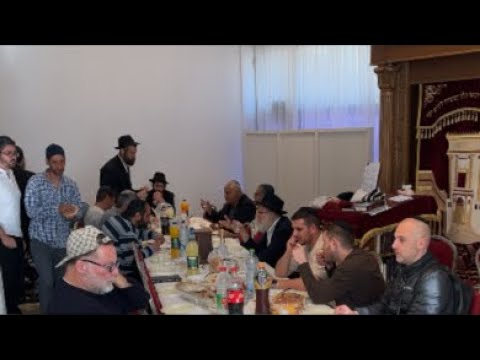
התוועדות ר״ח כסלו - בית חב״ד אזוה״ת הרצליה פיתוח
Kabbala & Spiritualité
בהשתתפות הרב השליח יגאל קרן
Extrait du cours
83 G >> Rabbi Peta Levi, a niggun; today is the Chabad niggun for Rosh Chodesh that was given at the Kinus Hashluchim >> of the Rebbe, King Messiah, in New York and all over the world L’chaim, l’chaim. >> Our Sages say that Rava would start his lectures to the rabbis by saying something before beginning the lesson. He would say a humorous word, tell a joke to amuse the rabbis, and then, with his mind focused, he would open with a serious lecture. This week I heard
Transcription15293 mots
Transcription automatique — peut contenir des erreurs.
83 G >> Rabbi Peta Levi, a niggun; today is the Chabad niggun for Rosh Chodesh that was given at the Kinus Hashluchim >> of the Rebbe, King Messiah, in New York and all over the world (Music) L’chaim, l’chaim. >> Our Sages say that Rava would start his lectures to the rabbis by saying something before beginning the lesson. He would say a humorous word, tell a joke to amuse the rabbis, and then, with his mind focused, he would open with a serious lecture. This week I heard
a joke, an interesting joke, about a boy before his Bar Mitzvah who wants to prepare a speech, so he turns to his mother and asks: "Mom, tell me, give me something about our roots, I want to say it in my speech." She says: "Listen, we started...""...
with Adam and Eve, then the Patriarchs and Matriarchs: Abraham, Isaac, Jacob, Sarah, Rebecca, Rachel, Leah," and so on through all the generations, she showed him until today. Good, he approaches his father: "Dad, tell me your roots." He says: "What do you mean? We came from a monkey.""We came from a monkey, a monkey .""And who was before the monkey?" He says: "There were all kinds of animals, and before...the animals, what was there ?""There was...there was an explosion." "There was an explosion.""The blast, before the blast, there were
bacteria." So he goes to his mother. She...He says : "Listen, I’m confused.""I don't know, you tell me we came from Abraham, Isaac , Jacob, Sarah, Rebecca, Rachel, and Leah, and he says we came from a monkey .""So Mom, where did we really come from ?" She says: "It doesn't contradict.""I was talking about my side, he was talking about his side." So everyone chooses which side they are from—whether they are from the side of the monkey, the side of the bacteria, etc., or if they are from
the side of Abraham, Isaac, and Jacob.
This is it, the month of Kislev. This is the month that clarifies what your true lineage is. Why? Why?
Why does the month of Kislev specifically clarify what your true lineage is? What, what about the other months? We have the month of Tishrei, we have the month of Elul, we have the giving of the Torah, the holiday of Shavuot, we have Passover, and so on and so forth. The prophet says this: "Behold, days are coming when there will be no hunger for bread and no thirst for water, but to hear the word of God." So one of the interpretations we've heard—what does "no hunger for bread" mean?
What is bread? What is water? Bread is Torah, and water is also Torah . "And Your Torah is within my heart"— there is no water like Torah, so there will be no hunger for bread, there will be no thirst for water, there will be Torah in abundance.
There is no place without Torah: open YouTube, open this, every second you can be in a Torah lesson. But there...there will be no hunger for bread and no thirst for water, only to hear the word of God. So what...if it’s Torah, what is the difference between Torah and hearing the word of God? Hearing the word of God is the Divinity within the Torah.
And the Divinity in the Torah is the inner dimension of the Torah. And the month of Kislev is the month of the inner dimension of the Torah. It starts from the first of the month, as mentioned earlier—what happened on the 27th of Adar? The Rebbe suffered a heart attack in the middle of the farbrengen.
It turned out that the functioning of the Rebbe's heart dropped to 15%. And a wondrous miracle occurred. The Rebbe transitioned to a completely different frequency. With a heart at 15 %, the Rebbe switched to an AI heart; it’s a different kind of turbo.
For example, once they used to lay cables to have a phone from land to land, today everything is... Using all kinds of high-tech knowledge, truly divine, literally divine. Since the Rebbe, since that attack, the Rebbe moved the world into a completely different state. I’m not just speaking now of returning from the Kinus Hashluchim—the world is full of the knowledge of Hashem like water covers the sea; there is no remote corner in the world where the Rebbe hasn't established a Chabad house.
Does anyone think the Rebbe sent someone with money, gave them an address, and prepared a ready-made corner for them— like, "here, this is where you will be" ? No, no, no. The Rebbe gave them blessings, gave them strength, paved the way for them, and everyone did what they did, and that is only through the inner dimension of the Torah. How, how do we reach this point?
Where, where, where does the inner dimension of the Torah take us? So, about a week, a week and a half ago , Rabbi Gerlitz from Be'er Sheva was with us and he told a very formative story: he said that when he was 11, his grandfather would take him on Mivtzoim at IDF bases. >> He would take him to IDF bases, and his father was a "Russian of the old school ," you know; he spoke the Holy Tongue with a heavy accent, very difficult, but his heart,
his heart spoke. And he arrived there on Chanukah and lifted the spirits of the entire base; the commander there enjoyed his wonderful, heartfelt activity so much that he invited him to his office, so to speak, and told him he wanted to thank him properly: "Thank you very much for lifting the soldiers 'morale." So he said to him, "Tell me, you want to say thank you to me?""You need to say thank you to the Rebbe." "You need to say thank you to the head, to the leader."
So he says to him, "Fine, convey it for me." He says: "No, no, no.""I'm not saying any...you, you take out your letterhead, you write it yourself, that you are saying thank you to him." Okay, he took out his letterhead and started writing thanks and blessings to the Rebbe, and so on.
Afterward, when he finished the heartfelt thank you letter, he says to him: "What about a gift for the Rebbe?" "What gift can I bring the Rebbe?" He says to him: "Bring him something from the army, a pin, some..." He says to him : "What pin?""What?""Think, think hard. " So he called one of his soldiers: "Go to the supply room, this is an airbase, get him a pin, get him an Air Force pin." He says to him: "No, absolutely not!" "Why not?" "No, quickly...R is head, head, from the head, which head?" "His beret, and the pin is on the beret ." He wants the pin specifically from his own head, from the beret on his head. He says to him, he says: "Listen, I can't. What's that?
I can't take it off my own beret." He tells him, "No, I'll tell you what to do." He'll bring the pin from the supply room, he'll put it on the table. Once it's here on the table, you'll take your pin, you'll give it to us, and then you'll put the pin on your head. >> What’s the difference? Or...
>> That is exactly the point. That is the point of inner Torah. What’s the difference? That God wants us to give the head.
What does "give the head" mean, guys? Today they say "give it your all.""Giving the head" is where your mind is at. It’s not enough to study Torah, it’s not enough to keep Shabbat, it’s not enough to put on tefillin—where is your mind at ? Where are you at?
Are you in, in... There was, uh, about 20 years ago, I remember 30 years ago, there was a man who would come to the Chabad house for Rabbi Alperowitz’s classes, and he didn't keep Shabbat yet. And one day, it was a Sunday, Rabbi Alperowitz and I were standing in the synagogue by the Torah reading table, and then this guy comes in with momentum and says to Rabbi Alperowitz: "Listen, that's it, I've decided to keep Shabbat He says to him, "What happened?" He says , "Look, I
was at a Shabbat seminar," he was at a seminar, "and they proved to me —""What did they prove to you?""They proved to me that it's a death penalty. ""He drove on Shabbat, and this happened to him.""That happened like this, that's it.""I’m keeping Shabbat." Alperowitz, in that special way of his, said to him : "Tell me, did you go to soccer on Shabbat?" He says to him: "Yes." He says to him, this is a quote from Rabbi Alperowitz, "I wouldn't say that." This is in a synagogue,
yes, he says to him: "You were worried about your own skin, right?" He says, "Yes.""Did you go to discos and listen to music?" He says, " Yes.""Worried about your own skin?" He says, "Yes." He says: "Now you heard that driving on Shabbat is dangerous." You’re worried about your own skin again , what’s the difference?
Truly, a Jew can be observant, put on tefillin, keep Shabbat, but, but his head—his head isn't there—he's worried about his own skin. His own, his own skin is what's there. He isn't truly there. He’s doing business with the Holy One, blessed be He, doing business with the Holy One, blessed be He.
Then he also checks to see, uh, if it works, if this deal is profitable for him. I’ll tell you something more: doing business with the Holy One, Blessed be He, in the short term is the least profitable deal in the world. There isn't one person who repents and doesn't get two slaps, at best. Four, in an average case.
Sometimes, as a mitzvah enhancement, they give him even more than four. But the Torah wants the head; it wants the mind, that a person should give himself over. And without the inner dimension of the Torah, without studying Hasidism, it’s impossible to get there. It’s impossible to get there.
And The central point in the inner dimension of the Torah is that you can even change your past. It’s not some change that happens to you from now on. It’s a change that works retroactively within you, making you a completely different person. There is a concept in Chapter 12 of the Tanya: the Tanya is called a book for " intermediates," and whoever hears the word "intermediate" might think it’s something shallow, something neither here nor there.
So it says in Chapter 12, it says there at the beginning: The "intermediate" has never committed a sin and never will, and is not called a wicked person for even one hour in his life. I wish a righteous person could be like that; that is the intermediate. So, when we see the threshold requirements for an intermediate, do we have a chance at this? In this way, externally, do we have a chance at this thing?
Seemingly, no. But if we move forward two chapters, the Old Rebbe says in Chapter 14 that the level of the intermediate is the level of every person, and after all, every person can be an intermediate at any time and any hour. How can that be? How does this intersect with the matter that a person has never sinned and never will?
And they tell them that everyone can be an intermediate; how do you do such a thing? So, Hasidism explains this very simply, very simply, in a very internal way. The ability to change the past is that you take the, seemingly, the sins of the past. Sins, or mistakes—not necessarily sins, who knows what.
You take the failures and you turn them into successes. How do you do something like that? When I was 15, 15 and a half, I played on Israel’s youth national soccer team. Those who play on the national soccer team, the Israeli team, get free entrance tickets to the senior team games.
So, I lived in Bat Yam, there was some soccer game for the senior team, and I got tickets. We’re talking about the 70s here, I'm talking to you about 50 years ago. The economic situation was, Life, people lived on the edge here. So my parents gave me money for a bus ticket.
The game was in Ramat Gan, I came from Bat Yam, so let's say a ticket cost 10 shekels, I got 20 shekels for a round trip. But as a kid going to a soccer game, I also wanted to have a popsicle. So how could I get a popsicle if I only have 10 shekels? It’s exactly enough.
So the bus goes through Jaffa, and I thought, I’ll pay for a ticket to Jaffa , who’s going to see if I keep going to the stadium? No one will notice I’m still on, the ticket will cost me 5 shekels, and I'll have 5 shekels left to buy a popsicle. That’s what I thought, and that’s what I did. Well, I get on the bus with a 5-shekel ticket to Jaffa, but the driver probably knew there was a soccer game and saw me looking sporty, so he suspected me right away.
And then he waited until we reached the Jaffa border, he stopped the bus, walked all the way to the back, and kicked me off in disgrace. 50 years have passed, and I still can't get over that incident to this day, you just can't, it’s impossible. That embarrassment is a lifelong trauma , but it taught me a lesson that you have to be straight as an arrow. An arrow.
I told this to someone who said, "No, it can't be that you did such a thing." I told him, the very fact that you say I couldn't have done that shows how a mistake from the past can change who you are today and how it shapes you retroactively. I mean, without that lesson, who knows how many more mistakes you might have made. Anyway, when I started becoming religious, so, uh... I played soccer until I was about 24.
25, and the life of a soccer player is— if I described it to you, it’s something masochistic, crazy to a level you can’t even imagine. It’s cortisone shots, playing with chest fractures, stomach tears, groin tears— it’s just insane. It’s ice at night, hot baths during the day, a person who is going through absolute agony. And I’m not talking about how many times you split your head open, stitches here , stitches there, it’s highly masochistic.
But ask any soccer player if he’s suffering, if it’s hard for him? Are you kidding? Everything is sacrificed for the goal. He wants to be famous, he wants to earn money; yeah, nothing is too hard.
His head is in a completely different place Nothing is hard. Well, when we became religious, we obviously stopped playing soccer, and I remember I had an infection in my prostate and was hospitalized at Laniado Laniado, that's in Netanya. So, since a Chabadnik dips in the mikvah every day—and I dipped every day—but I was hooked up to an IV, so morning came and I couldn't dip. I asked myself: "Tell me, when you played soccer, did you care that you were in pain here?" That you were hurting?
Did you ever skip a practice? Did you ever miss a game? Did you, did you ever give up on anything? So now, because you have some , some tube connected to your side?
What , you’re not going to go to the mikvah? I went to the nurse and said, "Take out the tube." I went to the mikvah, it was on the other side. To this microphone, I returned to Kiryat Tzad, I reconnected it fresh. Oh, Rabbi, come in.
>> How lovely. >> I thought I’d see you. >> Why did I think I’d see you, here at home? It's fine, everything is fine.
Well, >> All hands on deck. >> In short. In short, Hashem wants your head and your heart, that you are fully inside, properly, you are in a completely different place. And by the way, this is not, it’s not any spiritual journey, it’s a journey that is rewarding in the physical realm too.
After all, we read this just now last Sabbath, Sabbath Chayei Sarah. It is written there: "The life of Sarah was one hundred years, and twenty years , and seven years, the years of Sarah’s life." The commentators ask there: Why repeat 100 years, 20 years, seven years, the life of Sarah, two times, five, four times years? So Rashi brings there that all the years were equal for good, as we look at. Sarah's years, what, what years for good The lady was barren until the age of...
you have not known and will not know, G-d willing, what a barren woman is. It happened that over the years we met all sorts who hadn't had children for five years, and 10 years hadn't had children, and 1...what heartbreak each treatment is. All of this, this lady, until the age of 90, was barren. This lady, they take her to Pharaoh, afterwards that's not enough, they have to take her to Gerar too, yes, say "my sister." "Say she is my sister, so it may go well with me for your sake and my life will be spared," it's not that she can't talk ; she can talk when she needs to tell Abraham to banish his son, because he is not worthy, she tells him that clearly.
So how were they equal for good? Where, where are all these journeys of hers equal for good? But Sarah understood she was on a mission, and a mission—the essence of a mission—is that your head is in the right place. Meaning, I know: in this journey, every part of the journey is part of my happiness.
Happiness with an' aleph 'and also happiness with an' ayin '. Ah, there are challenges, there are difficulties. "At the bidding of the Lord they would camp , and at the bidding of the Lord they would journey." That is what the Torah says. The Gemara, the Rebbe brought me this Gemara, almost, that there is something fixed, something fixed does not nullify So the Rebbe explains that a stopover, seemingly, is a delay.
Now, when you travel to America: if you take a direct flight, it has a price; if you travel with a stopover, it’s cheaper. Is a stopover not good? The Torah says: No, no. A stopover is part of the journey; it’s the same ticket.
It’s the same ticket that when you stop over, when you have challenges, when you have difficulties, when you have things you need to pay a price for, it’s part of the journey, you cannot give it up. Therefore, years for good, that every event in life is part of a person's years for good, every challenge. It is even written in the Tanya, Chapter 25, citing the Baal Shem Tov, regarding the statement that whoever gets angry is considered as if they were worshiping idols. Why as if they were worshiping idols?
Because they lack faith, thinking that the person who angered them did so on their own accord, causing them a loss of money or...who knows? Really, truly, absolutely not! No person can harm another, no one can cause damage, and no one strikes a finger below unless it is decreed from above. This means that all events in life are essentially good, quite literally.
Where do we learn this from? "He renews in His goodness every day the work of creation," but there are events that arrive in a guise where we see them as good in the revealed world, and there are events where we must work to see the point within them. Without studying the inner dimensions of the Torah, without studying Chassidut, without studying Tanya, without studying Maamarim, without studying Likkutei Torah, it is impossible to reach this. We can study Torah, we can study Halacha , we can study Chumash,
we can study Shas and Gemara, and everything is holy But to grasp God with the mind, that is only through the inner dimensions of the It grasps things from their root, from their inner point, it takes you to a different place, and everyone has access to this.
There is no one who isn't connected to this. No one who isn't connected to this . The Gemara tells that in the time of Chaim...Chaim... >> Chaim, guys, say "Chaim"!
This isn't the exit—come on, we need to leave Egypt! They're telling me "Chaim," leaving Egypt, fifty words, Chaim! >> I'll tell you how we will know that we left Egypt, Rabbi Menachem. >> If the guys ask you to give them a Chassidut class.
>> There are classes, thank God. >> Not another one. >> With God's help. >> What will be, will be.
>> We need to do more. >> Not another one, the Rabbi asked for another one, another one, yes. >> At your request, another one, we will do it with God's help, right. >> Yes.
>> There, now the Rabbi asked for another one. >> I'll tell you, I'll tell you what, what kind of "another one"? I'll tell you what kind of "another one." Once there was a professor, a professor who became a Ba'al Teshuvah, a Lubavitcher, and he was appointed to be a dean at some university, a new university, and there were 7,000 Jews there. >> 7,000 Jews...oh no, not him, someone else.
So he asked the Rebbe a very interesting question: "Should I work with 7,000 Jews ?" >> Does it mean I need a newspaper, a newsletter that reaches everyone via email once a week, but it's very, very distant? Or is it better that I work with seven Jews, give them personal attention, meet them one-on-one, and then I can really reach them? So, does quantity determine it, or quality?" >> What do you think the Rebbe answered him ? The Rebbe told him "Both." >> Both.
He told him, "Seven Jews." >> Why? He says, if you work with seven Jews, those seven will work with 49, and those 49 will work with 350, and the 350 will work with 2,200, and then you will reach 7,000. So you hear, it's not, it's not just another class, it's a class with a human being. One-on-one.
One-on-one is something else entirely. Why? Because in one-on-one, you you shape them into a completely different place. When there's a general lecture, it touches someone in one way, touches someone else in another, but it doesn't have enough drive to take them from where they are and bring them to a new place.
When you sit with a person individually , you see it clearly, you see it in everyday life, it moves them, but it really requires persistence. Rabbi Halperin was a champion at this. Rabbi Halperin would say it like this: if you take a piece of metal and want to break it, if you press on a different spot every time, it won't break. But if you take that metal and press on the same spot again and again and again and again, then it breaks.
If you had, you weren't lucky enough to see Rabbi Halperin, if you asked Rabbi Halperin a question, you wanted...you, uh, It's possible you knew him, but not everyone did. >> That you saw him, but not sure you knew him. I'll explain to you why, what I thought here for hours. >> Yes or or this.
>> Yo, thank God, thank God, so the, so the Rabbi. >> So, so Rabbi Halperin: if you asked him a question like that, something small, you wanted a minute to get an answer—at best he would keep you for 45 minutes, until you understood the answer from front to back, until it got into your gut, and until you said, "That's it, I'm in, I'm there"—it wouldn't help. Therefore, the point of Torah learning is to change, to change ourselves from within, to become a new person. As the Rambam says in the Laws of Repentance, why is it that in the place where penitents stand, even the completely righteous cannot stand?
A penitent is not the same person they were before; it's a completely different person, with a completely different perspective, a completely different horizon, a completely different way of thinking, with completely different ways of being. As long as you are, that the world is developing and the world is advancing and there are and there are many wonderful things, that's excellent. Everything the Holy One, Blessed be He, created in His world, He created only for His glory, and we must use it. But when we use it, the question is what do we use it for?
It is written, "Taste and see that the Lord is good." If we take this to see that the Lord is good, are we using this to reveal more Divinity in the world, or the opposite— my power and the might of my hand, that I am so strong, so talented, so capable of reaching such and such achievements? There is an expression that says the difference between heresy and trust is a thin line. It's a thin line: there is a person who trusts in God and is afraid of nothing; there is a person who is a heretic and is afraid of nothing. They, they, they look exactly the same, but inside they are something else entirely, they are something else entirely.
Therefore, the inner dimension of Torah is this—this month, the month of the 12th of Kislev, the 14th of Kislev, the Rebbe's wedding, the 10th of Kislev, the day of liberation for the Mitteler Rebbe , which is the concept of "broad rivers ," this is the beginning of the month today, as it turned out this way. Let's look at this point with the Rebbe : precisely through the Rebbe’s heart attack, the Rebbe took us on a completely different journey, and this journey is not one that came
from comfort, but one that came from challenge. The Gemara says that when Moses our Teacher went up on high to receive the Torah, he saw the Holy One, Blessed be He, writing crowns, that's what is written, crowns and thorns for the letters, crowns and thorns for the letters. So he asked the Holy One, Blessed be He: Who is delaying You?
Like , what...what do you need this for? Like , who is asking...who is asking this of You? He says: Listen, a Jew will come named Akiva ben Yosef who will derive mountains upon mountains of laws from every stroke of the letter Yud. Now, in what period did Rabbi Akiva live Rabbi Akiva lived in the period of the destruction of the Second Temple, when poverty and misery were terrible.
There was one woman named Martha, daughter of Boethus. Yes, yes, she was a very, very wealthy woman. So she asked, she sent her servant to bring her fine flour. Fine flour is top-quality flour.
So this idiot returned and told her, " There is no fine flour." "There is white flour.""Fine, bring white flour." He returns, "White flour is gone.""There is only spelt flour." Spelt? "So bring the spelt flour." He returns, says, "Spelt flour is gone, only barley left, food for animals."" Bring it," she says, you idiot, then she says, "That’s gone too." Well, she went , and in the end, she found nothing. She took some figs that were from Rabbi Zadok. Rabbi Zadok was a Jew who fasted, who would eat figs, that’s what he lived on , the fig itself.
So she ate it and she was sensitive, she ate it and died, she ate it and died. So Rabbi Akiva lived in that period, and Rabbi Akiva managed, in such a time, to raise 24,000 students. 24...how, how is it possible in a period of poverty, of misery, of hardship, that Jewish slaves were sent on slave ships to Rome, sold for less than a pizza? Not ...nothing to do with Jews, really, to that extent.
He raised 24,000 students, and then we will look at the Baal Shem Tov. 300 years ago, when Judaism was in ruins , after Sabbatai Zevi, the Frankists, and the Enlightenment movement began to rise, and once again the Baal Shem Tov lifted Israel from the ruins, and now look at our generation, the Rebbe King Messiah arrived in America in the year '41, after the war, '41, he arrived... >> Not '41, I meant '41, yes, '41, yes, that was still the previous Rebbe, yes, and there was... >> Not in '41.
>> There was a catastrophe, there was destruction, people don't even know that Jews remained in the world, and the Rebbe raised the world of Judaism from the dust, from the dust, and brought it to a completely different place. Look at the Chabad House here in the middle of Herzliya Pituach, it is Divinity in simplicity, it is literally Divinity in the middle, in the middle of the shell, God forbid. Yes, it could have been a shell, but the moment there is a Chabad House, it is all
holiness, yes. >> And how many minyans, and how many classes, and how many gatherings, this is, this is, someone did this, someone who believes in Jews, one who believes in the eternity of Israel will not relent and will not lie, for "not a man ," it will not fight, this is a generation that is in the aspect of " not a man," it is only the Rebbe.
The Rebbe believes in every one of us, the question is if we believe in ourselves, that is the question. The Rebbe believes in every one of us. And the only question is if you believe , you don't believe in yourself from the place that you are worth nothing, you are worth nothing at all. What you are worth is that the Holy One , Blessed be He, chose you from all the nations and gave you—you are Igal, you are Moshe, you are Yitzchak, you are Menachem—and gave you His Torah.
When a person understands the magnitude of the responsibility, the magnitude of the trust that the Holy One, Blessed be He, has in you, it is very, very hard for you to stumble. But when, when do you lose your, your strength? The Rebbe wrote, there is some letter, to buy there is a pamphlet, the pamphlet of Joy and Trust. The pamphlet of Joy and Trust is, is letters that the Rebbe wrote to all kinds of people on all kinds of different topics related to joy and trust.
So one person there, the Rebbe calls him , he writes to him about his worries, about his difficulties. So the Rebbe says there that the things that depend on us are only matters of Torah and mitzvot that were given to us with free choice; The affairs of the world belong to the Holy One, Blessed be He. Everything is in the hands of Heaven, except for the fear of Heaven. But when a person lives with the matter of "The Lord is my shepherd," then even the body and the animal soul feel you are not lacking.
That you are truly living with—how is it possible to live with "The Lord is my shepherd"? It is only if a Jew studies Chassidus, but not studying Chassidus just here and there, skimming, here glancing at a few letters, here participating in a class, rather he participates in classes, he participates in gatherings, he participates in the " farbrengen," he needs to know that he is an emissary. Every Jew, after all, "I was not created but to..."—what is this "I was not created but to"? Seemingly, the Sages could have said "I was created to serve my Creator," why "I was not...
but to"? I was not...but, the Rebbe Rashab says that it is "li kaba"(for the sake of the Holy One), that if it is not to serve my Creator, I would not have been created. This means that all the purpose of my creation is "but to," and that is where all the blessings are; that is where the blessings in physicality are, that is where the blessings in spirituality are, that is where the matches, the health, the livelihood, everything is. The moment you grasped the concept, you got on the track.
The moment you, you, you—do the affairs of the world take up space for you? This is, this is the beginning. Where, where is your head located? Where, where is your head resting?
Are the Torah and mitzvot some kind of folklore, is it culture? Since I belong to a people and I belong to some place or another, well, does that mean I need to behave according to those manners? Or is it something essential, internal, that burns within me, burns in my depths , and I am on a mission? There is no Jew who is not on a mission !
There is no Jew...it’s not, it’s not about whether you have a hat or not, whether you have a beard or not, whether you wear a yarmulke or not. All Jews, generally, as the Rebbe said that all Jews in this generation are emissaries...there’s a concept in Chassidism—I have to go soon—about what it means to be alive; there’s an Alfa Romeo commercial that says just because you’re breathing... >> That doesn't mean you're alive. So, Chassidism defines exactly what "alive" is.
"Alive" essentially means living in order to give life. When you are busy giving life to other people, that is a sign that you are alive. If you are busy with survival—let me get through the month, let me get through the week, let me pay the mortgage, let me get the kids out, put them to bed, squeeze them, and then I’ll be relaxed— you haven't even begun to be alive. "Alive" essentially means someone who is always asking: How can I give life to other people?
Where can I dedicate myself to the mission that the Holy One, blessed be He , has for me? Everyone has their own talents: one has capable hands, one has money, one has a sharp mind, one has strong legs. Everyone—there is no such thing as a person who doesn't! After all , everything the Holy One, blessed be He , created in His world, He created only for His glory.
There is no Jew who doesn't add to the glory of the Holy One , so everyone must find their own soul's mission: where do I add to the glory of the Holy One? Not "where do I add to myself?""Where do I add to someone else?" But we do this, what is it? What is commerce? Someone buys, someone sells, someone needs your goods and is also willing to pay for this thing.
Meaning, there is some kind of exchange This entire world is a kind of exchange : I give and I receive. Are you busy taking or are you busy giving? If you are busy giving, you are the greatest receiver there can be. But if you are busy with "what will I get out of this" and your calculation is always "what's in it for me," you aren't in the game; you haven't even started to enter the game yet.
In the game, there was a Jew named A. Shadron, a respected Rabbi from Jerusalem, and his classes were very, very fascinating, and many young people from Jerusalem would come. So, in one of his classes, when the class ended, one of the young men said to him: "Rabbi, I can't come to the class next week." He says to him: "Why?" He says: " There's a Beitar Jerusalem game." So he says: "Explain to me what, what is a Beitar Jerusalem game?" So he says: "Look, there are 11
players on this side, 11 on that side, and they have to get the ball into the other team's goal." So Rabbi Chevroni said to him cynically : "What, what stupidity is this? Let them wait until they go home and put the ball in the net there!" What does he say to him?
"Honored Rabbi , you don't understand, the whole point is that there is resistance." "Ah, I understand!" "The whole point of coming to class is that there is resistance." I understood , that is to say, this is our life. Our life, it’s—no one understands this—at every touch, there is resistance, there are interruptions, there are hurdles, there are delays. "Ah, there are hurdles and delays.""Are you in the game?" "No hurdles and delays?""You haven't started yet, you haven't stepped onto the field." So is there anyone here for whom everything is smooth? Everything is roses?
If everything is roses, you haven't started playing yet. Ah, you have difficulties, thank God you've reached the game of life. L'chaim. Good luck, a wonderful month, may there be success for each and every one.
We need to see how to do a one-on-one class with God's help. L'chaim. >> L'chaim. Microphone.
>> Only blessing. >> Only and clear. We are continuing the Farbrengen. Ay, what No Maamar now, but that's okay.
It's more stories before the Maamar. They don't, you tell a Maamar. Hidlaleh. This guy here, don't let them see him eating.
Hala, Hala, Aila Hari The minister Strength, strength, Igal. Thank you very much, for all the mitzvot there are. The great chef, he's outside. Maybe she doesn't know, the ID.
Guys, can we sit? Don't push, there's room for everyone. Hadi, He, A, Hi Ral, Air, lah, Aila, Hala. >> L'chaim, l'chaim guys, we are at the Rosh Chodesh Farbrengen, and not just any Rosh Chodesh, the month of Kislev.
L'chaim, l'chaim, from concealment to revelation, there is going to be a great revelation, God willing. L'chaim, l'chaim. >> So by divine providence we merited yesterday, I merited yesterday, to return with many Shluchim, emissaries of the Rebbe, King Messiah, shlita, in our Holy Land. >> All over the world, we merited to be at the International Kinus Hashluchim, on the Shabbat of Parshat Chayei Sara.
L'chaim, exactly, thank God! Straight back to the mission—there are no vacations, no time to recover. You need to, how do you say, get straight to the goal. Yes, yesterday I had a wedding in Kfar Chabad, straight from the airport straight to the wedding , and after that there were a few more things.
Thank God, the fact that we managed to wake up in the morning—is a sign that the Holy One, blessed be He, is giving, giving life, And of course, everything is with heavenly assistance. So at the Kinus Hashluchim there was A Jew named Rabbi Zarbib, he is a Dayan in Tel Aviv, he... >> Zarbib >> Zarbi, yes, >> The one known for the religious courts, yes. >> So he came here, he came and he told, he spoke there at the gathering, you suddenly see a man who was always in pictures and on the networks, a man who took down many, many houses of Israel's enemies, he saw many miracles, he told of many miracles.
Big miracles that he experienced in Gaza So first of all, he told how he actually reached the Rebbe? So, an amazing thing , an amazing story. He has relatives from Chabad. >> He is not a Chabadnik.
Yes, he is not a Chabadnik. >> And in a moment you will see what an amazing thing this is. He has Chabadnik relatives. He arrived at a wedding two and a half weeks ago.
He arrived at the wedding of a Chabad family he knows. And then he looks at the groom. He sees that the groom is wearing a torn suit at the chuppah. He said maybe I should raise money for him.
Maybe, what is this , wearing a surtuk, with Chabadniks it’s a long coat, it’s called a surtuk, what’s called' Class A '. >> Yes, and he didn't understand what is happening here. So he comes, he comes to the guy and says to him, what is this, he says, what happened, did you ask for help, what, do you have no money for a suit? So they tell him, listen, this is the Rebbe’s surtuk, it’s not just a regular suit, so he was very moved by that and he touched the suit.
His wife isn't used to him getting excited about things. You know, a man, a chassid, no ...you know, someone who has seen a few things in life, doesn't get excited about everything. He didn't just recently get close to Judaism yesterday . And then he says: It’s a pity that I wasn't...that I didn't see the Rebbe, that I didn't go to the Rebbe.
It turned out that in his life he had never gone abroad. He is one of those guys who doesn't go abroad, he never went abroad in his life. Do you know how old he is? He's 50, I don't know how old he is, he was never abroad, never left the country He says: If the Rebbe had invited me, I would have come.
That is to say, the Rebbe...the next morning he gets a phone call from the Kinus Hashluchim asking him to invite him to the Rebbe. >> Yes, they pay for everything, yes, they invite him to come, they want him to speak, so he came. Now, he didn't have a passport, even though the Kinus Hashluchim was in two weeks, he had no passport and no visa, but the Holy One, blessed be He, helped that within two days he had a passport, a miracle dressed in nature. And then he had problems, even when he tried to do an ESTA—it didn't work, they wouldn't give it to him, he’s at such an age and so on, they sorted it out for him, he got up and within two weeks he had nothing.
That is what is called " you have labored and found, believe it. " He reached the Rebbe! When you want to reach the Rebbe, you reach him, and when you don't want to reach him, there are a million excuses, stories, excuses: now it's not convenient, there is a big evil inclination not to go, because it is holy. Everything holy, as the Rabbi said , has obstacles and delays, especially when it comes to getting to the Rebbe; because it is so holy, the entire atmosphere and holiness, being in the place from which the Divine Presence radiates to the whole world, yes, from the House of Moshiach, there are obstacles and delays, so one must not be discouraged, everything, all matters will work out.
Whoever wants to get there will make it , it just requires a decision. He told, speaking of him, he told an interesting story, that he was in Gaza at one of their parking spots where they were stationed, and he sees a five-story building standing close to where they were parked, so he says to the commander : Tell me, why... >> Why is this still standing? Like, how did you leave a building like this?
Five stories? He tells him, "Go ahead, take down the building." So he goes to take down the building, he approaches with the D9, takes down a part, and then they come out, he saw two, some driver and an assistant and a spotter, they come out of the building, literally standing by the door, and suddenly it turned out there were terrorists inside. It was a great miracle that it popped into his head to take it down. They were waiting for the soldiers at night while they slept and, there were really terrorists there, and then a firefight naturally began.
But their luck was that they had to jump before, they had a miracle that he didn't...he didn't finish them off. They jumped into the D9, and the D9 is bulletproof. He only had a weapon, a, I don't know what, not an M16, he had something else. You say there wasn't something, and after that the army of course took over and nothing remained Anyway, that's one of the stories, he told many miracles, but each of us sees the great miracles.
So Rosh Chodesh Kislev comes to mark for us also the great miracle of 5738. The Rebbe had a heart attack on Simchat Torah, there were great miracles there, and of course, naturally, doctors and matters were brought in, and the Rebbe at first didn't want to leave 770 until he finished the Hakafot. It is a miracle in itself that he managed to finish the Hakafot. The Rebbe didn't come out to the Chassidim for a whole month, and on Rosh Chodesh Kislev the Rebbe came out for the first time.
The eve of Rosh Chodesh Kislev he came out to the Chassidim and there was great joy and dancing, and ever since it has been marked as a bright day, yes, a day of miracles, a day of holiness. And in general, this entire month is called the Month of Redemption. In the month we are entering, we also have Chanukah of course, and we have the 19th of Kislev which is the Festival of Redemption of the Alter Rebbe, and we have of course the 10th of Kislev which is the festival of the Mitteler Rebbe. So we have many joyful days and in Chabad this is what is called the Month of Redemption.
And the Rebbe says to increase as much as possible in gatherings, go and do as many gatherings as possible, what is called a celebratory meal and "L'chaim." Of course, this "L'chaim" brings the Jewish people closer and brings the redemption, because that is our point. How does it go? Behold how good and how pleasant it is for brothers to dwell together. When Jews sit together and say "L'chaim," it brings a blessing to all of the Jewish people.
So let's say " L'chaim," and sing a tune, a Chabad niggun: "Hinei Ma Tov Umanayim." There are all kinds of melodies, there is a Chabad niggun "Hinei Ma Tov Umanayim." "Shevet achim gam yachad." "Hinei ma tov." "Umanayim." "Shevet achim gam yachad," hmm-hmm. Ah, ra. Hey, na, na. In-a-min.
Hinei ma tov. "Shevet achim gam yachad," nah. Nam-tu. Umanayim.
Shevet achim. "Gam yachad," hmm-hmm. Yam-ma, he. Ti-ri-ah.
Dar. A. I, anna. I, in-ni.
>> L'chaim, L'chaim, we have to have L'chaim, bring some L'chaim. The guys here aren't saying L'chaim, sitting as if this is a lecture. Hinei Ma Tov, they need L'chaim, say L'chaim, and then things will get going. Do you want some >> It's Arak, do you want some?
>> Come on. >> Bring them L'chaim. Guys, say L'chaim, give a blessing, be together. How do you say it?
Get the party going, L'chaim, L'chaim, L'chaim. >> To get going. >> When I was at 770, I would reach out to some close friends to come learn a little. If you're in the area, you're in New York, you start making calls to this guy and that guy, yes, all sorts of calls and matters, just to get the guys moving, so to speak People can live in New York, there are many people who lived in New York for years and didn't get to be by the Rebbe , and afterward, they regretted it.
So you shouldn't delay a Mitzvah, if you have an opportunity to do a Mitzvah, you must do it today. You have an opportunity to come to the Rebbe, you are in the United States, what, you won't come to the Rebbe? So he came to the Rebbe, one of the close friends, and his brother was also in the United States. I tried to drag him along too, he was also in New York, he tells me: " Right now he went shopping in Manhattan ." Sometimes people come to the U.S., and instead of dealing with holiness, they start searching for all sorts of things.
>> Shopping, whatever. >> Yes, all sorts of things, in short, he isn't there all day and then he arrives toward evening. I told them to stay for the Farbrengen. I told that story there at 770, it was with the guy who sat there, as if he was there at the Farbrengen.
>> That guy was at the Farbrengen, yes, he told me. >> He can even testify to the amazing story . The guy spends a whole day in Manhattan. I asked him: "What were you doing in Manhattan?""What were you looking for?" And he says he was looking for...it started getting cold, it's starting to get cold in New York.
It was relatively cold, not the cold of deep winter, but it started getting cold. So he was looking for a scarf and everything, he was looking for a neck warmer. You know what that is? Yes.
>> A neck warmer, it's called, yeah. I don't even know what it's called, it doesn't matter. >> He was looking for a neck warmer a whole day in Manhattan, he's looking for... >> A whole day searching for a neck warmer in Manhattan, his brother is sitting in Manhattan and he's wasting his day.
In short, when he returns to New York, comes back from Manhattan to Brooklyn and arrives at 770, there are sometimes stalls outside selling all sorts of products. So someone was standing right there selling neck warmers, what did you call it? >> Neck warmer. >> Neck warmer, yes.
By the time I learn it , it will take me a couple of weeks. >> It's easy. >> Hot dog, and then he bought a hot dog at the entrance to 770. You are more, 770 is stronger than anything, you have to understand that.
The place, man, the day you realize...sometimes we are looking for Shraga. Tell Chaim Shraga, Shraga is the sweetheart of the world. Shraga, we are making you an advertisement here on YouTube now, a world-wide advertisement, just put it on your tongue for a taste. Yes, whoever wants the number one windows in Israel, then Zchuchito.
>> Chaim, Chaim is talking. >> Amen, long life and good years, a full recovery for all the sick of His people Israel. >> Frein ben, God willing, Ben Chen, a full recovery, Chen Chaim. >> Bat Rivka.
>> Sit, sit to eat, the month of Kislev. >> So l'chaim, l'chaim, you have to know what to look for, sometimes we are searching, we look for happiness in all sorts of places, looking for all kinds of matters, illusions in the world; you must know that everything is found in 770, in the Rebbe's court. >> Yes, in all kinds of searches or in holiness. >> L'chaim, l'chaim.
>> Save Your people, and bless Your heritage. Yoram Mor has it at home. >> Exalted, exalted, and exalted. >> It is better to check or, >> to check, why waste money.
and bless Your heritage, oh yeah! Exalted, exalted, exalted, exalted and exalted and exalted until the end of the world, save Your people. And bless Your heritage, exalted, exalted and exalted until the end of the world, save Your people. Bless Your heritage, ay, exalted, exalted and exalted, exalted and exalted until the end of the world, save Your people.
And bless Your heritage, oh yeah, exalted, Exalted and exalted, exalted and exalted until the end of the world. L'chaim, l'chaim, l'chaim, guys! We must say l'chaim, to know where holiness is found, where happiness is found, to be connected as much as possible to the Rebbe. Today, exactly 43 years ago, yes, if I'm not mistaken, 5744, yes.
>> 5744, it's exactly today. >> Yes, the Chief Rabbis visited the Rebbe , King Messiah, for the first time, Rabbi Mordechai Eliyahu and Rabbi Avraham Shapira, the Chief Rabbis of Israel, yes. >> And they were together, Rabbi Mordechai Eliyahu and Rabbi Shapira, Avraham Shapira, they were the Chief Rabbis of Israel, they came to the Rebbe, the Rebbe received them at one in the morning, do you understand? The Rebbe didn't go to sleep; at one in the morning the meetings start.
>> The meetings at night didn't start then , but like, their meeting started at the beginning, the Rebbe received them with a crowd for two hours and after, after the things the Rebbe spoke about, about the determination, about the necessity of studying the inner dimensions of the Torah, that only by studying the inner dimensions of the Torah can one overcome the trials of life. Today in our generation, it is not a recommendation to study Chassidut. Yes? Whoever needs Mincha, it's in the other room.
I am, whoever wants to Farbreng, of course, is invited. There is also Mincha later on. So the Rabbi, the Rebbe spoke with them about the necessity of what? Of studying the inner dimensions of the Torah.
How important it is for the body, for the soul, about the matter. A very, very important thing that we need to live by . Yes. This, and after that, the Rebbe received them for a private audience without many people, 45 more minutes, which is a lot , a lot of time, it's not...
>> What three hours? Jew, it was two hours 45. >> What? They have some time.
>> The Rebbe dedicated time to them. The Rebbe spoke with them, yes. And after that, they naturally released a statement on the matter, regarding its importance. The Rebbe told them to publicize it, the importance of studying Chassidut.
They spoke about it, and afterward, Rabbi Mordechai spoke with enthusiasm about his approach with the Rebbe. I was privileged to see him a few times; I even met him in Kfar Chabad once. He would regularly come to major events— Tey-Tey-Slav, I think—he would regularly arrive in Kfar Chabad. He greatly respected the farbrengens and Chassidut >> He is not a Chassid.
>> He is like close to the Rebbe; what is a Chassid? He is a Chief Rabbi of Israel, but you could say about him that he is a Chabadnik, even in his teaching. >> In his taught Torah, there was indeed the study of Chassidut. He was a very dear Jew, he brought many, many people from the Jewish nation closer, did many good deeds, and obviously has many merits.
I was privileged to bring him the book "Ata Yadata," I handed it to him personally. To publicize the matter of Moshiach as the Rebbe says, everyone must study. Now a new edition of the book "Ata Yadata" has been released, God willing, we will bring it here. If a person wants to truly live Moshiach, it is to study the subjects of Redemption and Moshiach.
When a person wants to live something, no matter what, he needs to study it, review it, read it, talk about it, and teach others. If we don't study something, we don't live it. That is how a human being is. Everything, a person deals in carpentry, then he lives everything, he sees the carpentry.
Someone told me once, he bought some car and suddenly he noticed that many people drive the same vehicle, why? Because suddenly that is what's on his mind. This happens many times, when someone is involved in something, suddenly he sees it. There are people who say: I constantly see 770 on cars and such, why ?
He lives the number, he sees it everywhere. In everything that a person lives, he sees it. So if a person wants to live the Redemption and live the message of the Redemption, we must study the subjects of Redemption and Moshiach . This is the only way among all the ways of the Torah, as the Rebbe says, that since it is difficult to live the matter of Redemption due to the exile and trials, then the fastest and easiest way among all the ways of the Torah to bring the Redemption is studying Redemption and Moshiach, because then you live the anticipation, you live the matter, to live, to live the matter.
>> Where to start? >> Where to start? Take a book and start reading a book of Moshiach and Redemption, God willing, to study, to study this matter like the Rambam. >> Start the Rambam, Laws of Kings in the Rambam and its commentary, yes, we will bring you a book as a gift soon, there is a book that Ori released, by the way , a booklet on the Rambam, yes.
>> So, L'chaim, L'chaim, as Rosh Chodesh Kislev is arriving, one must make all the preparations to increase in the study of Chassidut from today. The Rebbe says, by the way, Divine Providence, every day to study from the teachings of our Rebbes, of all our Rebbes, and exactly from today—it is Divine Providence—I once really brought books here, we have books here on this and also booklets. >> Every day, the Rebbe says in the month of Kislev, one should go over a point of Chassidut from our Rebbes, because this is the Festival of Redemption for our Rebbes, the festival of the spreading of Chassidut; there was opposition to the spreading of the Maggid's Chassidut. >> Uh.
>> Including. >> The Baal Shem Tov and the Maggid, all of them, from the Baal Shem Tov until the Rebbe King Moshiach, to study every day some point of Chassidut and to live it and to learn it; when you learn something, you live something, you speak something. If a person cannot study, then they should teach others, and by virtue of teaching others, they themselves will cling to the matter. So that is the point.
The point is that we must always remember to live the matters of redemption. And of course, when the month of Kislev arrives, we should increase the study of Torah, the study of Chassidut, daily Tanya, so that a person has a daily study. A person needs to have a daily study: daily Chumash, daily Psalms, daily Tanya, to study, uh, how do you say it? Daily Rambam.
Starting with one chapter or the Book of Mitzvot. To advance. The point is to advance. A very, very important point, and of course, every mitzvah we do influences us.
We don't always see or understand, but thank God, Jews arrived at 770 to write to the Rebbe King Moshiach. Now that we were there, several dear Jews also arrived and wrote and asked for a blessing, and the Rebbe wrote about increasing the spreading of Judaism. Also the matter that everyone, everyone at their own level: there is one for whom putting on tefillin is "wow," there is one who already puts on tefillin, so they should add more parts to the prayer , more recitation of Psalms, more lessons. The point is addition, like Rosh Chodesh—it is a new month, so there is renewal, and so there is also renewal in the study of Chassidut.
So we really met all kinds of emissaries who are in the world, all kinds of guys who are struggling; we go here to the supermarket and buy meat. It's very simple there; you have to bring a slaughterer from abroad and slaughter and do all the work, and kosher food, and for milk, you have to go and milk cows, after that boil it, and there are strict rules until the milk—they drink it halfway through. >> Also, they slaughter themselves; it's not always—there are slaughterers, not everyone, not in every place is he also a slaughterer; there are rabbis who also slaughter. >> Things and matters and food, and I met guys in all kinds of holes in India who also.
Everything there is work; you see people who went on a mission to all kinds of remote holes, once in India at a Chabad house, once two chickens. >> You hear in the background the knife, in the background you hear him calling me with blood, says "Coming to you in a moment, fresh." >> Fresh, straight, fresh on the fire. >> That's how it is in India. >> Yes, in India it depends where; there are places in India where it is forbidden to slaughter, uh.
>> There are places in India where it's forbidden to slaughter, uh, it's a joke >> To eat. >> If it is delayed, they say, "What, is he going to slaughter that thing there?" >> Someone there in India told me: "If a Hindu knows that you are eating a cow, he might kill you, God forbid." That's what someone tells me. It's like you're touching now—what happens when they bring meat and suddenly there is meat? Because there are places in India that do slaughter, and there are places that don't.
So don't tell the guys eating with them that there are pieces of, otherwise there will be danger. He exacerbates the danger of the issues >> Oh yes, that. >> Yeah, listen, bring it, clearly what it >> The cow chocolate annoys them. >> That there's a cow on the chocolate, it's like.
>> So l'chaim, l'chaim. >> We want each of the Yeshiva students to say a few words so it will be. >> The students here, of course, we have here Yeshiva students who study Torah, they make an effort, specifically they travel for half an hour or an hour every day to Pora—not half an hour or an hour back—to come and learn with people, to learn themselves, to strengthen the college for rabbinate and outreach, and strength to Yarden, of course, for the encouragement, for the supervision, and for the videos, the man and the. >> The man and the media.
And also Rabbi P, who will soon return from the Rebbe King Moshiach, will also return with lots of strength and energy , with God's help. >> Tomorrow, God willing, but the Yeshiva students here sit and learn Torah, and of course make study partnerships with everyone who comes, and put on tefillin , and help the people of Israel; and of course that brings the redemption closer , because every mitzvah, every deed we do, brings the redemption closer and brings great satisfaction to the Holy One, Blessed be
He, and it brings, how do you say, redemption and salvation to the people of Israel. So now, we are entering a new month. We need to, a month [chodesh] from the word renewal [ chidush], and now it is the head, like Rosh Hashanah: we don't call it the start of the year but Rosh Hashanah.
The same thing for Rosh Chodesh, it's not the day the month starts, we say Rosh Chodesh, meaning it is the day that influences the whole month. So now we must decide that we gather properly, say l'chaim properly, and decide to utilize this month as much as possible for study —both in revealed Torah and in Chassidut —and of course to help as many Jews as possible with mitzvot. That's life, >> We, God willing, are going to receive thousands of Chanukah menorahs for Chabad Houses to distribute. Dam-di-dam.
Ai-dam, ai-dam, hey-da-da. The hands. We aren't done; I want the students to say a few words, the video we are making with filming, you are continuing the broadcast now—we are live, by the way. >> Up to Antarctica, to India, to Thailand , and to New Zealand.
I also met [ people] like you in New Zealand, and in Australia, and in. How do you say, also in France, everywhere in the world. A-ai-lad. The child, ai-lad, ai-dam.
Say it too if you want there. You want to bring the video about it. To tell something very. >> On air, one second, let him tell.
A divine providence story that happened to you, it's a book, we are now on live broadcast, live broadcast. >> Name, give us. >> Eitan is with us, and Eitan is going to tell us now a story of how to strengthen us, God willing, in joy and with the holiness of joy, Amen. >> So, l'chaim, l'chaim.
>> L'chaim, l'chaim, l'chaim, l'chaim. >> So whoever knows me already knows my previous profession, that I was a tattoo artist for 10 years; I got to tattoo over 3,000 Jews, unfortunately. >> Maybe some weren't Jews. >> The majority, almost all of them, were Jews.
>> They don't know, they don't know. >> There are 3,000 Jews there. >> At least, I was in...but I was really, because they asked for India, so I'm telling about India, where I learned this profession from an Indian guy who knew Hebrew, by the way, he knows many Israelis, and I arrived by divine providence—the whole event was in Dharamsala, in Dharamkot, where there is a Chabad House in the shape of the 770 [ building]. Back then I didn't know what Chabad was, what 770 was.
I just knew they had kosher food there, and that didn't particularly interest me. But during my studies there, for tattooing, I wanted to go to Chabad house because I heard there was an electric piano. I play, and I couldn't find one anywhere else, so I went there. I met Rabbi, I’ll try to remember the name, Rabbi Dror Shaul.
Rabbi Dror Shaul in Dharamsala, in Dharamkot I met him and he. And I asked him if there was a piano here to play, he told me only if I have Jewish melodies. He said I didn't have any unfortunately, but then he asked me, what are you doing here in Dharamkot? It wasn't exactly the season.
I told him I’m here learning to tattoo. And then, boy, his face fell, I won't forget it. He gave me such a piercing look, he said to me, you are tattooing the body of That stuck with me, it echoes to this day. In real-time I didn't give it too much meaning, but I think that little remark was one of the things that eventually led me to take that step, to understand that even before I got closer to Judaism and became religious, I already knew it was something not right, and that’s what bothered me, like on a moral level, not even Jewish.
Like, that I should do something right, and thank God it also led to my repentance today and I don't do it anymore, thank God for about a year now . Although you can always throw out all sorts of excuses, there are trials, but if a person is strong enough they understand that livelihood comes from the Holy One, blessed be He. >> But another, another small matter regarding the Chabad house in Dharamkot in Dharamsala. While I was there, I was in India a long time, I was there twice and most of the time I was in Dharamsala , in Dharamkot, also unrelated to the tattoo matter.
And I always felt at home there; of all the places in India I had been, I felt at home and I felt some kind of inner peace, like something inexplicable, more at home than at home . In hindsight, I think it’s some kind of Divine Presence that is there, from Chabad, something of the holiness. Because it’s in the mountains, they come up to it, you sit there suddenly at 770 without realizing it; I was how many, sitting there a few hundred meters from the place, and I think that’s part of it . So that’s it.
>> Thank God, L'chaim, L'chaim. >> Those who sow in tears shall reap in joy , you just have to sow, those who sow shall reap in joy, L'chaim, L'chaim, >> Bring him the headphone for how do you call the book, like to make... >> The tattoo. >> First of all, that...
First of all, what makes people get a tattoo? Everyone has their own excuses, and the truth is that it’s a Band-Aid on something deeper; in the end, it’s always related to externality, even if the person doesn't admit it, it’s something that... >> He feels a void, like a person opening the fridge ten times, what do they really need to eat? It’s something emotional, something internal.
>> Only with tattoos it’s more than that, it’s a hole, you don't look for food, you are marking your skin for life, something... >> One with crazy haircuts, each one after a little thought—and I think it's just the suffering of the Divine soul, that's how it's expressed. >> The soul seeks, the soul wants, it goes crazy, it doesn't know what it wants, searching, trying, trying all sorts of >> And something like that, yes, it ultimately comes from pain, wanting to do it. >> So I say it from, in my opinion, it's from inner pain; I can speak for myself that I wanted it for completely superficial reasons, nothing more.
>> No, forget the whole body. >> Actually, just a point—the whole body— it's just a question of how much you suffer, in my opinion, how much you... how the soul, how disconnected you are, how you aren't connected to the Holy One , blessed be He, in the end. >> Something mental, alright.
>> Something mental, so you could just sit and tell you. >> After all, the further a person is from the Holy One, blessed be He, the more the husks (klipot) take over, yes, so he ... >> Sits for even two minutes, five minutes >> Then everything, then everything, his soul is not right, it’s not in a good place, as if influenced by psychological >> What a Chassidic gathering might call this angel of Israel wants. >> To show something, he wants—he wants others to see something, no?
>> Exactly that, he wants, he wants the majority not to know about it. >> The majority don't say. The majority say : "It's for me, I don't care what they think," and so on, but...but you, if you don't care, why would you do it? What do you need that for?
It hurts, it's expensive, it's...it remains, it's irreversible, irreversible, everything, as if. It's clear that it's something external. I understood, I understood for myself, I did all of that and then I regretted it —why did I do it at all? I said.
>> Because I care about what they think of me, because I care about this and that. I understood it was something superficial, and then after that, that I don't care, it doesn't go away. I can't do that to people, it's impossible, impossible. Also what the Rabbi said, Take it out, that too.
Tattoos. How. Guys. I..
Advertise. The miracle, I'll film it in a moment. He also wants to tell a story of. Like that, yes, life.
>> Come on, give him a "L'chaim," give him a "L'chaim." >> Guys, we are live to the whole world, guys, to the whole world. >> The whole world. >> L'chaim, l'chaim, Chaim Bucher. >> Long live our Master, our Teacher, and our King, Moshiach, for us, long live.
>> So truly, today is a special day, Rosh Chodesh Kislev, the day we merited to see the Rebbe. Of course, we are waiting for our own Rosh Chodesh Kislev, of this generation , of the current situation, that even now we will, God willing, also merit to see the Rebbe, King Moshiach, in his full beauty, in the true and complete So I heard that the Rebbetzin—uh, when the Rebbe went outside, that actually this opportunity when we saw the Rebbe, then—the Rebbetzin was upstairs, in the apartment upstairs,
and watched how the Chassidim all looked, how the faces of the Chassidim looked when the Rebbe, once, when they saw the Rebbe. And then she said, she remarked, she said—I think she said it to her sister, the Rebbetzin Chana—so she said to her: That for my father, For my father, for the previous Rebbe, there were Chassidim who sacrificed their souls, but for my husband, for the Rebbe, there are Chassidim who love him Because she wanted the faces of the Chassidim when the Rebbe first went out
, that is how the Rebbetzin expressed herself. So anyway, the Rebbe truly explains in the discourse of Rosh Chodesh Kislev 5752, the Rebbe explains that every single Jew actually has the starting point of the day, the point of his own essence of soul that is revealed in the And that is really, uh, the matter of a Chassid, the matter of a Chassid, whose assumption, what is called his primary premise, his initial assumption, is the Rebbe—is the Rebbe, Melech HaMoshiach.
What does that actually mean? That sometimes one is in all sorts of situations, all sorts of circumstances, but what is the first thought that comes to a Jew? That, what is the first thought that comes to a Chassid? It is how the Rebbe looks at things, how , uh, yes, where the head is placed, so to speak, in the matters of the Rebbe.
So I once heard a story that actually happened in the army in Russia; there was some base where one day the commander got up in the morning for inspection, and sees there are no soldiers, not a single soldier at the inspection, nobody is standing. So he says to his assistant: Tell me, what happened? His assistant says: Try to think what happened, army in Russia, a base, try to think for yourself. Anyway, the commander says: Where?
Surely everyone is in the tavern, drank all night. Anyway, he walks towards the tavern, and truly sees the soldiers lying like that on the way, some lying, some this, all the way to the tavern. Well, then he woke everyone up, they stood for inspection, and the commander executed them. Some of the soldiers the commander executed, and some he left alive.
So the commander's assistant asked him, tell me, why did you decide? To kill some and decide to keep others So the commander said that for a soldier to run to a tavern is understandable. But I saw how he was lying. So the soldiers who lay with their heads toward the base, I kept alive.
The soldiers who lay with their heads toward the tavern, I killed. Meaning, we see that truly, in the end, we all have an animal soul, we have an evil inclination. Sometimes, sometimes one can get confused, but where is the head placed? Where, where is the head, where is the head located?
So truly, Rosh Chodesh Kislev arrives, and the Rebbe says in the talk: Where is the head placed? The essence of the soul of the Jews is placed with the Rebbe, the essence, the primary premise. What really happens suddenly to a Chassid? Some kind of confusing thing.
What does the Chassid say? What, what, what, what, how the Rebbe looks at things, how the Chassid is placed in what the Rebbe is placed in . So hearing that, it also reminds me of another story: Shmuel Hefer, he was a Chassid, he founded the Beit Rivka school here in Kfar Chabad, so...he was with the Rebbe in 5724. It was...the Rebbe spoke very strongly there just about the Jews of Russia, about their troubles and all, the Rebbe actually cried, it was on Shavuot.
And at the end of the farbrengen, the Rebbe said that the Jews of Russia must leave, leave Russia, and the crowd answered amen. And then the Rebbe became very, very serious, and the Rebbe said that if they had said amen, if they had said amen properly, then it could have been achieved that the Jews of Russia would leave. So Shmuel Hefer was at the farbrengen, he returned to the Holy Land, he had a stopover in Paris, France, so he traveled to the Yeshiva in Brunoy. There
was there, Rav Nissan Nemanov was there So he asked, he told Rav Nissan everything that happened at the farbrengen on Shavuot, what the Rebbe said and what...then he asks Rav Nissan : "Tell me, how could we have known what the Rebbe wanted?" The Rebbe mentioned a certain remedy, how could we have known?
So Rav Nissan told him that a Chassid needs to be on the same wavelength as the Rebbe, the same direction as the Rebbe. So even if you don't know exactly, of course—since the Rebbe is something most elevated and most spiritual and you don't know exactly—but what is the Chassid? Aligned , his mind is aligned with what the Rebbe is focused on. So naturally, the Rebbe, on Rosh Chodesh Kislev, revealed to the Chassidim, the Rebbe tells us on Rosh Chodesh Kislev that every Chassid, every Jew, his essence of soul, his mind is placed in the Rebbe's matters, "all the days of your life." So naturally, what is the Rebbe's matter now?
It is " all the days of your life," to bring the days of Moshiach. So every Chassid now, his mind is basically set on bringing the days of Moshiach, to bring the revelation of the Rebbe Melech HaMoshiach immediately, right here, right at this moment. L’chaim! Albocha, Tell us something.
>> Gentlemen, it is very important to hear this month. It is well known, the month... >> I am not the one telling this, I am telling it about someone who was a Holocaust survivor, he lived in the United States. So it turns out that this Jew would say Kaddish, and every time he said Kaddish , he would cry.
And whenever he reached the words "in your lifetime and in your days" and so on, he would really cry, a bitter cry like that. In short, this Jew, someone American approached him and said: "Tell me, you are saying Kaddish all the time, tell me , explain to me why you are always crying when you say Kaddish, all the time?" I have skipped a lot of the details for them. So he tells the story of what happened, that he was saved from the Holocaust. And I will say this very briefly, because the scope is too wide, and everything is recounted, and to write it all down would take a lot of value because time is short and the work is great.
So he says that they were herded into the railcars, may the Merciful One have mercy, led like sheep to the slaughter. So back then, they say that suddenly someone threw a note at him. I don't know what it is, but secret things belong to God, they really do. Someone threw the note at him and it flew away, And listen, I think it was Case, I don't remember what, how could it be?
There was no wind or anything, suddenly it flew, not just like that, like a butterfly over the fence. This guard, he was there with a whip, so he gave it to the Jew, what's cold? What is this note ? What, what are you?
Bring the note! So he came, called him by his name, with light wine and so on and so forth. So he came, saying to him: Where is the note? Go you, won't you bring the note!
What's written in the note? Maybe you're planning to do something, escape the ghetto or the trains, the wagons and such. In short, he leaps over the fence, over the fences, and he runs. He says fast, fast!
And he runs after him, alerted their soldiers, the Germans, may their names be blotted out, all those brutes at the time, and they chased him. Come on, fast, you saw! And he can already hear the dogs, and they're running after him. Gentlemen, this Jew says, what can I tell you, that back then, out of his fear, out of the fear as he ran, he ran to find this note and he ran as if following this note.
He couldn't believe his Olympic strength , I'm really not joking, his immense strength, that he's racing like a rocket after the note and he doesn't know where he's racing through the forests. And he says, he no longer hears them turning behind him, he sees no one there. He runs, he runs, he runs until he sees the partisans. In short, he comes, leaps, climbs high up from the dogs until they lost his trail, meaning the dogs couldn't see.
He climbed down quietly in the dark from the tree and started to run, to run fast , past the partisans, where the partisans were waiting in the mountains , from those kilometers, from those wagons. And then he survived, when he arrived in the Land, in the Land of Israel, then he really came and told the story. But what , he couldn't even, and this Jew, out of his astonishment that he couldn't see it , for some reason I don't know, he went down to the United States then. He says to the Jew he told, he says to him: Why are you crying during Kaddish?
So he says to him: Thanks to the note, the note saved my life. But something even more than that, that he ran near the wagons, like roughly tens of meters, they yell to him, listen, this is something, can this even be understood? His friends in the wagons say to him: Pray for us, say Kaddish, say Kaddish, we are going, what's it called, do you understand? Say.
Kaddish, you understand what that is? They are yelling for him to say Kaddish for us, and then he says it, you understand? So understand, that's why I choose to say, as a prayer for us, the Kaddish. And that is why he is constantly saying Kaddish.
It was something tremendous, these are things that are impossible to grasp, let alone explain. Meaning, God performed such a miracle for him, a rescue because of...because of his fear of them, not because of the note at all , what is the note anyway? The note was just an excuse for a party , and the answer is that he ran away from them because of the...uh, the harassment from these people, that's what it is. >> L’chaim, l’chaim.
>> Great, does anyone want to say a few more words? >> But not really about the note. >> L’chaim, l’chaim, so we are at the Rosh Chodesh Kislev farbrengen. >> Always after the concealments there are revelations, God willing.
>> Who wants to tell us something before we close the broadcast? Uh, yeah. I am, uh. Does this sit okay?
Do they know how to put it on backwards Uh. Yeah. This one. Do you want to say a few words for us to end the broadcast?
Tell some story, think now, you have a minute. Saying. >> Are the pastries in the kitchen also ours, or are they mine? One.
I want to briefly ask for a farbrengen, it is known what a Chassidic gathering can accomplish, even the Angel Michael cannot accomplish; two Shluchim who have a very serious illness, that He may grant them miracles above nature, within nature, [God] willing. Laughter, noises. >> Among them. >> Uh, good, l’chaim, l’chaim.
Uh, thank God, we are holding at Rosh Chodesh Kislev, a very special holiday. It has already been said a few times in the farbrengen, but I will just say it briefly for anyone who, so to speak, didn't quite catch the point: basically , basically, this period between Simchat Torah and Rosh Chodesh Kislev was a period where the Rebbe, my master the Messiah, so to speak, was concealed from our eyes for a short time. The Rebbe was in his room. And from Simchat Torah, from the heart attack until Rosh Chodesh Kislev, so, uh , what you call it, the Chassidim were constantly wanting—you know, the Rebbe is their father, especially—so like, what you call it, very strong periods of revelation and they were constantly, like, in great pain.
That is why Rosh Chodesh Kislev, and the joy was so great , although it was a one-time event, they made it an event for every year. Rosh Chodesh Kislev is celebrated every year : the date the Rebbe came down to the public for the first time after a few months, after the heart attack. Now, it just reminds me that last year I was at this date in 770, it fell on Friday night, right? If I’m not mistaken , Rosh Chodesh Kislev fell on Friday night last year, so, uh, it's just, what you call it, a detail.
>> On Friday night Rosh Chodesh Kislev fell >> Thursday, Thursday night. >> Thursday night. >> Maybe, it doesn't matter, around there. >> Mostly Shabbos, close to Shabbos, yes, I don't know, regarding Rosh Chodesh Kislev, I don't know, so, uh, yes, it's important to set the...
So we were there, I was with a friend there at 770, what's called the "story of the record" and the >> Before the wedding >> Yeah >> And we went to, we went to some family we know there that we visit a lot on Shabbat, it doesn't matter, an interesting story, we got into some situation there, now actually, I'm connecting another topic here, yes, there is a strict custom in Chabad, for those who know, that even if a gentile saw it, we don't drink it >>
Yes >> Right >> Kabbalistic >> Kabbalistic custom, anyway, we reached a situation there where we accidentally made Kiddush on open wine that a gentile saw, and my friend is very strict about these things, he was very upset by it >> If he saw it open >> If a gentile saw it open, kabbalistically we don't drink the wine , like he touched it, like non-kosher wine, unboiled wine >> Closed >> No, closed is fine >> Closed with two seals >> Anyway, he was in what you call,
he was at a breaking point. Why? Because he is strict about these things, he told me: I am now. Anyway, he started pouring us drinks there like I don't know what, Rosh Chodesh Kislev.
He started pushing it on us, and that's it, he started drinking there, you know, what's called drowning his sorrows. Anyway, and then I don't remember what, we farbrenged, we celebrated Rosh Chodesh Kislev there for a long time, and then we came up with one point that I actually lived by for a long time afterward, a very strong point about Rosh Chodesh Kislev, which is like , just a very deep point, it really grabbed me, that Rosh Chodesh Kislev, in their days, is a Rosh Chodesh of,
uh, as much as it sounds like a harsh statement , but wow, it's a holiday for spoiled kids. Why is it a holiday for spoiled kids? Just a title, it's people who received from the Rebbe of the generation, he constantly gave them vitality, screamed like that into their faces all the time , and then for three months they didn't see him, they started whining, crying: We don't know, we want to stay in Chabad So, the Rebbe came down to them, feeding them back with a spoon.
Let's make a holiday. Now, just think about the point: obviously, the Rebbe is alive in a physical body and everything, but think that in 5754—like in the Chabad Chassidic idea—people going on shlichus give up their lives all over the world. Yes, people who have, uh, people who have, yes, we have friends: every one of the guys here, the young married men, has—either he himself or his friends have gone—on shlichus to all sorts of places, all sorts of spots where, you know, he gives up his life
for a person they have never seen in their lives. And it's not something that, what's called, he feels some great excitement from; it's like it's taken for granted, like they give their lives for someone they haven't, you know, seen, they don't make a holiday out of it, they didn't make a , it's just so.
So you see, like, at the internal point of the matter, the connection of this generation is like the connection of the Chassidim; even if it seems like we are far, the connection is much stronger. These are people, people who actually never saw him in their lives. You know, the Rabbi, the Rabbi opened the Chabad House, but look , honestly, the Rabbi chose the Rabbi ...my wife tells you Mashiach, but I'm talking about people in general, people who reach the Nasi Hador [leader of the generation] and
say: we never saw him, not this, but what, they dedicate their lives to the Nasi Hador because they understand in their minds that there is a leader, that he sends emissaries, and there is a goal and a destination. Yes, they understand it with their minds and hearts and are preparing the world to welcome our righteous Mashiach.
Yes, so, just, it's a point that really caught me. So with God's help, may everyone find their mission and their purpose. Ah, last week was Shabbat Chayei Sarah. So the Rebbe, the Rebbe said that all the mission that was, what you call until then, it was like a mission that you reached level A.
Yes, there is what is called the evil inclination, for those who know a little bit, it is to always keep a person at level A. Meaning , don't, don't get into it too much with them. The Rebbe says: Our mission now is welcoming our righteous Mashiach. Go to people, go hardcore with them, talk to them about Mashiach.
Don't, don't just stay with them at "Did you lay tefillin today?" Lay tefillin today. Ah, didn't you pray today? Pray today. That is very nice.
It is a good and beautiful thing. You will have a lot of Gan Eden, God willing. But our point as emissaries today is welcoming our righteous Mashiach. This is what the Rebbe calls, "I have raised you to a new level." It was good and nice, you were playing the games of the beginners, we have moved on .
Now your job is to reach the real game , the big game. Now an emissary goes on a mission. Everything you do needs to be permeated with welcoming our righteous Mashiach. So with God's help, may the holiday that comes next be truly the complete, full, and real revelation of the Rebbe, our Mashiach, immediately and now, and may we merit the true and complete redemption, Yechi Adoneinu, to life, to life!