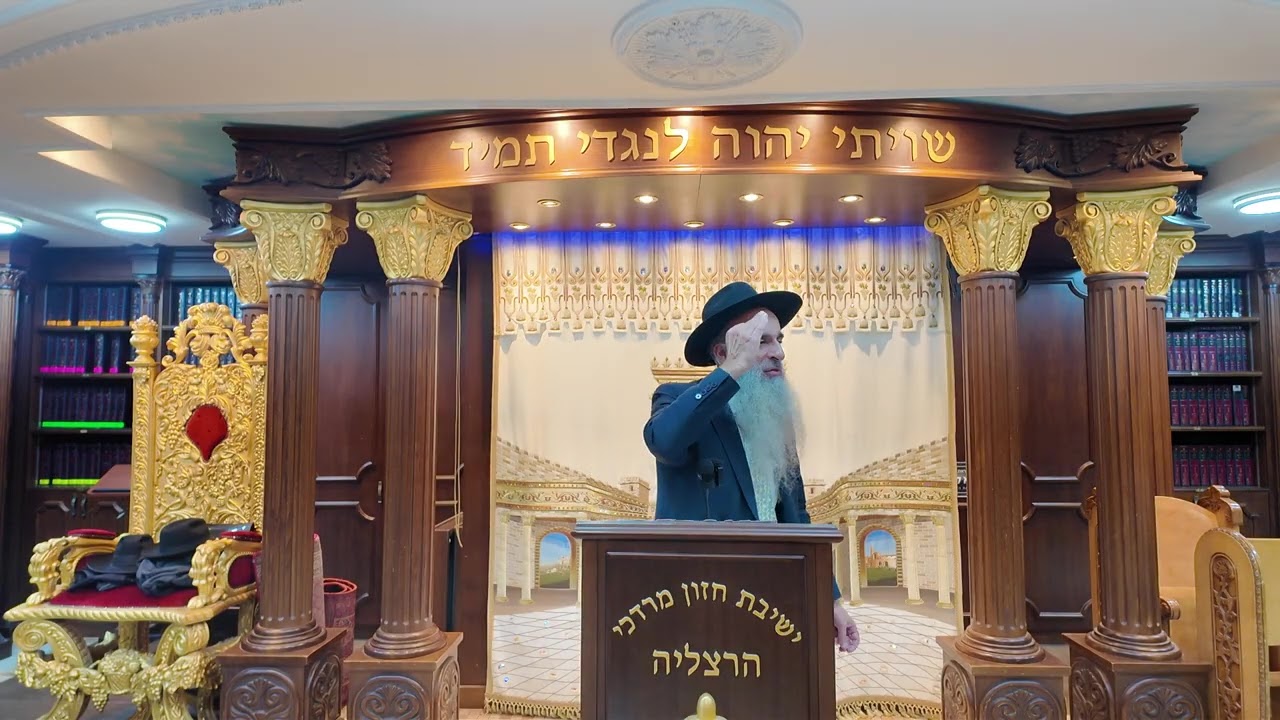

הרב מאיר דוד שמואלי שליט"א - הלכות שבת שולחן ערוך סימן שי"א
Halakha Chabbat
הרב מאיר דוד שמואלי שליט"א השיעור המרכזי של הרב מאיר דוד שמואלי שליט"א, הנמסר במוסדות התורה "חזון מרדכי" בהרצליה, ע"ש המקובל האלקי רבינו מרדכי שרעבי זצוק"ל. 🗓️ השיעור המרכזי נמסר בימי שני ורביעי בשעה תשע בלילה בישיבה בהרצליה. מטרת השיעורים היא להפיץ תורה תוך שימת דגש על מידות טובות ויראת שמיים. לתרומה לשותפות בפעילות הישיבה או לקבלת ייעוץ מהרב מאיר דוד שמואלי שליט"א: https://nedar.im/aDPy פרטי התקשרות: 📞 משרד: 03-778-1778 📧 דוא"ל: yhazonm@gmail.com
Extrait du cours
Do you know where the issue is? I'm not to blame that you opened it. Seals on vessels, such as a dresser, a box, or a tower whose lid is tied with a rope, one may untie or cut with a knife. Untie ?
Transcription6407 mots
Transcription automatique — peut contenir des erreurs.
Halacha seven, what page, friends? How? Do you know where the issue is? I'm not to blame that you opened it.
Seals on vessels, such as a dresser, a box, or a tower whose lid is tied with a rope, one may untie or cut with a knife. Untie ? Only that, yes; but a rope tied into a wood or metal seal, it is forbidden to dismantle or break objects, vessels, as it constitutes complete building and complete destruction. For this reason, it is forbidden to remove hinges after a box if the key is lost, and there are those who permit breaking a box's lock; there are those who permit and those who forbid, and it can be permitted through a gentile.
How did they use to lock it back then? They had a rope. This rope, a person now cannot untie the knot, he may cut it on Shabbat, even if he cuts it on Shabbat, there is no problem. But a "poteach"(today we call it a lock , for 500 years they called it a " poteach", "poteach" doesn't mean like a wood or metal key, they also had a key) it is forbidden to break it, why?
It is called building and breaking in vessels . But if you are stuck now, you need to break it, you have a lock or something like that, you can't get in, you can bring a gentile and have the gentile open it; there is no problem, even though a gentile is also forbidden to do it, it is permitted to take out. Today there is bread, it comes with a wire that closes it, actually, it was allowed to open and close it. It used to be with green wire, today they bring it with square wire.
It is permitted to open and close it, as it is a wire; on Shabbat it is forbidden to close and open a wire, but since it is locked, it is permitted. Therefore, what they found in our time in champagne bottles, they put a wire on their cork, wrapping it around the cork so it doesn't open. From the moment of opening the bottle, you remove the wire, it is permitted to open and remove it on Shabbat. Therefore, it is permitted to [ inaudible] the wire packaging so they don't open.
Friends, Halacha eight, "chotelt," baskets of dates and dried figs. If the cover is tied with a rope, he unties and dismantles. Untying the rope and cutting even with a knife, even the bodies of the baskets, all this is like breaking nuts or almonds to get the food inside them. Now the dates need to be cooked.
The same goes for figs, dried figs come and they bring them, they would bring them by taking the... Palm branches that they take out and make into boards, and that's what they would, they used to bring the lulavim in it. Whoever went to buy lulavim, how did the Arabs bring the lulavim? They would create from the leaves of the lulav itself, no, not the lulav, from the palm branch they would create...
Really long boards and make a box out of it, really a box. Truly a box, all the lulavim were placed in it. It is called "chotlot." Back then they used to make "chotlot," that's how they used to do it. Is someone sitting here or is this...
Come friend, you can sit here if you want, or here, whatever is comfortable for you friend. >> Come. Wherever you sit, you are close to my heart. So also the wrapper, the wrapper itself is a disposable tool.
You keep it, you inject it. Like, to distinguish, a person now brings pallets, brings these things, he has many secrets. These secrets usually can be reused. But many times they are thrown into the trash.
Now it's not such an important tool for you, it is worth money. So also this, it is disposable. Therefore it is also permitted to break it in order to take food from it. Friends, Halakha 9.
It is permitted to undo and cut the knots of the spit that they tie on the roast meat or chicken. There were ovens where they would put in large pieces of meat or chicken, they would literally tie it to the spit. It wouldn't fall, they insert it, take a spit, hang the meat, all the things, as they go, they arranged it as needed, according to what is required, according to Halakha. And they put it into the oven, and then the whole piece was roasted.
Now on Shabbat, huh? >> Is salting not required if it is roasted ? >> No, it depends on each case. The liver, for example, you have to take out, you cannot leave the liver inside.
Full of blood. There are its laws. Parts inside you have to remove. Now they tie it, so it is permitted to cut these knots.
Now there are today, for example, I don't know which communities would take a chicken and sew it. >> Stuffed chicken. >> Stuffed chicken, beautiful. >> The Iraqis.
>> The Iraqis do that. Huh? So this chicken, they sew it. Now, huh?
Rice, well? >> Rice and raisins. >> Persia is dozens of cities, at different distances, and every city has its customs and a different language too, other dialects. Whoever speaks in this city doesn't understand another city.
A completely different dialect. Dialects, 500 kilometers away. Exactly this Saturday night is the memorial for Rabbi Ohr Sharaga. >> Oh, really?
When is this Shabbat? >> This Shabbat came for the sake of Heaven He was a man of miracles and wonders. And world wars. During the Gulf War, all the gentiles there would go down to his grave to hide All the gentiles knew this was the most protected place in the world.
They were very connected to the whole matter there. My grandfather told that they had a drought and went down to pray there. He says that when they finished the prayer, they started to go up the mountain, they hadn't reached home yet. He told me this personally.
He rotted until his bones. They had a plague, my grandfather says. They prayed, in the middle of the prayer they were stopped. Then the Rabbi said he saw the face of the Rabbi on the grave and he said to him, the decree is annulled.
>> What is there, there is exactly two two spits >> There that is in the lessons, he says >> It's from there Yes, one of the Rabbis there, he was the Rabbi at the synagogue He writes in his book that one year there were 17, 17 times of my... The whole valley around filled with rivers of water, rivers. >> With him, there wasn't. >> So they say that at the cemetery they saw where his whole grave became like a circle and the water didn't reach there That someone told me in his lesson.
They really believe in this righteous man, and someone borrowed a lot of money and didn't pay him back, so his father donated a meal in honor of Or Shraga, held here on Sunday, on Monday a meal in honor of. >> What is it, like, the next one? >> When is it? >> Monday, next week, next week.
>> But I won't be here on Saturday night. >> Oh, yeah. Three days here, here. A week in his honor.
Oh, what is that? Names in the distance, all of the people of Israel. Seeing. Good thing I called.
Can I see now too? I'll win a cup. This holiday morning? How many to say?
Come. Only one cup? Rabbi, there are more people here. Ah, a portion from his honor, I, because it's natural, put it, put it, it's also natural, everything is natural here.
I want there to be natural juice in the beverage machine. >> Amen. >> Fruit of the land. Everyone needs to drink natural.
>> No, put, put for the people. >> Everyone from the Rabbi now. >> Here, come, come, I'm always hesitant but it's okay, take it. We don't have anything.
Whoever wants, maybe Avishai wants, look, see if Avishai wants, my friend. How was it? Were you here on Saturday? We did, they did it for you and someone donated.
Did we do it or was it there? Who donated it, though? The supporters or the helpers? Good thing you came at four.
Light, light of lights. A righteous man arrived. A righteous man came to town. Thank you very much for coming.
Come every day. There are things like this, you're here every day. Thank you very much. >> As it is said, come every day.
>> Without the cover, it is permitted to cut the light in order to be able to take the food out of the vessel. From here we learn that it is permitted to remove on Shabbat a cover made of plastic or thin metal paper on top of vessels, such as a bottle cap and its end, and also a cover of an end of it. Friends, Halacha 10, seals that are in the ground, friend. Such as a door of a pit that a rope is tied to, you can untie it, a permanent knot that is meant to be untied, but not break or cut, simply destroying, simply a destruction.
Specifically that which is made to last in order not to destroy on Shabbat. Not made to last at all, the reason, the reason is on Shabbat precisely because of building the oven, that they seal it with mud that is meant to last. So also in the past, how did they drink water, friends? There were water cisterns.
I don't know what there was in Jerusalem , yes? In Jerusalem there were water cisterns. That they used to tie it, it's permitted to open the rope for you. Now, also in the past, how did they bake on Shabbat, how did they heat the food on Shabbat?
Huh? How did they heat the food on Shabbat? Huh? >> In the ground?
>> There was a central oven. There was a neighborhood oven. The oven of the whole neighborhood at the baker's, it was a big oven of the bakery and everyone would handle. Now, how.
>> Something that the Gentiles came and did once. Wanted to replace them. >> Yes? It's a repair to the ground.
I said there would be food. >> Doesn't look like an investment worth it , come every day. >> More? We will have food here every day, many people will come here.
There is abundance for all of the people In good apartments. Good neighbors. So, how did they close the oven in the past? They would put in all the pots and place wood, and around the wood, they would put clay.
That’s how the heat was maintained. It is permitted to break the clay around it to remove the wood. And all of this is temporary. Therefore it is permitted.
Yes. Even wine barrels in the past, it wasn't a stopper. The lid, they would seal the lid with clay all around. But there wasn’t silicone like today, or all sorts of glues of that kind.
And this clay, they break it. Huh? >> What is that? >> That is the iron hoop.
What barrels of >> Today, today you are right. In the past, in the past it wasn't like that. >> Did it have an iron hoop on the barrel? >> I mean, it wasn't, it was It was a jar.
You know, it was only a few hundred years ago that they started with wooden barrels. Oak wood. >> No, not now, there was always wood >> It seems to me In the vessel, it wouldn't keep the >> I know that the Gemara says it was a clay jar. That’s what it says in the Gemara.
Friends, Halacha 11. It is forbidden to put wax or oil in a hole in a barrel to seal it before smoothing it out. Now it has holes, it needs to be closed . Other things that do not have the issue of smoothing are permitted, and if the wine was leaking through the hole, it is forbidden.
Even putting garlic there—what is garlic? They take garlic and put it there; the intent is something soft. And anyone who doesn't intend anything but to seal it, a Torah scholar is permitted to act that way. There was in the Torah the labor of erasing—what is erasing?
It says the skin itself, they would remove the hair from it, like smoothing it out, removing the hair. Removing the hair, why is that called erasing? Now someone who takes, he has a bomb, he smears the ointment nicely. That is called "smoothing," which is a derivative of erasing.
>> It is forbidden to stick the bottom of a wax candle to a table or vessel on a holiday. You take the—now when you want to stick the candle to glass or a tray, you heat the bottom of the candle, then it melts , and you stick it on. Why? There is a concern that one will come to smear the wax and violate a Torah prohibition.
And some say that the very act of sticking the wax by heating it is forbidden by Torah law. >> If a person heats the glass and then puts the candle there, is that permitted >> That is not a Torah prohibition, it is a Rabbinic one. Like him scratching his ear, like that. At the end of the day, he is scratching his ear.
It is appropriate to be stringent not to let children play on Shabbat with things made like dough, like Play-Doh or clay, because they are not fit for play for little ones on Shabbat, they are considered "muktzeh" due to their own nature, and it is forbidden to give them to them on Shabbat. Yaakov says it is appropriate to be stringent. Meaning he did not say it is forbidden. From here one should learn that it is forbidden to smear silicone or glue into holes in a vessel to seal around a nail driven into a wall to strengthen it.
>> Now friends, we have actually finished the entire lesson. This is the new volume that Rabbi David Yosef just released for the month. But there is a summary here regarding clocks. We need to think about what to do here.
Friends, like this. A wristwatch whose mechanism is mechanical via a screw on its side; when you want the clock to continue its operation, you turn it a number of times. Clocks from the old days, you would sort of screw them in. That winds the clock.
Therefore, a wall clock that operates mechanically by a chain then there is reason to be strict not to wind them on Shabbat. A clock that operates using an electric battery it is appropriate to be strict not to wind it on Shabbat, even by a non-Jew. Friends, come do Psalms, friends. Oh, Jacob our forefather has arrived.
It is permitted to wind a clock while it is still running, a mechanical clock. Even from the outset. It is permitted to wear a wristwatch on Shabbat that winds mechanically through the movement of the hand, where every time he moves his hand it causes the clock to wind and prevents it from stopping. As long as the hand moves, the clock continues its operation.
>> As long as it is running. >> Yes. >> But to activate it >> even if he knows that if he winds it by wearing it on his hand, the clock will stop running. And since the clock has already stopped, it is forbidden to wear it on his hand and forbidden to move it on Shabbat at all.
Why? Move it >> and activate it even now. >> It is forbidden. >> Do you want it for jewelry or for a clock?
>> Let him take a bracelet. >> A bracelet, let him take. Why is he taking a clock? He wants a clock.
It is permitted to pull out the button on the side of a mechanical clock on Shabbat to set the clock hands. It is forbidden to pull out the button on the side of a clock that operates using an electric battery on Shabbat. An alarm clock that operates mechanically, and has no electric battery and has a hand that sets the time for when the clock will ring, it is permitted to turn the button. Therefore, it is permitted to turn the winding button, the the ringing operation of the clock, and therefore it is permitted to raise the pin, it is permitted to lower the pin; all this for a clock whose mode of operation is mechanical.
But if it operates using an electric battery or electric tool, it is forbidden to perform any action with it. It is permitted to handle a clock that runs on a battery, just as you move a battery, you have, you are wearing a battery as well And it also has an electric light, maybe you'll press it suddenly? There is no need to worry about that, as usually a person is careful. If he knows that he is a restless person and might touch it, then that is an issue.
The same goes for children's toys that have a spring, and their mode of operation is by tightening the spring or turning the button; it is permitted to operate them as long as it is not, as long as it is only mechanical. A toilet pipe or a drain opening that is clogged , where water is not exiting through them at all, it is forbidden to open them on Shabbat by a manual pump, by a hose or similar. If there is a great need, it is possible to
be lenient by asking a non-Jew, And if it is impossible without a non-Jew, by way of hint, if it is possible, he can hint to him, yes. And if it is not completely clogged and the water is saying, saying slowly in the, in the, in the sink, you have a manual pump, then that causes it to start flowing well Then there is no problem with that, you can.
>> Rabbi, regarding the children's jars. >> Just a minute, with your permission, one more thing: if the sink is clogged with grease, is it permitted to pour boiling water in to melt the grease? It's not from a primary vessel; don't let it be. If he has a hot water urn now, and wants to open the urn, what should he do?
He can do it into a cup and pour. Yes, no problem. What do you say, sir? >> Once there were more, perhaps those who walked around with them, and that's the subject of this urn, but it could also be that it might emit sparks too.
>> I said that it is forbidden, he says if it emits sparks it might. >> I remember there used to be something like that, I remember like in those lighters that emit a light like that. By friction. >> Talking about that car you travel in.
>> Yes, you understand what they have in their pocket. >> What is found in museums, I think. >> What in the museum? >> Only things of ancients; there is still someone who has such a push that has pulses and it emits sparks.
>> No, even in cars it can emit sparks and you can see them. >> This is a car, it says it emits. >> Ask if there are cars like that that don't have it, and he was rich. A cover of a drain opening inside the house, which people are accustomed to opening frequently to pour, to wash the floor; therefore, the cover of the bathtub drain, as well as the sink cover , to ease removal and replacement from moving on Shabbat, even if they have no hinges.
From this. Unlike a mezuzah that was placed inside a mezuzah case and fell, if the mezuzah case falls, it is forbidden to go back and affix it using sticky adhesive. Always go to celebrations. He will pass it on from us, also from the friend for free.
>> Thank you. >> That we all pass on to him. If it was placed inside the case and the case nearly loosened and the mezuzah fell, it is permitted to put it back in. It is forbidden to stick anything to walls on Shabbat, but it is permitted to attach paper to a metal wall or to the refrigerator using a magnet.
And also it is permitted to attach to the wall a hanger made of plastic or rubber that connects via air pressure, because it does not connect the magnet or the hanger with a permanent and strong connection, and there is no complete connection here. It is forbidden to pour water on Shabbat on new concrete casting which is strengthened by the pouring of water, and there is a Torah prohibition of " building" in this, and even if he wants to wash his face, hands, and feet as if from mountains—it is forbidden. And it is also forbidden to tell a non-Jew to pour on Shabbat, but what can he do? He can do it by means of a Shabbat clock; a Shabbat clock will open the water and ...
>> Like watering the garden. >> Yes, watering the garden. It is permitted to lower the mercury inside the tube until shaking by hand. So that it will be.
Is it possible to use a thermometer, and is there room to be lenient in this even after using the thermometer when there is no need to use the thermometer again on Shabbat? So back then they used to measure fever with mercury. When there was mercury, so one does like this, ah... Yes, do like this and the mercury goes down.
Ah, one doesn't put mercury. We were children collecting the mercury from the floor. What is a regular thermometer? Battery?
Battery? Form a soul. >> They have it at Osher Ad, they sell this charger. >> We want life; this is heaven forbid, there might be a danger in it, things like that.
Welcome, Baruch. It is a privilege that you are coming to us. Privilege, privilege, privilege. The Name is very great.
A new light will shine on Zion. I will rejoice and be glad in You, rejoice in You. It's so good, a good day for the people of Israel like this. Drawers in cabinets that are mounted on rails can be removed from their place and returned to their place using buttons.
It is permitted to disassemble and reassemble them on Shabbat. And it is not the way of using drawers to remove them from their place. When one is accustomed to always inserting and removing them, one may be lenient. Even with large drawers.
Even if they contain 40 se'ah. All the more so with drawers of small cabinets or tables, anything that can be easily removed and returned. It is permitted to connect a hose to the faucet on Shabbat. Whether it is a metal hose or a hose...
the light of the world. Only his honor descends for us. faucet on Shabbat, whether the hose is made of metal or plastic. Even if it's loose.
Intended to remain permanently, but today, Yaakov, there is such a thing, you do this and it goes in. You don't ...it seems that there is no...If one is used to it all the time, then... >> It goes in for... >> To connect and not remove, so it should be...
>> Yes, it's not with a twist, and also today people occasionally remove, tighten, insert, they do it...they need to wash the sink, so they don't...yes, you're really, as he says, you do it so it will be connected permanently. Sometimes even if it's screwed on, it is permitted to connect and disconnect it on Shabbat, since it is the way to connect and disconnect it frequently. And if a window glass breaks, the shards of glass will remain inside the window frame. If there is a concern, it is forbidden to touch them, but if there is a concern that people might get hurt, especially if there are children...
One should bring a non-Jew. If there is no non-Jew there, one may be lenient to remove the glass shards in an unusual manner. >> There is a contradiction there. >> What?
>> Because it is connected to the building That's how it seems. It is forbidden to oil the hinges of a squeaky door so it will open and close, to be lenient. Exactly the first portion in the Torah, exactly, thank God we finished. That part is easy, thank God, the first portion in the Torah, we see it is written that on the first day the Holy One, blessed be He, created...second day , third day, every day has what the Holy One, blessed be He, created.
Why didn't the Holy One, blessed be He, create the entire creation in one shot? Of course, that is what is written in Genesis, Rashi writes that the Holy One, blessed be He, created everything on the first day. It is written "and the earth brought forth" everything was included, including the sun, the moon, everything was on the first day. On the fourth day the sun and moon were just hung up.
And everything was already created on the first day. And we see that if there is no order, what the first day had a specific order, second day, third day, fourth day, fifth day, everything has its order. It teaches us that order in life is a great thing. That one who has order, they say that the Saba of Kelm...
That when he went to check how his son was learning in the Yeshiva, he didn't go to ask his Rabbi about his child, he went to his wardrobe. May Hashem grant us. They told the Rabbi, in that situation he said: a person whose wardrobe is organized shows that his Torah is also organized. And a person whose room is messy, pardon the words, throws things around, doesn't keep things in a physical sense, it also shows in a spiritual sense.
There is another point, my friends, friend Shlomi , you came quickly. Almost 6 o'clock. Okay, thank you very much. Thank you so much for coming.
Thank you Order, my friends. We talked about order , an acronym for "seeing Heaven's help. " A person who is organized in life sees Heaven's help. As it says in Psalms, "Give thanks to Heaven." For everything, we say, "Give thanks to Hashem." As if the world would be chaotic.
Why? Woe to us if the sun and the moon, light and darkness, were mixed together. Hashem made everything. Everything has light, day, night, winter, and summer.
If everything were mixed—winter and summer together—what kind of life would that be? The Holy One, blessed be He, created the world beautifully. Why tell you that order is a very great thing? Everything is order.
We also see there is a Cohen. Order in the synagogue. After that, there is a Levite, then there is an Israelite. Why is there a Cohen?
So that not just anyone can say, "I want to." The Cohen. Everything has an order to it. We have a book called the Shulchan Aruch , which is basically there to show you order. What to do in the morning, what to do in the afternoon, what to do at night.
A Jew has a book called the Shulchan Aruch. What is this book? This book is the book of a person's order. All of life is in order.
A person who has order has everything. As we said, if his head is organized, then I know that everything about him is organized. I know that he is disorganized. And also the first leader of the people of Israel, Moses our Teacher, built this platform in the desert; who succeeded him?
Joshua son of Nun. Moses our Teacher had sons. His sons did not inherit his position. Joshua was perhaps the greatest of the generation.
And why did Joshua merit it ? Because he would organize the Holy Temple. Cleaning, organizing, tidying up— everyone was laughing at him. Organizing the benches, arranging, clearing the cups, clearing this.
So this cleaning that he did is what the Holy One, blessed be He, loves, and the Holy One, blessed be He, chose him to be the leader. So what is it when I organize? Actually, when a person organizes, it's a person who cares. The Holy One, blessed be He, wants leaders who care about others.
That there be a leader who cares, like this Roni Bar. On the day of Simchat Torah, he wasn't answering his phones. Or he doesn't answer; everything was already "in order," everything was already sold there, all good. He was sleeping.
Where was he? Sleeping. Until noon he was sleeping. What happened?
1,000 casualties. What happened here? Irresponsibility. A lack of caring.
A leader must be someone who cares. Look at one of the intelligence officers, a religious, ultra-Orthodox man. He will resign because he knows it affects the order. He took responsibility for his actions.
He resigns. To choose a leader is to choose a person who has order. The Temple also had order ; how was it built? When do they offer sacrifices?
There is the morning sacrifice, there is the afternoon sacrifice. When do they burn the incense ? There was a specific Torah for the Holy Temple. Life, my friends, is order in life, order in life.
And a great person whom Hashem loves is one who cares about where he is. Who keeps things clean, who maintains order. Now, thank God, my friend Rabbi Avishai was here. He helped a lot over the weekend.
Helped a lot over the weekend with all the campers, with all that. Thank God, Yitzhak helped here too. Do you know where Yitzhak is, the one who helped, and Yehuda? That they worked, and there was some non-Jew who helped.
And we need to know it’s not just two people, everyone needs to be together. We need to know that when something happens, we are all together. When there’s a celebration, we are all When there’s a memorial, we are all This togetherness, this order, is the strength and the power. How important it is to always be united To be together.
How was it? There was that father who wanted to give a lesson to his sons, Shlomi. He had 10 sons. He asked them to bring 10 reeds.
What, they took one reed? In one second, they break it. He said, take 10 reeds. It’s hard to break them.
And that is a reed. They are united. Even if a reed is thin, in a second and a half you break it. But if it is united, if there are several people together, you can’t.
Unity is the power itself. I also said this, I spoke here, trying very hard to speak gently about the blows that were dealt to Jews. It doesn’t matter who he is, but here in our case it’s Haredim. So it is a terrible and awful thing, people don’t know what "between a man and his fellow" means.
When a person causes distress to his fellow. Grief of a lost soul. A person who has peace, has everything. A person who causes distress to creatures, even causing distress to animals—many people don't know it can be a biblical prohibition against animal cruelty.
Causing distress to a person, a Jew, a religious person, a Jew who keeps Torah and commandments, a Jew who studies Torah—why do you strike him? You blocked the road. Because he is religious? To know that the Holy One, blessed be He , created "between a man and his fellow " is the most important thing in the world.
And who is closer than your wife, closer than your husband? We need to remember this, friends. All of us together, paying attention to the order, whenever there is an event, whenever something needs to be served, we need to help, everyone helps together . After that, tidying up the place, everyone cleans up.
It is very important not to dump the work on one person. Everyone together. This time the completion of the Zohar will not be on the eve of the new month , it will be during the month, God willing. Next week is the Hilula of the Or Sharaga.
What is the reason? That’s what Rabbi Victor requested. He wants a "Tarka". We must arrange it.
All right? If Victor asks. How can we not fulfill his wish? There is also a Torah scroll dedication for Ares 'father.
The new month, at his memorial and the memorial of Yaakov, their father. Is it one day after another, or is it on the same day? What day is it? >> 21st.
The custom of the ancients is to invite guests, and also everything we do today for Shoval Eliyahu ben Noa—tomorrow he has a trial, God willing, he has been detained for seven months, may they release him from his detention. >> All the detainees. guests for Shabbat, to invite them nicely before Shabbat, so that every person has ample food to give to the guests who will come on Shabbat. Spending money in honor of guests, it seems to me, is included in Shabbat expenses, and a guest should not come without notifying.
Yes, today, friends, the memorial is for Rabbi Raphael Yosef Chazan, Ovadia Avraham HaLevi, and Avraham Pinto. And Avraham Peretz. Also yesterday there was an Avraham Peretz, right? Rabbi Moshe HaCohen, Rabbi Chaim Salem, Rabbi David Messas.
Rabbi David Messas, the Rabbi of Geneva Of Paris and the son of Rabbi Shalom. My dear friends, so whoever eats Bamba or chips needs to recite "Borei Minei Mezonot." And whoever ate Bisli needs to recite "Al HaMichya." >> If he ate a little, is he hungry? >> If he ate a little, he will recite a little. What is a little?
Bamba, if he ate a handful of Bamba, that is already " Borei Minei." >> No, for the Bisli, he ate four or five of them. >> Apparently, he was a bird in a previous life. Are you sure it's four, five, or grandmother zero on everything? Four or 40, Rabbi?
Death and life are in the power of the tongue, friends. The tongue is harder than the sword. The sword strikes close to a person, but the tongue can kill; a person speaks here and can kill in a distant place. The sin of evil speech is worse than bloodshed.
Evil speech kills three: the speaker, the listener, and the one they testified about. Every word a person utters is all recorded. A person who is accustomed to evil speech has all his merits taken and transferred to the one he spoke about. He receives all his sins.
Jerusalem has no sin, besides evil speech and the baseless hatred that existed between them. May God grant us merit. Shabbat is protected from harmful forces , as we said. Although, how did we say yesterday in the name of the Rabbi?
Shabbat provides... Also cleanses spirits; we said, what do you see on Shabbat? The whole world is clean. You see the skies are clear.
But on weekdays, you don't see the Shabbat. They tell us about harmful forces. Shabbat chases everything away. The Creator who sanctifies the day on Shabbat eve, a sukkah of peace rests and spreads throughout the world.
Who is this sukkah of peace? It is the Shabbat . It is not this sukkah that is found there. All spirits and storms are all finished ; they enter the vehicle of Torah and holiness.
What is going on? May God grant us merit . And then the world is under supreme protection. There is no need to pray for protection.
We don't say "He protects the people of Israel" until...This is for the weekday, when the world needs protection, but on Shabbat, a sukkah of peace is spread over the whole world; even the wicked in Gehenna are protected Therefore, in the Kiddush, we bless "He who spreads a sukkah of peace over us, over all His people Israel, and over Jerusalem." Why Jerusalem? It is the place, its place, this is the sukkah. And we must take it upon ourselves so that it may dwell with us. That's why we are not afraid.
Why? "He who spreads a sukkah of peace over us." Therefore, all week we are in a sukkah of peace. The day of the prophet... We are all in peace.
Newspapers, television, radio, movies, internet, computer, computer, MP3, MP4, USB, handheld, mobile, mobile, phones of the generation of the flood, nowadays a new iPhone that flies a person in one moment to perdition, and the Galaxy. Everything is meant to bring a person There is no doubt that all media and multimedia outlets are central sources for the dire situation the world is in. They have a great and immense power to shape public opinion, to intrigue it, to stimulate it, to seduce it, to incite it Certainly, if we wish to instill our pride and preserve our Judaism, our families, and our values, we must carefully monitor the media entering our homes. Therefore, [we must stay away] from any destructive tool that could, heaven forbid, harm us.
You spend your hard-earned money to bring in viewing devices and content that have been proven beyond any doubt to cause an increase in crime, violence , destruction, and other such evils. May God save us all. >> Thank you very much. Thank you very much to the entire audience.
Rabbi Hanania ben Akashya says.


