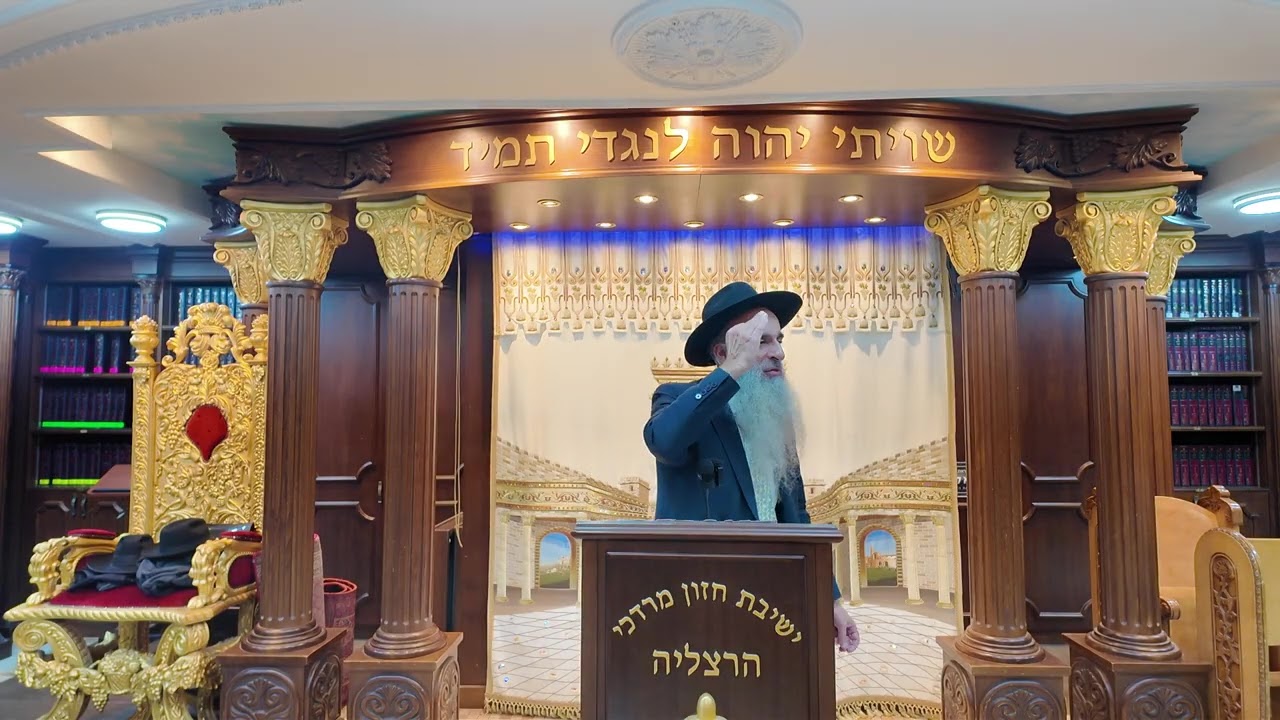

הרב מאיר דוד שמואלי - האוצר היומי סדר שפ"ג
Etude de Torah Halakha
הרב מאיר דוד שמואלי שליט"א השיעור המרכזי של הרב מאיר דוד שמואלי שליט"א, הנמסר במוסדות התורה "חזון מרדכי" בהרצליה, ע"ש המקובל האלקי רבינו מרדכי שרעבי זצוק"ל. 🗓️ השיעור המרכזי נמסר בימי שני ורביעי בשעה תשע בלילה בישיבה בהרצליה. מטרת השיעורים היא להפיץ תורה תוך שימת דגש על מידות טובות ויראת שמיים. לתרומה לשותפות בפעילות הישיבה או לקבלת ייעוץ מהרב מאיר דוד שמואלי שליט"א: https://nedar.im/aDPy פרטי התקשרות: 📞 משרד: 03-778-1778 📧 דוא"ל: yhazonm@gmail.com
Extrait du cours
Friends, we are on Masechet Pesachim, page 61, Seder Shepag in order . Yes. Today is the 24th of Cheshvan, 5787, at Yeshivat Chazon Mordechai, studying the daily treasure. Masechet Pesachim, page 61, and this order is called Shepag, here at Yeshivat Chazon Mordechai. "And he took...61... and he took the disease of all diseases , the haters of Israel, the daughter of Ishmael, son of Abraham..." The prophet says, Rashi says: He added wickedness to wickedness by not divorcing the first one. We are in the Prophets, in 1 Samuel, Chapter 25, where Abigail is speaking with King David. "Bound in the bundle of life with the Lord your God." She knew how to speak with him.
Transcription3617 mots
Transcription automatique — peut contenir des erreurs.
Great. Friends, we are on Masechet Pesachim, page 61, Seder Shepag in order . Yes. Today is the 24th of Cheshvan, 5787, at Yeshivat Chazon Mordechai, studying the daily treasure.
Masechet Pesachim, page 61, and this order is called Shepag, here at Yeshivat Chazon Mordechai. "And he took...61... and he took the disease of all diseases , the haters of Israel, the daughter of Ishmael, son of Abraham..." The prophet says, Rashi says: He added wickedness to wickedness by not divorcing the first one. We are in the Prophets, in 1 Samuel, Chapter 25, where Abigail is speaking with King David.
"Bound in the bundle of life with the Lord your God." She knew how to speak with him. "To reign, and this shall not be a cause of stumbling for you." Failure. "And a cause of offense of heart, to shed blood in vain." "May the Lord save you, and may the Lord do good to my lord." "And you shall remember..." What humility, oh my. Oh, what humility, oh my.
After that, he says to her, David says to Abigail: "Blessed be the Lord, the God of Israel, who sent you this day to meet me. Blessed be your taste, and blessed be the Lord, for I was given today in blood and saved by your hand." "As the Lord the God of Israel lives, who has restrained me from harming you, Nabal, the foolish man this morning, etc." Look at that. Even with his mouth, he can cause damage Therefore, they said that the sword kills from up close, but the mouth... David says he took from her; after that , he brings...
After that, she comes to the house, sees her husband, he is drinking. Stoned, and in the morning she goes out She told him, "I gave him, I gave David ..." He almost had a heart attack from the fact that David wanted to kill him; he was so stingy, yes. He started trembling, trembling: "How did you give him food?" But they needed him; he didn't care. It says, "His heart died within him," because he was distressed over the food she brought to David.
Ay, ay. Ay, "And it came to pass after ten days , that the Lord struck Nabal and he died ." Look at that. It says, why? It says exactly when Samuel the Prophet passed away, the Holy One, Blessed be He, did not want...
...the mourning for Samuel to be together with the mourning for this wicked man. It says, what is this? It says he died after ten days. Rashi writes, what are these ten days?
It says the Ten Days of Repentance. The Holy One, Blessed be He, gave Nabal the Ten Days of Repentance. And some say it corresponds to the 10 insults Nabal gave to David. He gave them a total of 10 insults.
For that, he remained 10 days. Look at that , it says even a very wicked man who does one small commandment, it sustains him. David heard that Nabal had died, and he blessed the Lord for pleading his cause . Nabal died, and David sent immediately and took her as his wife.
Answer me, friend. David married her, it says. Did you see that? So he marries her, friend.
Then all the sheep and cattle became his Huh? Now the prohibitions King David spoke of are reversed. No one will transgress it Okay, friends, we are on page 593, Masechet Challah, Chapter 1, Mishnah 5. "Dough that begins as fritters..." What is the meaning?
Soft dough. "...and ends as fritters." That one fries it. >> If it begins as fritters, and ends as dough, it is liable for Challah. What is the meaning if?
If you fry it in oil, like the*sufganiyot*(doughnuts) we have today, it begins as fritters and ends as dough. Therefore, regarding bread, which one returns to make into fine flour, to make food for infants from it, it is liable for Challah. Halacha in practice. It seems we separate it without a blessing, if it's the donuts; why?
Because they cook them, like the frying is the reason, therefore you can eat even a measure of Birkat Hamazon, and that is a problem, unless there are baked ones today, then it's a problem. The dough, flour that you put in hot water, Beit Shammai exempt it from Challah, Beit Hillel obligate it. Halita: boiling water over flour, now that it is boiling he put it in, Beit Shammai obligate, Beit Hillel exempt. Thanksgiving loaves, for so it is a Nazir, if for himself exempt, to sell in the market he is liable.
T. T. 194 G. Gemara friends, And it exists after the death of the enemies of Israel: that if a father was liable for a sacrifice and died and left assets, and the assets are pledged and they are the father's obligation, and whoever inherits the assets brings from them the sacrifice that the father was liable for, if they slaughtered the sacrifice as a different sacrifice, it is disqualified.
It exists in a public sacrifice like a private sacrifice, because changing the sanctity disqualifies also in public sacrifices. Anyone who says regarding change of ownership, that here the disqualification is not in the body of the sacrifice and it does not disqualify in all four blood labors, but only in the throwing, because the ownership of the sacrifice is only for the atonement and the throwing. Consequently, change of ownership is considered only changing the owners during the throwing, because there are no other labors that have the owners attributed to them. If he thinks for the sake of other owners 'service, it is not third.
And it does not disqualify after death. And it does not disqualify in a public sacrifice like a private one, because in a public sacrifice, change of ownership is not applicable. But also the "Tarta," is it really a refutation? Who said "Tarta" specifically?
The Gemara asks, why didn't he say specifically? If I have change of ownership also from the type of its body , and now regarding the owner what? Thought does not disqualify in the body of the sacrifice. Changing the sanctity is a thought regarding the owner.
And he said change of ownership after death. He said, always change of ownership after death. What is there to say? Who said "Tarta" specifically?
Rather, Rava said: A Passover sacrifice slaughtered during the rest of the year's service with a change of ownership, change of ownership also occurred at its time, and it is disqualified. Mishnah. Middle column. A Passover sacrifice slaughtered with the intent to eat its meat by those not eligible to eat it.
What does that mean? An old person, a sick person. Or not for those registered for it. Another group.
To be eaten by the uncircumcised, what is uncircumcised ? Not circumcised. It is disqualified. Slaughtered with the intent to eat part of it by those eligible and part by those not.
One must know these laws, friend. The moment Mashiach comes, we must be geniuses in this. And if not for those registered, not for those registered, for the uncircumcised, they are perfect and pure and valid. A Passover sacrifice slaughtered before midday is disqualified, as it is said: " And the whole assembly of the congregation of the children of Israel shall sacrifice it." They slaughtered it in the afternoon.
Slaughtered it before the regular afternoon sacrifice, it is valid. Provided that he does not throw its blood immediately, but waits to throw its blood until he throws the regular sacrifice, until he offers the regular sacrifice. Until he throws the blood of the regular sacrifice. If he threw it before the regular sacrifice, it is valid.
Gemara: The Sages taught, how is it "not for those eligible to eat it"? Because of eating unconsecrated meat and because of eating by an old person. How is it "not for those registered for it"? And he registered it for members of one group, and slaughtered it for the sake of members of another group.
The Sages taught in a Tractate What is this quota? From where? We learn that the Paschal lamb is slaughtered only for those counted for it. Anyone who slaughters it not for those counted for it acts against the commandment.
The Sages taught The verse changed it to imply a requirement. Rabbi says: [Number], slaughtering it for eating by the circumcised, on the condition that the uncircumcised join in the blood-tossing. Rav Chisda said: Invalid. What is the intention, counted or not counted?
Rava said: Valid . Rav Chisda said: Invalid, because there is the disqualification of the intent for the uncircumcised during the tossing, and one cannot apply the Passover to the uncircumcised. Rava said : Valid, they need the intent for the uncircumcised at the tossing. Rava said : From where, where is it derived that there is no intent at the time of slaughter to toss it for the uncircumcised?
As it is taught: Can it disqualify the members of the group who come with him, and his law is effective , while uncircumcision disqualifies? This is ritual impurity, which disqualifies—just as impurity is treated as partial impurity being like total impurity, so too is uncircumcision treated as partial uncircumcision like total uncircumcision. Let us enter this path: it is effective , and uncircumcision disqualifies, meaning it is disqualified for the uncircumcised. Time disqualifies with the intent of pigul regarding time; the verse treated partial time as total time , even if he only thought of a small amount of time—he had the intent of pigul for a part of the sacrifice as if he slaughtered the entire sacrifice with that intent.
So too, partial uncircumcision is treated as total uncircumcision. And let us see, to what is uncircumcision compared? We judge the law of uncircumcision, which applies to all sacrifices, and the law of impurity, which applies to all sacrifices, and we shall prove it by time, which applies to all sacrifices. Go along this path something that did not purify from our rule, something that did not purify in any sacrifice.
And impurity proves it, as impurity was included in our rule and purified from our rule, therefore the Torah labeled it, the Torah was lenient regarding impurity that it does not disqualify in part. The verse says: "This is the statute of the Passover; no uncircumcised person shall eat of it." What is "this"? Only if he slaughtered the Passover to eat the whole of it, and not part for the uncircumcised and part for the circumcised, can one say "this." Friends Yes, bother now to go to a non-Jew and take from him a plowed field that he plowed in the Sabbatical year. The non-Jew is not commanded regarding the Sabbatical release of the land.
He did not plow for you. He already plowed; you came and found it plowed, but not by an Israelite. He plowed it in the Sabbatical year in violation. They are holding on Be healthy and not by the hand of an Israelite.
You see an Israelite being healthy, tell him, "All the best to you ." We inquire after the welfare of non-Jews I will tell you the acronyms, you will say to the non-Jew, "All the best that you are this." He said that he said right What is "inquiring after their welfare" ? For the welfare of Israel. Yes? A person sees a Jew, he says to him , "You traveled on Shabbat," he says to him, "Peace." What should he say to him , "You are going to hell"?
Tell him, "Good soul, today is Shabbat. " May God grant us. That they pass from the world, do you hear? They will go from the world with God's help.
He now wants you to fix tomorrow properly. Fix. Only take from him gold. >> Sixth.
To write the name Rambam. May God bless you with all the blessings in the world, God, may God bless you. You need spiritual things, He will always give you, God is always with you Daughter of God. Rambam Everywhere.
This makes it upright. This makes it upright. This is a partition made from it. Great is human dignity.
That you should not make a thing of this . From here we will go out Come, columns I came to write Shabbat, much work is upon me. Servants of Shabbat Therefore Writing things, one must arrange things , in walking you shall set your Shabbat feet. Walking on Shabbat Do not walk on Shabbat like you walk on a weekday.
Walk at ease. How will you speak on Shabbat? Therefore, "speak a matter" on Shabbat Et cetera. Shulchan Aruch.
Orach Chayim , Chapter 308. A weekday strain, bedridden, there is no danger in it Some permit it, and guard against the danger of a limb injury. Some say, some say Midrash Tanchuma, now you see the page, ' A ',' A ',' A ', this means 1,000, the second' A 'is' A ', everywhere it says I didn't know that, do you know? Everywhere it is written "Vayeshev" it implies a bad thing Midrash Rabbah Ever heard that?
Look what it says, Terach used to worship idols, statues. One time, he went and gave Abraham to sell, to sell idol worship. A person came who wanted to buy an idol Abraham our forefather said to him, " How old are you?" This is a small child , imagine now, Elijah selling idols. Who is it?
Abraham our forefather. He said to him, "I am 50 or 60," he said to him, "You donkey, a man at age 50 buys an idol that was made just today? Don't tell me you're a kid, what are you doing?" He said to him, "Wow, you're a real man ," he says to him, poor Abraham our forefather, what a small child, supposedly, what a little tot, just born , he says to this adult, "You poor thing , you are bowing down to something we just took out
of the oven, why are you bowing to it?" He was ashamed and left; a woman came and brought food to the statue, she said , "Eat, may they eat." He said, He took a stick, and broke all the statues. He gave the The stick to the big one.
His father came, he said to him, "Tell me, who broke the statues?" He said to him, " The big one." He said to him, "What happened?" A woman came, brought food to the big one, brought food to the small ones. And I gave it to the small one. The big one said, "I need to eat first." And that one said, "I'm eating," they started fighting among themselves, fists It became a brawl. This one kicked him, this one head-butted him, this one gave him a double-whammy.
Everyone did something. So by the time the big one came, he had big muscles. He was strong. He broke them all.
He said to him, "Who are you praying to ?" He says to him, tell him, his father says to him, "Who are you laughing at?" He said to him, "Father, don't you believe?" He said to him, "No.""Then who do you worship?" "If he isn't like this, he's worth nothing?" He said to him, "What?""I am throwing you into the fire." He went and they gave him to Nimrod. He said to him, Nimrod said to him, "Come bow down to the fire." Abraham said to him, Abraham said
to him, how did Abraham mock Nimrod? He said to him, "Let's bow down to the water." Nimrod said to him, "Why should we bow to the water?" Who touched the righteous one? He said to him, "The fire, you want us to bow to the fire?""The water is stronger than the fire." Why?
The water extinguishes the fire. Beautiful, beautiful. The little one ensures afterwards that everything goes up, everything will work out. Oh, watch out.
Abraham said to him, "The water is purple." He said to him, "Fine, let's worship the water." He said to him, "If so, let's worship the clouds that carry the water." He said to him, "Fine," and Nimrod went with him to the clouds. Then he called to the wind, said to him ...He said to him, "Now, maybe let's worship the people who endure the wind. He said to him, "Look." He said to him, "You speak beautifully." He saw this little boy driving Nimrod crazy. He said to him, "You are right.""And I only worship the fire." "And I will summon you into the fire."" And let the god you worship come." He said, "Who is Nimrod?" He said to him, "Tell me, what are you?
" He said, "If Abraham wins, I'm with him.""And if Nimrod, I'm with him." They threw him into the fire. The four winds of the world. There will be no assembly of the heretics. Everyone will be people of truth.
There will be no chairs. Yes, so now the gathering of exiles is starting to happen, yes? 80 to 100 years ago. >> The truth that Ronnie Tan will arise, times of trouble.
Oh, sorrow. Why are they dark? And he said that in the sixth, a beautiful redemption will arrive, but I see quality more regarding the dwellers of the dust. Will all dwellers of the dust stand up?
Yes, that is the year 548 (Tach). Do you hear? The year is written in the Zohar, when is the time of redemption, 548 (Taf-Pe-Chet). And what actually happened in 548?
There were all the decrees of destruction in Ukraine. Why were they not privileged enough for it to come? That is the year of redemption , that is 548. Now they said 380 years since the sin, the year that is written , a beautiful year to return, "Return." But it is also connected.
And also a verse that shows 568 ( Tashach). It goes every 48 years, there is. Every... Every 24 years there is a dispute about this too.
This year is also auspicious, last year too, that is why we see many are coming down, many, many, many gentiles. Us. Us, ad, yes. Three groups: completely righteous, intermediate.
The completely righteous will rise first of all, you hear? They are the ones who precede the last. At the time of 488 years to the sixth evening, we will merit this longing being fulfilled. Repentance will advance everything, said Rabbi Joshua.
What is the good opinion of Rabbi Eleazar? Righteous, how many years do they advance? One year. During the time of the living, there will be a time of the dead.
That the King will be in it. In different eras. A time of the regression of wisdom in the world. This is all the artificial intelligence , all this that they are talking about now, everything.
Why, what is this artificial intelligence? It is the Holy Spirit; the moment there is no Temple, the Holy Spirit goes. It needs to be. All the days.
Isaac. What is the intention, "The Rabbi knew in a window"? How did he know? He knew.
A, B, souls. He sees a tabernacle of peace upon us, the higher peace, the peace of peace. There are levels of Torah. The Torah in the revealed aspects is the level of Sinai, Sinai and a mountain mover, Sinai is preferable.
The light of knowledge. >> Gathering the righteous. He asks, why hasn't the Messiah come? He says.
Turn the page, the righteous one, the gate of the seventh month, the King will open. Look at how beautiful. What did we see now in the Zohar? When is the coming of the Messiah, right ?
It says the seventh security that will open, that will bring salvation to Israel in our days. All fruits, to drink the spiced wine, yes, an Israeli pomegranate. Did you hear? More apples and his intention will be.
Although still small, terrible things have passed; there will be no Iran, Hezbollah, Hamas, no mixed multitude, and no trouble giving blows. For from the earth to the security of the eighth level in the world to come, which is in pleasantness—how can we describe the knowledge of the righteous , what pleasure is there? We say that just as a fish does not know what a bird feels, and a bird does not know what a fish goes through—in reverse , the bird would die in the water. From this world, one cannot understand what goes on in the world to come.
But here, what do you understand? Food, this, a white car—that is how he understands. Messiah or not, the one who merits the level above will have such pleasures. Playing in the streets—yes, if he has no knowledge, he plays.
In this world, you can get to know a little. Like, heaven forbid, when a person is honored, what does he feel inside? He feels it, yes, he feels a certain pleasure. That is a spiritual pleasure.
The world to come is a spiritual pleasure, but a good one. When a person hears good news, he is happy; even the living entity, right? And he enjoys it, yes. It says it will be like this in the world to come.
The world to come is the end of man, with attributes. The result of good deeds. All the prophets and...how fortunate we are to have finished three pages. Beautiful.
Thank you very much, your honor.


