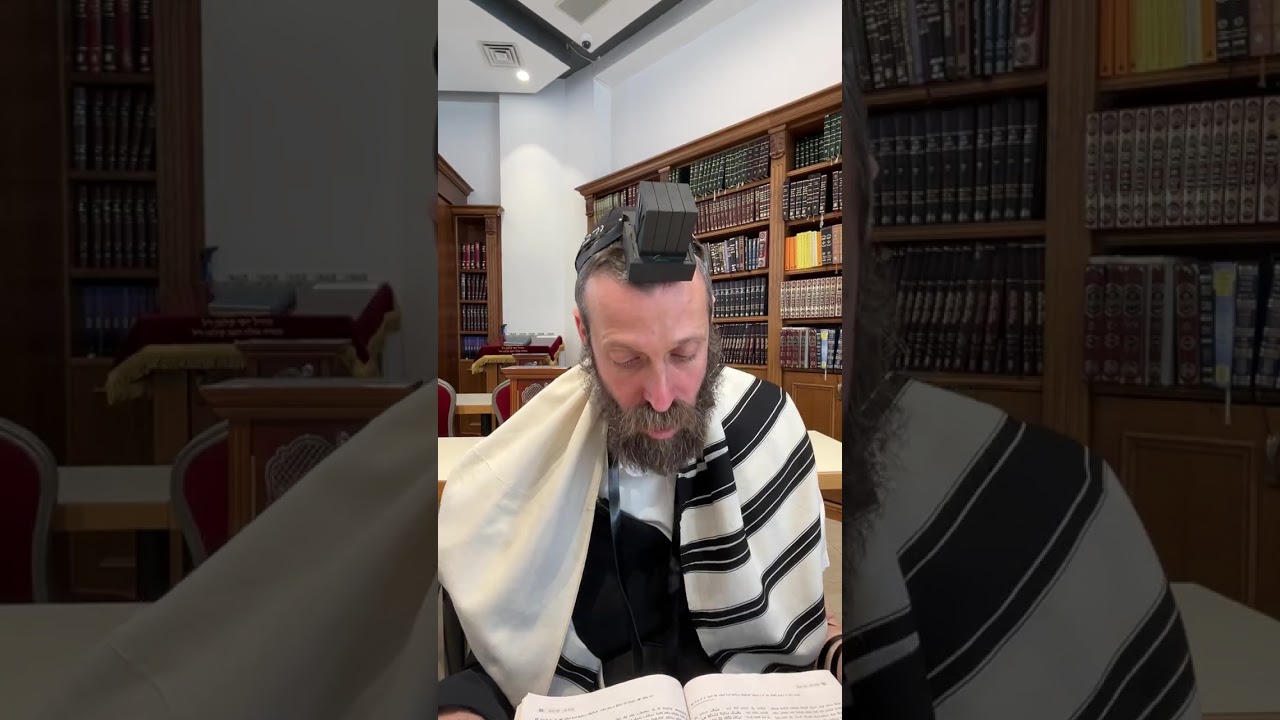
הדרך הישרה - אל יבוש מפני המלעיגים
Moussar
לימוד בספר הדרך הישרה - לימוד יומי בענייני גאולה ומשיח, ר׳ דובער שנהב ז' כסלו, תשפ״ז
Extrait du cours
A story about Rabbi Yoram Abergel, who once wrote a letter to the Rebbe. >> Yes. >> It was relatively early in his years of marriage. He wrote to the Rebbe that he had looked into Maimonides, in the Laws of Kings, and read all the signs regarding who the Messiah is. He wrote to the Rebbe that according to all the signs, it seemed to him that the Rebbe is the King Messiah. The Rebbe wrote back to him—he saw the Rebbe's response was like Laban's response to our forefather Jacob. Okay, he knows the Pentateuch a bit, looks into it, tries to remember. He doesn't see any relevant answer.
Transcription1267 mots
Transcription automatique — peut contenir des erreurs.
A story about Rabbi Yoram Abergel, who once wrote a letter to the Rebbe. >> Yes. >> It was relatively early in his years of marriage. He wrote to the Rebbe that he had looked into Maimonides, in the Laws of Kings, and read all the signs regarding who the Messiah is.
He wrote to the Rebbe that according to all the signs, it seemed to him that the Rebbe is the King Messiah. The Rebbe wrote back to him—he saw the Rebbe's response was like Laban's response to our forefather Jacob. Okay, he knows the Pentateuch a bit, looks into it, tries to remember. He doesn't see any relevant answer.
What is the connection between Laban and the Messiah? So, he asked the Rebbe what the Rebbe meant. The Rebbe wrote to him, "Like Laban’s answer to Jacob: 'It shall not be so done in our place.'" That is our forefather Jacob's answer to Laban. Okay, today we will talk mainly about the matter of what the greatest difficulty is before the coming of the Messiah.
Let us see it first in the Rebbe's own words. The importance and merit of the service at this time for the time to come lies primarily in the service of the exile. In the time of exile itself, the main emphasis is on the service of the last generation. Our generation, the generation of the footsteps of the Messiah, when we are in double and redoubled darkness, yet we still study Torah and fulfill commandments without being deterred by any obstacles or delays.
Yes, so now we are in the time just before the redemption, the last generation of exile and the first of redemption, as the Rebbe King Messiah, may he live and reign, constantly repeats. This point is crucial now because, as is known, before the morning, the darkness is at its greatest, and so it is now, just before the redemption, that we are in the deepest darkness. So, precisely in this darkness, we must continue, without being affected by worldly reality, to keep doing Torah and commandments as the Holy One, blessed be He, wants from us. Now, we see a very interesting point regarding Moses our teacher.
It is written that the man Moses was the humblest of all people on the face of the earth. What does it mean for a person to be humble? It means that a humble person looks at the whole world , at all the people around him, and at all of reality from the bottom up. When he looks at a person, he sees, "He is better than me; he is more elevated than I am." And that was Moses our teacher.
Moses, to whom the Holy One, blessed be He, was available 24/7. Whenever he wanted, he would just call out to the Holy One, and the Holy One would answer him. Where did this humility come from? >> In Hasidism, they explain that the generation of Moses was a very, very elevated generation.
It was a generation that ultimately merited to witness the giving of the Torah with their own physical eyes. They merited to see it; they were, in fact, a "generation of knowledge," right? They were in Egypt and saw all the greatest things that had ever happened in the history of the people of Israel. And after all this, Moses our teacher had already seen in prophecy the generation before the coming of the Messiah.
And he saw that this generation would be one that lacks all the virtues of its predecessor; they would have no divine vision, they would have nothing. It will truly be a generation of rascals , in the words of our Rebbe. And despite that, they continued, and they were not swayed by the world. That is why Moses our Teacher saw this generation and said , "Wow, hats off to you, I take my hat off." >> To the final generation?
>> Yes, to the generation before the redemption. And as we see, ultimately, the greatest difficulty is indeed not to be ashamed of the scoffers. This means we find ourselves in situations where we come from our faith , and especially, the Rebbe says, not just with Torah and mitzvot. Today, the whole world is happy that you observe Torah and mitzvot.
If you suggest someone put on tefillin, well, good for you, whether they agree or not, people know how to value that. But regarding faith in Mashiach, the Rebbe says this is where the greatest difficulty lies, especially in our time. This is actually the thing they scoff at the most. Even people who keep Torah and mitzvot—when you talk to them about Mashiach, they say, "No, that won't happen, I don't think so." Maybe one day, but the Rebbe says this is the greatest challenge right now—our trial before the coming of Mashiach is to constantly hold onto the belief in Mashiach, to talk about it, to live it, so it never leaves the conversation.
To keep bringing this topic up. And even though there is this issue of shame, right? Ultimately, the feeling of being ashamed is a natural thing. Every person has a feeling of shame if the world or their environment doesn't accept them.
So, even though afterwards the truth will be revealed and their righteousness will shine, right? That everyone will eventually see he is right and the Rebbe King Mashiach arrives and redeems us, still, for now, there is an issue of shame. So the Rebbe says, even though you are ashamed, even though you feel uncomfortable, keep going, do not be swayed. And take it upon yourself to increase in all matters with greater intensity and strength.
So, what does that mean? So, how are we supposed to—like, should we be swayed by the world? Should we not be swayed by the world? Should we relate to our environment?
Should we not relate to our environment? So the Rebbe distinguishes it in this way. One must relate to Jews who are connected to the Torah. Right?
And specifically the Chassidim of our Rebbes, starting from the Baal Shem Tov, right? And all our Rebbes: the Alter Rebbe, the Mitteler Rebbe, the Tzemach Tzedek, up to the Rebbe King Mashiach. Why? Because ultimately, they are connected to the Source.
So, when you are connected to the Source, you cannot get confused; so, you should be swayed by them, you should be nullified to them. But when you come to Jews who, Heaven forbid, are not connected to matters of love for Israel, and are even the opposite of love for Israel—such Jews, you must not be swayed by at all. You need to help them and strengthen them. Right?
And the reason for all of this is , in the end, a very, very simple matter . But the reason the Rebbe mentions this is that, at the end of the day, we are still human beings and we feel ashamed before the kings, so one must know and remember constantly that we must not be ashamed before the kings. And the fact that we have a difficulty with this is because this is, this is, this is our challenge, the challenge of our generation. So, with the help of God, may we not be ashamed of anyone and continue to raise the flag of faith and of the Rebbe King Moshiach Shlita, who will come and redeem us immediately and truly.
Long live our Master, our Teacher , and our Rabbi, King Moshiach, forever and ever.