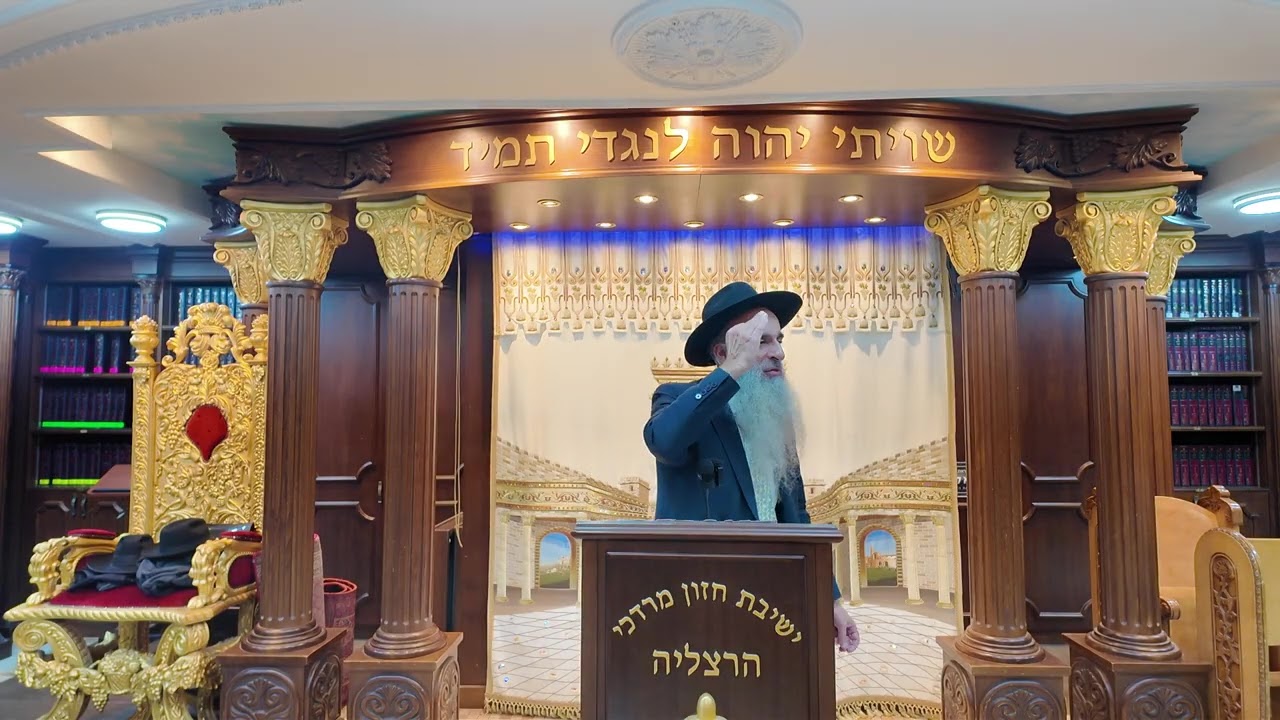

הרב מאיר דוד שמואלי - האוצר היומי סדר שע"ט
Etude de Torah Halakha
הרב מאיר דוד שמואלי שליט"א השיעור המרכזי של הרב מאיר דוד שמואלי שליט"א, הנמסר במוסדות התורה "חזון מרדכי" בהרצליה, ע"ש המקובל האלקי רבינו מרדכי שרעבי זצוק"ל. 🗓️ השיעור המרכזי נמסר בימי שני ורביעי בשעה תשע בלילה בישיבה בהרצליה. מטרת השיעורים היא להפיץ תורה תוך שימת דגש על מידות טובות ויראת שמיים. לתרומה לשותפות בפעילות הישיבה או לקבלת ייעוץ מהרב מאיר דוד שמואלי שליט"א: https://nedar.im/aDPy פרטי התקשרות: 📞 משרד: 03-778-1778 📧 דוא"ל: yhazonm@gmail.com
Extrait du cours
No, no, Mina said, I never drink tea, you should know. >> Oh, forgive me. >> Yes, I’m not a fan, I only drank it for you. Look across the way in the shop to see if they brought pomegranates, a crate of Israeli pomegranates. If they brought some, tell me, I will give you money. And don't spend your own money. If there aren't any, then don't bring any, it's not necessary. Because Rabbi Maor becoming a ger became a light to the world. You saw, he is learning with me. He finished 15 tractates. Do you understand? What is that? Where? Here? Soon we will have a Siyum HaShas. We will know what will be.
Transcription3492 mots
Transcription automatique — peut contenir des erreurs.
No, no, Mina said, I never drink tea, you should know. >> Oh, forgive me. >> Yes, I’m not a fan, I only drank it for you. Look across the way in the shop to see if they brought pomegranates, a crate of Israeli pomegranates.
If they brought some, tell me, I will give you money. And don't spend your own money. If there aren't any, then don't bring any, it's not necessary. Because Rabbi Maor becoming a ger became a light to the world.
You saw, he is learning with me. He finished 15 tractates. Do you understand? What is that?
Where? Here? Soon we will have a Siyum HaShas. We will know what will be.
This is how the healing of Alona Sarah needs to be. Dana Dina, daughter of, all the sick, all those in need. Moraz, whoever needs salvation will have salvation. Without a break.
May you have it, Rabbi, pray for us so that we too understand something in Kabbalah. Where? We don't understand anything. May the Living God bless you and keep you and increase your household.
Now she sends, uh, our father Jacob, and wheat, he sends, uh... Our father Jacob sends, uh... Jacob. And he told him, hear from his mother that she doesn't want your wheat.
He said to him, I heard they are not free-born women. He says, and there are...may He bless He will give you the blessing of Abraham and make you a great nation. Who is that? To Abraham, prophets.
David sent to Nabal, and Nabal guarded his flock. David, son of Jesse, today many slaves are breaking away. Each one from before his master. Pramina told him, to whom?
He comes from Ruth the Moabitess. Everyone knew that Samuel anointed him as king, everyone knew. And I took my bread and my water and my meat that I slaughtered...and gave it to the men whom I don't know where they are from. And David said to his men, gird on every man his sword.
Gird on every man his sword. His sword, and 400 men went up after him, after David, and 200 with the supplies. Abigail, Nabal's wife, answered one of the lads, saying. Why is this one rising up in rebellion against the kingdom?
Now we are in the second chapter, I want good things for you today. Do you see what we saw on Friday night, look. "And Abraham looked," Rashi writes, every instance of "looking" is an evil expression. Except for...
Rashi for us in Parshat Vayera. Go straight, last week's parsha. He says: giving to the poor turns the attribute of justice into the attribute of mercy. Oh, how beautiful, how beautiful.
He says you gave to the poor , you turned the attribute of justice over yourself into the attribute of mercy. Aye, aye, aye. You know, today, he told us yesterday, he told us today, that yesterday he told us, this is one that is written "and he appeared," and there are three men. So in the Midrash it says they were Arabs, in another Midrash it says they were angels, and in the Zohar it says it is Abraham, Isaac, and Jacob.
Everything that says Abraham, it appeared to Abraham; Isaac, everything that says the intention is kindness and strength. So one of the great preachers asked, he says, how can it be that there are angels or Arabs? How does that go together? He says that everything depends on the person's perspective.
And that was a lesson, I really enjoyed it. A person can see all of life, his whole life, like an Arab, all evil, all black , all bad. And a person can see his life , a life of angels. So is it angels or Arabs?
A person decides; however you speak, so it will be. A powerful verse: "Look down from Your holy habitation, from heaven." Rashi says every instance of "looking" implies judgment, as in looking down at the people of Sodom, except here, where giving to the poor turns the attribute of judgment into an attribute of mercy. So he explains: "Look down from Your holy habitation, from heaven," we have done what You decreed upon us, and You shall do what You promised us. "Look down from Your holy habitation, from heaven, bless Your people, Israel, Your sons and Your daughters, [for] the land we have given, it is permitted to give to cattle." Are you with me, friend?
We are on page 527. Good for you, Noam. Priestly service and the explanation of the Name to do so with things that are permissible for that reason, because of... Rabbi Eleazar says: >> Tractate Pesachim, page 57.
And I will add: Not for all things. I will pay for it, not from your money. Okay? Come take it.
Just bring an apple and we’ll share it with everyone. If it’s enough, it will be enough for everyone. Bring, bring one by one this. He told me here: Ours.
This says here: What, what has happened to us so far? So I am reading from the previous page, not here. Before that, it is written: And cabbage. There is another type of food, they call it*kefolot*.
And in the*Tannaitic* teaching: It implies not all the time. What is the meaning? Now I am reading the Gemara, and then we will understand the Gemara. I am on page: The Gemara says there are three conditions: do we give*Peah*(the corner of the field for the poor)?
What is the intention? A person who now planted turnips or cabbage. Must one leave some of it for the poor or not? The Gemara says, first of all, there are two conditions.
In the*Tannaitic*teaching it says: Rabbi Shimon says they truly give *Peah*to turnips and*kefolot*. Rabbi Yosef said: The*Tannaitic*teaching says Rabbi Yosef thinks not for turnips and* kefolot*. But rather for turnips and cabbage. The Gemara says: And Rabbi Shimon also thinks so.
What, what is that? He, as it were, added. It says: "Only here, what is the reason?" To the first one. He said turnips and added*kefolot*to it .
That is the meaning. What is the problem? Now, when you give , if you give*Peah*, *Peah*is exempt from tithing. You are feeding them untithed food.
You are making them stumble. There is no such thing. He said to them: He told them, "Do not take this.""I will bring, I will bring you tithed food."" What do you want from this?" He says, "No, because I am not stingy." Why? If you take this, you will do an act.
It turns out you are eating straw. Straw is, heaven forbid, they ask for straw. The Gemara asks: Why? Why did he promise double?
Certainly he did not intend any stinginess. We are in the middle section Because they didn't teach themselves that now he really... That he wants to get rid of them. No, I don’t want to get rid of them.
>> Bring two cups, bring there, bring two cups, pardon, empty. Of this. >> Bring one cup. Of cardboard.
Leave, leave that. Thank you very much. Blessed. The commentary says that they served on that day, that every watch...
Every paternal house gives... They were forceful people, taking them by force. That all the watches are present. Taking it equally.
And there are still great priests there who learn from them to be forceful. You say, "Not only today in the Knesset are there bugs." All the priests of the watches stood and sanctified themselves to Heaven. Because of this, the Temple's wealth increased; they said it took only a few days to cover the entire sanctuary with gold plates. A cubit by a cubit, the thickness of a gold coin; see what beauty there was.
What we are doing here is nothing. You fold the legs, and you place them on the altar in the house. A lesson. You have two cups here.
And there are no buckets in them. Dala. One by one, in His name, may He bless May He bless you with a good spouse. May He bless you, with God's help, with sons and daughters.
A full recovery for David ben Simcha. >> Amen. >> Thank you very much, let's make a mix of apple with >> No. No, no, each one separately.
>> Each one separately? >> After that, pour for whoever wants, let him have some. That's enough tzimmes there. Be blessed.
Succeed, take care, my dear. A light for one is a light for a hundred Tanna in Shaul says that Tzimmes is blessings. Thank you very much. Be blessed.
Now whoever wants, give it to them. Just ask yourself what you will reject. >> Yes, I want from the "Me'or" object. I see in your eyes that you want it.
>> In Me'or it rises. Where did you pass the priest? Hello. Hello, Priest, no, you didn't ask the priest if he wants.
Ask the priest. Well, come on. You have the righteous Rabbi here too. Coming out of the Tosefta.
Erase the Tivi. Come on, the Gentiles, we must give all the—all the— All the disgusting things. The haters of Israel. What is "Timur"?
No, the meaning of " Timur" in practice is that they didn't give, they didn't offer the sacrifices, so bad things happened in the houses. Heaven have mercy. Moving on. Another cry, a second warning cry.
This comes from Yissachar of Barkai, who respects himself but profanes the holy things of Heaven. Why? He would work with gloves. He performed work.
In the end, the King came and cut off his fingers. The third cry, a warning cry. Beautiful. That he himself was kosher.
His household were... A fourth cry. That he eats 300 calves. He raises many priests in his house.
The Queen said to him, she says, "What is this? I learned this many years ago, now I am just remembering it." So we were privileged, like Rabbi Meir, to review the Talmud. It's just that I told you, they cut off his fingers—may it not happen to you. The King said the goat meat is good.
The whole...who will tell the High Priest? They erred in one thing. He laughed a little laugh. The Queen said, "Not only did he not say it like me, he also laughed at me, so he has no place in the kingdom." The Queen heard, and he cut off his right hand.
Wicked people too. So he said to him, " Why are you cutting off hands?" Cursed wicked men. It is good that he received his punishment in this world. Many who repented.
In any case. If a lamb, he shall bring his offering. Do you know which lamb? Both are weighed as one.
Rabbi Nachman didn't even read the scripture. It is written: if a lamb , he is offering his offering. The truth is that goat meat is tough meat, and it's a wonder. Lamb meat is soft meat.
It's a wonder that he says the goat is better, perhaps in taste. Ah, blessed is the one who swats a fly. This fly is a bad thing. All the bad has left the Yeshiva.
For our adversary has come into our midst. Huh? There is nothing, what is there to take from it, songs. Whoever has studied more Torah than me, I respect him.
You have studied more Torah than I. He says that both are equal. That is what the Gemara writes. We nullify our opinion before the Rabbi , that is enough.
Sorry. Sorry for the bitul Torah I caused you. Who am I, what, nothing, there is nothing at all, tomorrow we will merit, God willing. Anyone else who wants to drink should drink.
Talmud Yerushalmi, friends. We are today, we are in the treasury. Today. At first they say: A person may gather wood, stones, and thorns from his own, not from his neighbor's.
And if it was the coarse, coarse [wood] of his master . They are transgressors, they want to improve the field during the Sabbatical year and say: "Yeah," as if to take wood . They ordained that whoever gathers from this one, gathers from that one, not as a favor and not for pay, to cut off their provisions. He said: Whoever comes to work for you in the field, do not give him food; if you give him food, he will do the things you want.
Gemara, we see in the law of the soul. At first they say: It is possible to take, to gather from within the field. This is how the Mishnah should be taught : At first they say a person may gather wood from not, gather from his neighbor's, whether thin or coarse. They were suspected of gathering thin [ branches] for themselves, they don't take coarse ones for us, therefore everyone should take from this one.
It is forbidden for the field owner to even take the coarse ones not as a favor , and this too, not as a favor; they were suspected of gathering as a favor. Now suddenly it starts to be the chest, you gather at my place and then: "Come come come," I will do for you and you will do for me, and everything is schemes. They say they gather not as a favor. They ordained that if they bring to gather in his neighbor's field, Rabbi Zeira said: The first, if you are fulfilled, if his burning was there, his burning that he wants to attain with wood, he gathers the coarse ones.
Therefore, if his burning was there, his wood, he gathers the coarse ones, Do [something] for the coarse ones, Clear everything. The Gemara says: There are two Mishnahs , one said: the coarse ones are permitted, and one says: forbidden. He who clears the field gives the stones >> Who is the pruner? Ttk Klg: The one who prunes the olives.
Regarding the lookout , it is permitted to cut one or two, from one tree, two trees from your row, in a bad person it is forbidden. Efk in the Moed, I found a Tanna: And cut the markers around from within the [gate] ... And time; but in the Moed, no; wait for the holiday to come and you will take. With stones, yes, it is found the Tanna : Even with stones.
If he wants to arrange the way or comes to the way in the way of baskets, the meaning is in the way of transgressions . Rabbi Yosef in the name of Rabbi Menachem; the name Menachem and Akiva said in the Shemita he works in a " smart" way, they keep Shemita. One said , one person, harlots, he told him not to forbid, he told him To make baskets out of them. He told him Shabbat month: All vessels of Except for the weight of the matter that they are not hung, that they are stuck.
So the pillars of the weaver, it is forbidden to carry them. Dates of a palm tree, slaves are a plug , how much is the intention of a matra All to sit on them, to arrange them. Small earthenware. Broken pottery of a barrel; the fragments are permitted, while a whole utensil is forbidden.
To bring into the synagogue. Soil that is [unfit] to be blessed is forbidden; it is permitted to bring in stones. If recorded, it is called. Terminal; form after form of clay.
If the situations are soft. There are remains of clothing that are forbidden to be handled. >> Regarding [spices], we recite a blessing over the fire. You see here he says " light," earlier he said...
You see here it is well punctuated. Well punctuated, we bless the light that comes out of the wood, from the stones. A furnace light, we recite a blessing over it. Made for illumination.
In the end, it was made to illuminate. A synagogue lamp: if an important person is there, we do not bless it as it was made to illuminate, and if no important person is there, we do bless it. Why? Made to illuminate, no.
When there is no important person, we bless, it was made for the honor of the Divine Presence. A soul that eats, we recite a blessing over it. Light that will not be common, it came out for the honor of the Divine Presence. We recite a blessing over the light of the deceased.
By day and by night we recite a blessing over it. During the day, we go before it , yes. For its honor, at night, we do not recite a blessing before it. The blind man wrote in his margins not to bless.
Why is it written? He doesn't say where he knows. Some say one must be careful. It is forbidden to wash in hot water because of the danger, or to bathe in a river.
How? In the public domain it is permitted to drip on his head, and one may wash his face on Shabbat, provided it doesn't leave the hair. It is permitted to wash a person with bran. Here, gentlemen, is a level everyone needs to know.
This is the source for soap. There is a responsum by Hacham Ovadia that it is permitted to use soap; soap on Shabbat is forbidden. What is its source? From here.
It is forbidden to wash hands with salt , and all the more so with lye. According to Binyamin Ze'ev or other opinions, and not the world. Hacham Ovadia brings evidence from here, bringing that it is not "born"[ prohibited]. He disagrees with this.
He brings evidence from other poskim. Lye is soap. And therefore Hacham Ovadia writes that if he is a doctor, certainly he is fine ; if he is not a doctor, he can also [ use it]. Ah, you do it this way.
Someone who asks if it is now Shabbat or not, you must ask him. Most people know it is Shabbat immediately. Most of Israel is forbidden so that he might eat. You call it a bag, where are you going?
As it is said, "I will give you the blessing of Abraham." What was the blessing of Abraham? That Abraham was blessed in everything, and this is the Torah portion of the week. Midrash Rabbah. This is one of the ten descents that mankind experienced.
Not the sons of Cham, but the son of the first man who was ungrateful, who said the woman...like that, two years. In all the land. It says how much time was the difference between the generation of the Flood and the generation of the Dispersion? Two years Already everyone rebelled against Hashem They are one nation, one language, and one truth at the opening of repentance.
A vineyard at the time it bears fruit, the owner of the fruit guards it. The Book of Zohar said: >> It was in cooperation, Heaven forbid, a lot of dispute, angels, cooperation. The holy angels, truly. And aspects.
Dispute in the world. Everything the Holy One, blessed be He, did. He made it like the body to the soul, so it is. Ah, Tikkunei Zohar.
Anyone who wants to taste. May Hashem grant the merit. For I am at the opening. This is the Lamentations of Jeremiah.
Friends. There are many messengers for the Place , listen Rabbi. There are messengers for the Almighty, for nothing can stop God from saving a person, even if they are in this department or that, He gives you the strength to live your life. No one keeps it in their heart, may God grant us the merit, thank God.
Everyone leans on their neighbor now, everyone is one, the Shepherd leads them all. How do the blind walk? Because one holds onto the other. So now, the blind might think there is someone in front of them who can see, but they all know they are blind.
So who is the one who sees? The first one, who is the Holy One, Blessed be He. Now that the Holy One, Blessed be He, leads us all as blind people, everyone... ...strength in their neighbor, because He is the Supreme Leader.
Now, whatever happens in the government , one must know everything is from the Holy One, Blessed be He. Like a blind man who sees, this was said , I walked as the blind. We were privileged, thanks to you, for two pages, it seems. We reached page 380, pages from the beginning.
Thanks to the Creator for granting us the merit to study two pages today. How much we must say thank you to Father, Father thank you, thank you to Father. By the merit of Rabbi Meir, by the merit of Rabbi, Rabbi, Rabbi.


