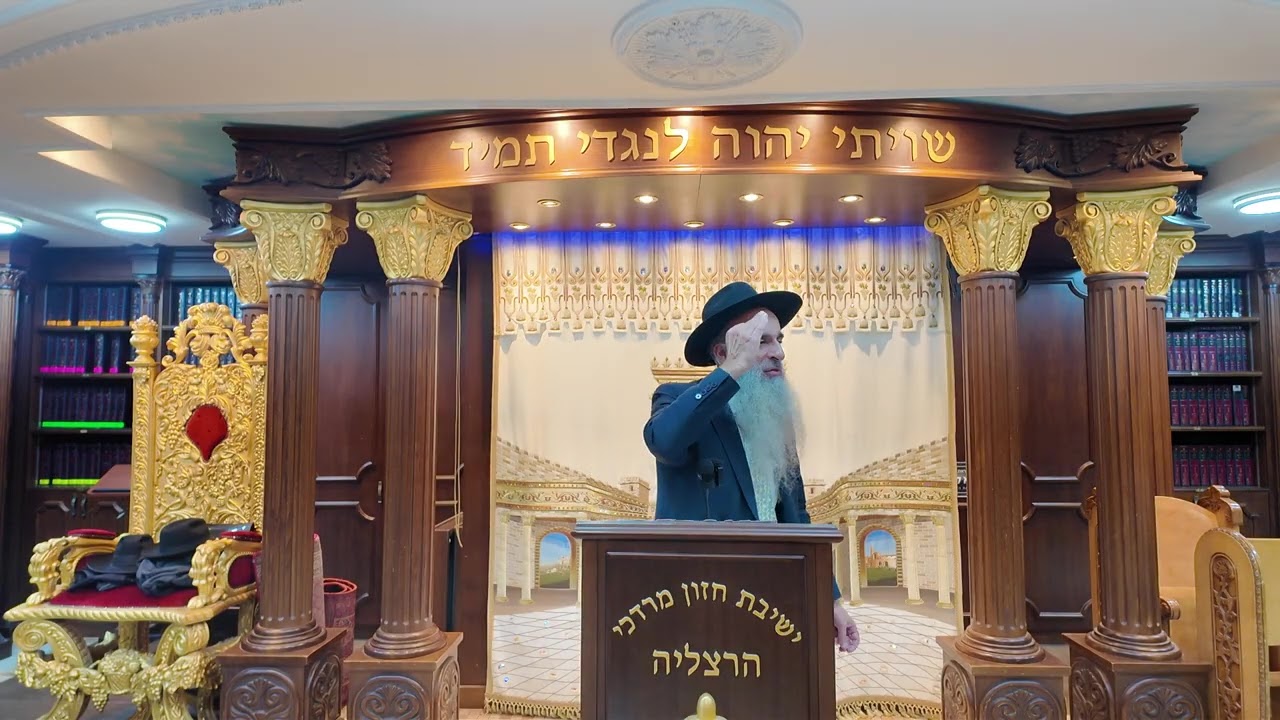

הרב מאיר דוד שמואלי - האוצר היומי סדר שע"ז
Etude de Torah Halakha
הרב מאיר דוד שמואלי שליט"א השיעור המרכזי של הרב מאיר דוד שמואלי שליט"א, הנמסר במוסדות התורה "חזון מרדכי" בהרצליה, ע"ש המקובל האלקי רבינו מרדכי שרעבי זצוק"ל. 🗓️ השיעור המרכזי נמסר בימי שני ורביעי בשעה תשע בלילה בישיבה בהרצליה. מטרת השיעורים היא להפיץ תורה תוך שימת דגש על מידות טובות ויראת שמיים. לתרומה לשותפות בפעילות הישיבה או לקבלת ייעוץ מהרב מאיר דוד שמואלי שליט"א: https://nedar.im/aDPy פרטי התקשרות: 📞 משרד: 03-778-1778 📧 דוא"ל: yhazonm@gmail.com
Extrait du cours
Now today you don’t have much time, Rabbi, we must do this. The Rabbi will take this carton, he wants to move apartments. And he will put this for him , the Rabbi, after the Rabbi, please forgive me for what the Rabbi is doing. We are on page, friends. Oh, oh Hananel. Page 55, order of Seder Zeraim. Order of Pesachim. And Isaac called to Jacob his son and commanded him and said to him: Do not take a wife for my son, do not take a wife from the daughters of Canaan.
Transcription7939 mots
Transcription automatique — peut contenir des erreurs.
Now today you don’t have much time, Rabbi, we must do this. The Rabbi will take this carton, he wants to move apartments. And he will put this for him , the Rabbi, after the Rabbi, please forgive me for what the Rabbi is doing. We are on page, friends.
Oh, oh Hananel. Page 55, order of Seder Zeraim. Order of Pesachim. And Isaac called to Jacob his son and commanded him and said to him: Do not take a wife for my son, do not take a wife from the daughters of Canaan.
Oh, oh, oh, everything we do is enough, don’t bring more, it's a pity. Even if you bring less, only if someone wants, you will put it. Everything we do is to raise the Shechinah, the redemption of our righteous Messiah speedily in our days, with David. Forgive the Rabbi.
No, no, he did it on purpose, put it aside for him. Page 492, 492. Welcome, welcome, may Hashem bless them . 492, also Rabbi Yehuda Nachat, thank you very much.
Everyone, also Rabbi Dan son of Violet, Tomer son of. , Omer son of Shoshana, Isaac from his name. >> Yosef son of Yosef son of Esther, may Hashem help him, Sarah daughter of Jacqueline, Ayala. Baruch son of Mira, Aaron son of Rina, son of Mazal, all the supporters and helpers; and Isaac called to Jacob and blessed him and commanded him, and said to him: Do not take for yourself a wife of the daughters of Canaan.
So it says here in 1 Samuel, chapter 25 And there was a man in Maon, his property in Carmel, and the man was very great, and he had 3,000 sheep and 1,000 goats. And he was shearing his sheep in Carmel. It says, and he went down perhaps by the way of the wilderness of Ein Gedi, and men go to Saul to count Samuel, he was afraid of Saul’s men. And we went from there to the wilderness of Paran.
And the name of the man was Nabal, as his name is, so he is, friends. Nabal, notice that it is the letters of Lavan, this is what the Ari writes. That he is the reincarnation of Lavan. And his wife’s name was Abigail.
And the woman was of good understanding , and the man was harsh and evil in his deeds. And he was Calebi, what is Calebi? Huh? Thank you very much.
Thank you very much . May you be strengthened, your honor. It says Calebi, and he was close to the family of David. I blessed.
And David heard. In the wilderness that Nabal was shearing, that he was shearing, that he was shearing. Nabal his sheep. David sent ten young men, David said to the young men, go to Carmel and tell Nabal that you should be in my name, for peace.
Tractate, Tractate Maaser Sheni, chapter 5. I have done according to all that You have commanded me, concerning the second tithe to the first, I can confess. I have not transgressed Your commandments and I have separated from it, neither from the untithed nor from the tithed, nor from the plucked to the plucked, nor from the detached, nor from the new to the old, nor from the old to the new, and I forgot, and I forgot to bless You, may Your name be remembered forever. We are in the Gemara, friends, 494, Tractate Pesachim.
Any place where there are Torah scholars , they are exempt. What is the meaning in a place that. Tisha B'Av, things like that. Rabbi Shimon ben Gamliel said that a person should always make himself a Torah scholar.
The Gemara house. How do you act like a Torah scholar? How is a bridegroom exempt from the recitation of the Shema on the first night. If a bridegroom wants to recite the Shema on the first night, he may recite it.
From whom, from whom do the Sages say this? Not everyone who wants to come and trick Hashem, but now it is the exact opposite now. Rabbi Yochanan said to change the method It will never be turned, and there is no contradiction. Now, on Tisha B'Av, a person should not just be idle from work.
And why do they recite the Shema? The bridegroom also recites it. It doesn't look like arrogance; the custom of the world doesn't change. Rabbi Shimon Gamliel, Rabbi Shimon, it's not a difficulty.
The reason regarding the recitation of Shema is as he says, And we know that he cannot concentrate; it appears that >> Mishnah, friends. 894 D, Mishnah. The Sages say: In Judea, they perform labor on the eve of Passover until midday; in the Galilee, they do not perform any labor at all. So everything we are doing here tonight, friends, For all the deceased, especially also Neta bat Carmela, this poor woman who committed suicide.
May we not know of such things, she passed away today. The Psalms we are reciting, may she have an atonement in heaven. May the people of Israel not commit suicide, may they not take their own lives. A poor soldier This learning brings good influences in heaven so there will be great protection for the world of Torah.
All these wicked ones, all their 19 mandates should be sent to perdition, with God's help. This is the power of unity. They will unite. Apparently, if we don't unite, it is coming our way.
Apparently so. The Sages say: In Judea, they perform labor on the eve of Passover until midday; in the Galilee, they do not perform any at all. The Gemara says tonight, of the light of the 14th, in nine days they perform labor in ... The Gemara says...
The custom of the place where they have the custom. At the end, it teaches a language of prohibition. Rabbi Yochanan said: It is not a difficulty, Rabbi Meir... Custom, said Rabbi Yehuda, may you be privileged to perform commandments.
Blessed is my mouth, [my] answering, [ my] counting. Abundance. Good blessing. >> This is said here on page 894, in the middle column.
Yehuda says... If you say... Why would you plant it in Nisan? >> Rabba said: Why, why did Rabbi Yehuda not permit weeding in the Galilee?
That we... That the House of Hillel permits. Why do you say 14? Rav Sheishet said: Like the House of Shammai, who forbid.
Rabba who said: Actually, even like the House of Hillel, as it is not the way of people to weed at night. Rabbi Natan said: No, Rabbi Yehuda...And it is not forbidden due to the prohibition of performing labor. And three, one, we say a part of the day is like the whole of it. Tzari, we do not say a part of the day is like the whole of it.
Mishnah: Rabbi Meir says any labor that you begin... And he shall not begin at first on the 14th, even though he can finish it; they perform labor and the eve of Passover Rabbi Yehuda says, Rabbi Yosef bar Yehuda says: Even the cobblers perform labor. Friends, we are in the Gemara. Gemara 894 D, in the third column in the middle.
We are, friends, 894 Z. Masechet Pesachim, page 55, page B; Masechet, page 55, page B. The Gemara says: When does he finish it ? On the eve of Passover, before Passover; he should not begin before Passover, to begin on the eve of Passover, even a small trimming for the needs of the festival, [but] not for non-needs of the festival.
The Gemara says: No. It is permitted to finish, but not to begin. It is taught that Rabbi Meir says : Any labor that is for the needs of the festival, he finishes on the eve of Passover; [if it is] not for the needs of the festival, it is forbidden. Specifically in a place where they have the custom; in a place where they have not the custom, they do not perform labor.
For the needs of the festival, they finish; not for the needs of the festival, no—derive from this. It is different...Mishnah: The Sages say three ...it is permitted to perform in them ...as they are...also permitted to sew in his customary way during the festival . Barbers and laundry workers...as he who comes from the state...in the state ...during the festival they cut hair... on every day of the festival.
Yosef bar Yehuda says: Cobblers...as for the festival...they fix...during the festival. And what are they arguing about, Rabbi Yosef? In the work of a scribe, they learn from the beginning of the work to the end of the work; he holds that we the end of the work, therefore, they are forbidden. Mishnah, friends.
Page 497, we place chickens for incubation in Nissan, because it is permitted to place eggs under chickens. Yes, a chicken that was sitting on eggs and ran away, we return it. And then we seat it back underneath, we clear it from under the heaps of work, the heaps of the animal, on the day of incubation in Nissan. But on the intermediate days of the festival, it is only permitted to move them to the side; we take vessels from the craftsman's house on the fourteenth of Nissan.
From the craftsman's house, sorry, and so we bring them because they are not needed for the festival; we are on the page in the middle column. Gemara: A chicken that ran away, we return it; to seat it, it is certainly permitted to return it. The Gemara says: What is at the end? Chickens of the intermediate days of the festival are stricter.
That it is forbidden to seat the chicken initially, but if it was sitting and ran away, it is permitted. What is written in the Mishnah that it is permitted to... >> It is still possible to turn around. But if three days have passed, the eggs have rolled.
There is nothing to do; three days of incubation have passed, the wise man says it dies and it will not return to the eggs. He said a statement: three days of incubation. The eggs have already changed a little. The Gemara has a difficulty.
And after that, it is written that it is in the stable in the courtyard. So how is that? It contradicts itself; why do you remove them? We do not remove them.
Here it is throughout the intermediate days of the festival. So we remove it for incubation. We are on page 497, friends. 497, we bring in the left column, yes, the left one, we bring vessels from the craftsman's house.
We bring, we bring vessels from the But it is written, we do not bring all vessels except from the craftsman's house, unless one is afraid they might be stolen, and then move them to another courtyard; the Gemara: it is not a difficulty, and on the fourteenth of Nissan, throughout the intermediate days of the festival. >> Not of the festival, only if you are afraid they will be stolen. He will sell them in the meantime to be free. It is not permitted to return to someone else if you do not trust him.
Wool to the dyer and vessels to the craftsman. And if the craftsman has nothing to eat , give him his wages. If you do not trust him, place them in the house adjacent to him. The Gemara has a difficulty again: is it not forbidden to bring vessels?
What are you saying, we bring vessels to the craftsman? The Gemara says they bring. Three things are not suspected for a person. Three are not suspected for a person; three things that are not suspected for a person, they bring vessels.
Vessels all day and recite the Shema and reap and stack the new grain before the Omer. We are not concerned that a person might come and eat from them. Three things we are not suspicious of. What are they?
They permit benefiting from the clippings of the holiness of the side. Friends, Rabbi Amir Habesh said that you came today also to the tomb of our teacher. Talmud Yerushalmi, tractate, chapter 3. Mishnah: stones that the plow shook, we already see this.
Now, the Seventh Year (Shmita), if you come to clear stones, they fear you are coming to plow. Or that stones. Are already moved. Why?
You want them for building. He clears his field, he removes stones from the field, he gives pleasures, behaviors in the land. Therefore, a grain of flint, stones of a pile, stones of a pile, he gives If a rock was hit, these are not; the Gemara says it is not just that the plow shook them. Even a plow that is destined to shake them.
Yaakov, Rabbi Bun, in the name of Rabbi Yitzhak, says: this means that it is forbidden to collect flint from a neighbor's field because of theft. Why? Because the field owner benefits from them. And since there was a cleaner there, a stone cleaner.
Its land is cracked. In the rocky mountains, there is an abundance of stones, and it is good now that he has plenty of soil and stones. He wants someone to take the stones. The Gemara says one may not build steps in a sloped valley; have you seen terraces?
Today, we call them terraces in Hebrew. If you have seen in the mountains that they make something like a wall, then another wall again. Why? Since the mountain is sloped, it is impossible to sow there.
So they build a wall, and then it becomes straight and they can sow. After that, they build another wall , and this is called terraces. This is called in the language of the Gemara, once in the time of the Jerusalem Talmud , they call it steps. Why?
If you notice , it looks like steps. These are not real steps; they are steps just for sowing. It is forbidden to build this on the eve of Shavuot, yes, when the rains have ceased. It asks, why?
Because he is preparing it so he can irrigate his field for the Sabbatical year. It says they used to do this after the rains ended, so those who go down for water will not slip. And some say it is forbidden to build not because of what I said today—that they do it for sowing—but he does it so they won't slip. Apparently, it was a steep mountain.
And because he is preparing it, why? He can irrigate his field for the Sabbatical year. He should not support it with lime when building the steps, as that is a partition. It is allowed to place stone upon stone without mortar.
This is Rabbi Crispa in the name of Rabbi Yochanan, Hanani ben Gamliel, concerning the prohibition of two periods with mortar. What is the meaning? The Mishnah says it is forbidden to work in the Sabbatical year; in an orchard, one may plow until Shavuot, but it is permitted to work until just before Rosh Hashanah. >> Do you want a book, my dear?
I am listening. Listening is like reading. Not regarding the prohibition of the periods. And here regarding the prohibition of two periods.
Who is it? Who is that? Rabbi Shimon, when he says if it is the prohibition of two periods , in my opinion, it is not written explicitly that plowing is permitted while building is forbidden. So how does the Mishnah permit plowing in the Sabbatical year?
Rather, it is the permission of two periods. The permission of two periods means it is not speaking about the Sabbatical year itself. But rather before the Sabbatical year. Yes, it was truly permitted to plow until the eve of the Sabbatical year.
Plowing is permitted, but building is forbidden. The Gemara asks, how can that be? Plowing is worse . How is it permitted?
Rabbi Mana said correctly, Rabbi Shimon said that plowing is permitted because it is still the Sabbatical year. He plows in the summer at the end of the seventh year, but building is forbidden When did he say that? Yes, but he builds during the Sabbatical year when the rains have ceased. When did he teach that he is building?
Good, the Tosefta: Rabbi Shimon ben Elazar says orphans who were supported by a homeowner... Orphans who are raised by a homeowner, it is permitted for this homeowner to tithe their food. For the repair of the world. And so he used to say.
The world. Rambam: Fruits that are forbidden to eat , all fruits that are not tithed are not obligated by Rabbinic law, or first tithe that was not given. Or Terumah and second tithe that were not set aside according to the law, it is forbidden to give them on the Sabbath , but yes, second tithe to give a fifth. Terumah is now fit for a Kohen; thus, you give the Terumat Ma'aser from the pure, and they have it in one vessel, and these are the words, t, t, k, friends.
If the pure was below, the fruits are moved on the ground. He does not move them with this, but if there were scattered nuts, he moves the vessels from the pure. Therefore, more by hand, one needs, instead of the vessel, to take it how a row of stones that they learned is permitted, for tomorrow a Mincha is forbidden. The responsa that the Maran told me regarding Shabbat to the Yeshiva.
You have stones, you want to turn it into a chair, you are permitted to move it on Shabbat. Regarding the bed, this is what you learned, Amir, here: do not move Muktzeh by hand; I say with one's body, as Rabbi Amir taught us, that it is permitted to move it, or, blessed is Rabbi Yaakov, may the merit of Rabbi Sharabi protect you, elder of Eshet Chayim, said Rabbi Yaakov Ben Sofia. So what they taught us here, friends, is that this is called "moving with one's body."
This is permitted for any Muktzeh in the world, even for a permitted need . But if a person uses another tool, now I take this for example a cup, and I have Muktzeh here, and I want to move the Muktzeh with the cup, even though ostensibly it is another tool and I am not touching it, it is forbidden.
To move Muktzeh. But if I do like this, friends, it is permitted. And it is best that you do it this way. So, any Muktzeh may be moved in such a manner.
You have no problem moving it. Unless, G-d forbid, I see that Shabbat is being violated, then it is forbidden. Know that moving with one's body is the easiest thing in the world. Now for example, a person is walking, Yaakov is walking outside, he sees $ 1,000 lying in the street, he is allowed to kick it like a soccer ball, bring it to the Yeshiva, put it under the...
And I can take it for myself on Shabbat ; there is no problem with that. With your foot, you are permitted to move it , just as long as there is an Eruv, of course. Needed in order to extinguish it, because I am bringing it in; perhaps there is a Rabbinic prohibition. If there is an Eruv like this, there is no problem.
Regarding this, many people do not pay attention, and we saw this in 312 at the end, many people do not pay attention to this distinction. Between moving with one's body and moving with another tool; logically, ostensibly, using another tool is easier because I am not touching the Muktzeh, it is touching it. Moving with one's body, my hand is touching the Muktzeh. Ostensibly, we should be strict about it.
Not so. L'chatchila, moving with one's body is easier than moving with a tool; for example, now you have a book. You want to take the book, there is a cassette there, a machine, a phone, all sorts of things. You move it, you move it—it is forbidden because I am taking a book.
This is called "moving from the side for the sake of a permitted item." It is permitted to take a book. This is permitted. May Hashem grant us merit. >> Amen.
>> It was hit on the bed; one should not shake it with his hand, but with his body. Animal feed is permitted. Who is on it like a judge, to him, why? You prepared it, now you want to lie on it.
Putting a container of ash inside it. I mean, far be it from you and your loved ones, if oil spills on the road or things like that, it is permitted to take ash, which is muktzah, and sprinkle it on it. Why? Danger to life.
Certainly, it is permitted. When the Master warns a person, things like that, things that are not I don't know what. A matter that is a danger, certainly. Once, I was driving on Shabbat and saw oil spilled on the road, I called the [ emergency] center, which led them to call the municipality.
To the municipality, so they would be notified that a lot of oil was spilled on the road. Why? Anyone walking there would slip; it’s a danger to life. So it is permitted to violate Shabbat for that.
Another thing, the Rambam writes it is forbidden to render a vessel useless, or to place a vessel under a lamp on Shabbat; it is also a debate whether it is "destroying" or "rendering a vessel useless," which is something else. Do not place a vessel under—the Rambam writes that it is "destroying," that it is like building, it is forbidden. Therefore, anything like that, one should not place a vessel under a hen to catch her egg; rather, one takes the vessel and turns it upside down over her , and does not put the vessel there so she will lay in it. Why?
This egg is muktzah. If she lays it for you, you are rendering the vessel useless; turn the vessel upside down over her. Something that is forbidden to give him, friends, the Arba'ah Turim says, Maran... ...concerning Motzaei Shabbat, the laws of the Havdalah blessing.
One recites a blessing over the spices. Why do we recite a blessing over the spices? Because it is difficult for the soul that now it is Motzaei Shabbat. Now pay attention, friends, tomorrow Shabbat comes in quickly.
Four, four-thirty it is already in. It’s very hard to light [candles]. Shabbat goes out very quickly. Shabbat goes out very quickly.
At 5:30, when is sunset? Five, right? >> Yes. >> Five is sunset.
>> Yes, yes, yes. >> Ten to five, right. Ten to five, 5:30 is already Motzaei Shabbat. If one is strict like Rabbeinu Tam, it is six.
How six? Six and a few minutes. A person now went home, spoke to his wife, did the dishes, did this, put the kids to bed, ate, drank, how much time did it take him? An hour, two hours, tops—at a slow pace , it took him two and a half hours.
At the very most, the poor guy, in Yiddish, it took him three hours. Meaning, six, seven, eight. What are you doing until 12 at night? Until midnight.
But someone who is a bit quick, an hour and he finished everything. So at seven he finished. 7:30 tops, gave his wife another half-hour at home so they look at each other instead of looking at the picture You have eight, nine, ten. Eleven, you have four hours.
How much is all of Motzaei Shabbat? Four hours. How much Torah can one manage to learn? Therefore, on the contrary, Rav Tomer, has the group arrived, no?
Are there no groups in the winter? >> Let the Rabbi announce it. >> That’s it, I have announced it, now I am announcing it. Great, now we have announced it.
So that is... But we have now decided that we are not doing it later. Immediately on Motzaei Shabbat. All right?
No, you barely did it afterwards. But now they won't come, why do it? You did it last year and they didn't come, because Shlomi already did the vegetables there and development was done there, so they didn't come. Did you forget that you told me it's better to do it after Arvit?
>> Yes, we did it after Arvit and then we were really... >> There were just a few more left. You will do it twice, do it after Arvit, whoever wants will come after Arvit too There will be two shifts, the main thing you need to do is start getting the Rabbanit used to it at home, you need to have a Kollel session here on Saturday night. Even if you have to pay for it, for the Kollel.
You must study in the Kollel. Take Baruch for example, he has already taken upon himself Harish. When he goes to the study hall he learns , he'll tell his wife, the Rabbi said, the Rabbi said, you want salvation? You want a living?
You don't want trouble? You don't want this? For sure. What did the Rabbi say?
The Rabbi said to study on Saturday night for two hours straight Two hours straight, what? Start putting in two hours straight here , for sure. What? A bit of Kabbalah.
A bit of Kabbalah? What Baruch? Baruch, yes, Rabbi Baruch, forgive me for the honor of the Torah, Rabbi Baruch, Rabbi Baruch, yes, forgive me for the honor of the Torah, forgive me from the Torah, it's forbidden. What, how will you let him go work now on Saturday night?
That's right Rabbi, it's Rabbi Siboni, you sit in Bnei Brak. Sit there and study, you're in Harish, ah. Shabbat is Shabbat, Rabbi Sharabi, Rabbi Yehuda decided he was helping me, look at all the Rabbis, wisdom, Rabbi Sharabi on Saturday nights in the winter would teach us for two hours. Sitting for two hours, he would teach for two hours.
So how can we not learn from them? Rabbi Sharabi on Friday night, on Friday , I used to accompany him. For a year or two, I was about 10 years old. At 3:00, hurry, hurry at the Talmud Torah and he tells you, hurry, wait for the Rabbi behind the door.
Don't let the Rabbi go up alone. And then the Rabbanit sees, Meir arrived And then the Rabbi comes out, takes hold here. The Rabbi always had a custom. He doesn't walk like this.
He doesn't walk like this. He always holds someone's hand. Holding the robe with one hand so it doesn't get dirty. And with one hand he holds us.
And that's how he would walk. >> Studying Zohar. >> There never were any. >> Zohar on Shabbat?
>> Zohar is studied in most places. Here with us, the Rabbi would teach Intentions (Kavanah). Rabbi, Rabbi, they do Reshit Chochmah, forgive me for his honor. They do Reshit Chochmah.
And after that, they would study Intentions . My father had a two-hour class on Saturday night. Yes. So on Friday afternoon the Rabbi was already early, and by 3:00 the Rabbi was already in the Yeshiva in...If he did the delay on Thursday, then he would tell the Rabbanit.
That on Friday there is nothing left to do. Only a little rest, a little...A little taste and he sat, and after that he would study Torah. After the night on Thursday, it's easy. Not difficult.
Maran says in sign 297, ah? Rabbi Sharabi, he never slept at night. He would sleep half an hour every night His whole day was about half an hour. The Rabbi was very spiritual.
They used to say two hours, but there are versions of half an hour too. He was very young. He would do penance for himself, for the sake of the people of Israel, he would weep. There is a prayer book, they found his prayer book called Ben Ya'or.
Ben Ya'or is not Benayahu, it is Benayahu, the name Benayahu the son of Adam. That is the name from the Ben Ish Hai. It is all unifications and intentions. There are no pages.
All the pages are stained with tears. All stained with tears. He performs many unifications on the prayers and the morning penance. He would wake up early and go up to teach a lesson, then he would stay until about 11:00 or 12:00.
After that, he would receive the public until noon. Eat something small, and then perhaps rest a bit, rest at noon. What will be with that now? Thank you May God bless you.
Thank you very much for all that you do After that they study, the Rabbi comes at 3:00 or 4:00 until 9:00 in the evening. They study Mincha and Maariv. The whole night it was like that. At 9:00 they go home.
At 3:00 or 4:00, or already at 2:00 or 3:00, everyone is already up. Mikveh, intentions, unifications, and prayer. At 8:00 or 9:00 in the morning, the kabbalists leave. When the sunrise was early.
Everyone studies a chapter of Rambam, they study Tur Beit Yosef with the Rabbi Everyone studies the Chok LeYisrael together with the Rabbi, then they go to work. Only then. They go to the station for two or three hours and that's it. >> Rabbi Sharabi has, I heard a short lesson of his on a part.
>> And they made a sanctuary. All of this lesson. >> This. >> All of this lesson is recorded in the book Beit HaKnesset KeHilchata by Meir Dabi.
Not Kedushat Beit HaKnesset, Beit HaKnesset BeHalacha, at the end I wrote it and I also wrote more very beautiful connecting words. >> There isn't anything else from the Rabbi >> There is, there is an emphasis, there is another part there, Simchat Beit HaShoeiva. >> Yes, Simchat Beit HaShoeiva. >> Certainly.
There is someone who recorded all his Kabbalah, but that cursed donkey , that fool, did not want to give the recording. It seems everything disappeared. >> Where is everything? >> It disappeared, it seems to me.
May God help that it be found. May God help that it be found. Here. >> Is this the Rabbi?
>> Huh? >> Put this, is someone looking for it? >> They went to his house, he has been missing for decades now. I remember he used to record the Rabbi.
>> Is that person alive? >> No, he passed away decades ago, we don't know where it is. We don't know where, he was an American Soon we will see his face, I heard many lessons from him on Kabbalah, not just in understanding. I would just sit and see that he didn't have any book on the table.
Everything was by heart, the entire Torah by heart. Correcting, explaining, everything, no, no books. The Rabbi never used a book. Not Ben Ish Hai, no book was before him Everything by heart.
All the books by heart. He corrects you, he explains to you, he never gets confused. He knows when you make a small mistake, he immediately points it out. Certainly.
Everything, the whole, whole world before his eyes. He sees you, he knows exactly what your tikkun is, what your reincarnation is, how many times you’ve been in the world. Who you are, what you are, what you will be in a few years, he knows everything about you. He is a real X-ray.
He knows everything forwards and backwards. They say he would catch you, take your soul out while you’re fully grown, keep you alive, talk to your soul , and return it to you. He doesn’t just do corrections for you, he does everything. It’s frightening.
He would fix things at the root; that’s why today people end up with illnesses. He would enter the root , fix it at the root, and the person would be healed. My son was sick when he was a baby, he came to our house. He performed some kind of intentions for him, and after that, he didn’t feel well again, so he said, "I have already fixed you, that’s it, you don’t need more." Something like that.
There is no understanding that. May his merit protect you all. >> With you is Yitzhak Gaja today. Nine years ago, someone told me I was missing a part in my body to have children.
Visit the Rabbi’s grave; he can bring salvation. Within 24 hours, his wife was blessed. And we came in today and I told people, there was a man there, I didn't know he had called and asked for the request. He says, "That’s me." And I asked for the other uncle.
And it’s true, I said within two days. He told me, "Within..." He tells me, "I also made a feast in honor of the Rabbi’s hillula afterwards, and thanks to that I was also saved," he says, " also within 24 hours." >> But Ovadia said about him, "One in a generation." He said there was no one like him in Kabbalah in all the recent generations. >> He told my brother that in our generation he is one in a generation. He has no equal.
Peretz told me he would see him studying with the Rabbi. It is known they studied every Friday. The Rabbi also guided him spiritually so it wouldn't just be Kabbalah. He gave him a lot of spiritual guidance .
Tension. One does not recite a blessing over the spices of gentiles. I didn’t know that, I’d be happy for something that says Shabbat is not broken under the myrtle leaves. Some say the reason is because it was used for the mitzvah of the lulav.
Used for one mitzvah. I recite a blessing on myrtle, the kind that is dry, and we use the fragrant one . A small glass, look what he says, did you see? From a small glass, and it comes from spices, and he doesn't recite a blessing.
What is myrtle? Which myrtle? They didn't have myrtles in Ashkenaz. It refers to dried myrtles.
That is the intent. He wrote. And a blessing in vain. He can exempt his household members.
Thank you very much, Rabbi M. Simon. Just in shock. Just for his house.
What is the primary obligation? Shulchan Aruch, friends, Chapter 320. Even an Israeli. It is permitted.
Bring something to clean. Moving on. Even if the floor got dirty, clean it. And do not let it be like that.
Someone will help him if he needs help. He will take it, take it, says Maran, take it, the elders need their animal and do not know it. That is standing in front. To stand them there is forbidden.
To stand it there is forbidden, lest he take muktzah in his hand, if he knows it , it is forbidden. Anything. There is no partition, it is permitted. It is possible to increase candles.
Speak, lamb, to that lamb. He said yes. Now they got 19 mandates, may He ruin who the will is. The will of Israel.
Yes. He will take, you will arise. Israel should not protest by his hand, once an hour, it is forbidden. Segoy on Shabbat, a coffin, a grave for himself, and thus many will disappear to his grave.
Where will they bury? In hell. It is permitted for Israel. Day of Purim.
Israel does not know. >> The Zohar book says that the Holy One, blessed be He, created for man. Amen. >> Come, Noah.
Strong. A broken hot adult, age 50, 60, started with wine, his wife kicked him out of the house, his wife kicked him out of the house, why? A person has a rabbi, he is the conduct of the place. All right.
Yes, was he here? >> He was. >> Don't walk around here, I didn't say anything. Not with perfumes, crazy is he who touches perfumes, crazy.
It is forbidden to touch those things. Good. We don't touch perfumes. What if you know how much here?
One called me, a mother called me with her worry. People are getting divorced. How many bad things come from this. Seven of the womb.
It says Noah was a righteous man, how did he become "bar minan"? And that is because he started drinking wine. He ascended to his first degree. Abraham begat Isaac.
Friends, be sanctified, be sanctified. Isaac said, do not call them "duda'im"( mandrake), but "dudim"(beloveds). This is the body and the soul which are beloveds and friends. They are truly beloveds.
Out of love in the world. Beloveds, friends, and not their openings, they are all the garments, but openings of heaven. Souls, garments. Old garments.
Everyone is destined to descend at once How many times I thought, I am with Rabbi Sharabi, suddenly there will be the resurrection of the dead. What a mess there will be there. Suddenly all the dead will rise and ask me, tell me, where are we? How do we walk?
How do we come? You have to accompany hundreds of dead, thousands of dead, imagine what that is. That every moment you look back so they won't grab you suddenly. How will you know?
Therefore, it is not worth being there at night. Always, the resurrection of the dead at night will be very scary. Suddenly you will see white people rising from that, forcing and scaring. And you are forbidden to travel here at night anymore.
There was one kabbalist among the kabbalists who entered after Rabbi Sharabi passed away and became a real madman. Everyone really saw an evil spirit enter him at the cemetery. >> If they force us to go to the cemetery, does it protect against something? >> Rabbi Ben-Eliyahu told me it is forbidden to travel at all, even with a congregation, unless, with all due respect, someone passed away and is being buried, what will they do?
Heaven forbid. At night? If it is family and it is required for his honor. But even when going for family, one should immerse in a mikvah before that.
Don't leave the external, what? What for example, what is a "temporary need"? Of course it is allowed. And not for those who blemish the covenant, he who blemishes the covenant does not go there Also not all types of souls, there are souls that they stick to them very much.
It depends on the types. But always also know, sir, even for a temporary need it lowers you spiritually It harms the spirituality of the person Now, because this is our rabbi, this is Rabbi Sharabi, so we go. Also, all those buried there are righteous people. They are not harmful.
A person should be careful. >> Are all the people on this mountain righteous, Rabbi? >> Where Rabbi Sharabi is, all those from our neighborhoods, those are Kurds who lived together with us. They were all pious.
They were working homeowners, but they were pious. Those who made Aliyah from abroad were And working, but they were pious. They were pious and men of action. Yosef, are there a couple more Sabbaths ?
>> Are there more cookies for a few more Sabbaths? >> There are two more. That are being served. >> Thank you very much.
May you be strengthened. Thank you very much to the Rabbi. The Rabbi should just mention all the names there. >> Yes, we remembered them.
>> Thank you very much for the Torah. A holy body, an old man there. That we learned, Rabbi Yehuda says three companies of ministering angels every month, every month of the year, hear your place of honor. Therefore, those who now want to go to Rabbi Sharabi tomorrow, know to go before midnight.
After midnight, the souls are already in heaven. Someone told me from here, "Rabbi, I am going with my wife at 12:00," someone said, "He is not there anymore." He is not there at those hours, but his Torah is there. How do they go on the Sabbath, Rabbi Ovadia? To Rabbi Shimon Bar Yochai.
He is not there [in person]. The fact that his Torah is there, something he learned in his life, it is in the air. And that helps for the acceptance of prayers. >> Don't be at Rabbi Shimon's alone.
>> Why? There is never a time at Rabbi Shimon's where you are alone, our Rabbi. Except for Corona or... Even during Corona there was...
>> I was stuck there one day, even during Hanukkah in Corona. >> And there were people there. >> Of course, Rabbi Shimon is all the time >> There were three or four people there. >> The Baba Sali.
He came to Gii-Rain, almost no people. It pained him greatly, he prayed to God that this place would have people there all the time. By the merit of the Baba Sali. He says he started to pray, buses started to arrive that were passing through Meron, they just happened to feel like stopping.
Whole buses. By the merit of Rabbi Israel who brought that about. And there is tremendous holiness, know, at King David, peace be upon him. David's grave, we don't know where the grave is, but the whole area is holy.
It is worthwhile that if a person wants , just once... Whether it's a Friday or a day without study, to go there. There is a great presence of the Shechinah there. I would always go at midnight after I would go from here to there.
Now I cannot, but whoever can, it is something special. Also the grave of Rabbi Akiva is very strong. With a lot of power. And still Rabbi Shimon is beyond question.
It says in T.T. 485. >> It says: Just don't talk there. My friend, okay?
In "Torat Chesed". It would be appropriate to always innovate new insights, Because one does not know what to ask for. Where were you, Yosef? Friends, open to page 497, "Orchot Tzadikim", the Gate of Trust: He who believes in his God and trusts in Him...
Will not fear man, will not fear bad things from neighbors, a little from the west, a little from the south, a little from hell, there is no one who can cause harm. Why? That we should merit and we will merit trust? And the greatest gift in creation is trust.
>> I trust in God, and this trust does not let me be swayed by the things of the world into sinning. Don't worry, what will I do here? God will provide for him . First, know that God has more compassion for man than any other.
He watches over him in secret when he does not guard himself. He keeps him. Everything comes from Him, blessed is He , for there is no such thing as father, mother, grandfather, grandmother, uncle , aunt. Who gives the compassion?
Not your father. The Holy One, blessed is He , puts the compassion in your father's heart toward you. Everything is only the Holy One, blessed is He. Next.
Lastly, tell the rabbis there isn't here The work of Solomon. Third thought: know that all goodness is by the grace of God. Not that he is worthy of it. The Holy One, blessed is He, treats him well.
Fourth thing, know that there is no That His matters have no limit or end. No person can subtract or do anything against what is decreed. Now a government will come and say, "Oh , you didn't vote for me, I'll show you what that's like." You don't need to fear me. What you actually need, you will receive .
From your place they will answer you. From your place they will call you. Third, know that everything he receives is the grace of God. The Holy One, blessed is He, owes us nothing.
Everything is the grace of God Fourth, know that all His matters have no limit or end. No one can take anything away from him. He says third, know that all his goods are by the grace of God. Not that he is worthy of it.
Not that the Holy One, blessed is He, needs him. It is by grace. Fourth, know that all His affairs have no limit or end; no person can add or subtract from what is decreed for him. Now, no one can come and take anything from him.
Now, someone took—here, I found out from someone that a guy took 4,000 shekels in donations from one of the people here. 4,000, I questioned him. Why? I see them talking and I investigate.
What did he say to you? What is this? What is this? He tells him, "Someone gave it to me here." I told him, "Listen, we are in such large debt here, look, 100,000 just recorded." How could you do such a thing?
Why do that? That is why I told Rabbi Tomer today to speak about it. Did Tomer speak about it today? Huh?
It's not nice, it's not pleasant. Also, let everyone try to be—they are doing a Hillula for Rabbi Sharabi now. This Rabbi Sharabi is the father of this place. How much he prays for us, how can one not be at his Hillula?
Not to honor him. We must honor him. We need to be united. It's hard for a person, I understand.
Go at noon, return in the evening. It's hard for your wife. Even I had to be here today to help them with the fundraising. I was with the Kabbalists until almost 10.
I was here at 7:30 after all the classes , the three classes before that. It's a privilege, a privilege—a person says, "Do you think I did someone a favor?" I did myself a favor. Helping the Rabbi, certainly. We need to always be in unity.
This is a person from Harish, not everyone can come, that's fine. Those who are here in the area, why not? Know that it also says another thing, it says in "Orchot Tzadikim"(Ways of the Righteous), be careful to be wise. It says that one man is great, one man can precede his fellow.
Now he says, "I will surely go to him, he is my relative and he is my friend and he will help." It's all imagination , may the Name bless us. No one took our money, and may everything be well in the end. Fifth, that he knows the Creator, blessed be He, sees his heart, his trust is in complete trust and not in deceit, for no man serves a master of flesh and blood, a man can steal his heart and a master counts he draws him even
though he hates him and has no good for him, or this is impossible, the Creator, blessed be He, knows the inclination of the heart, break, break his faith and his denial, therefore one must not go before Him with deceit. Fifth, So we were privileged to finish, friends Do you know how to close?


