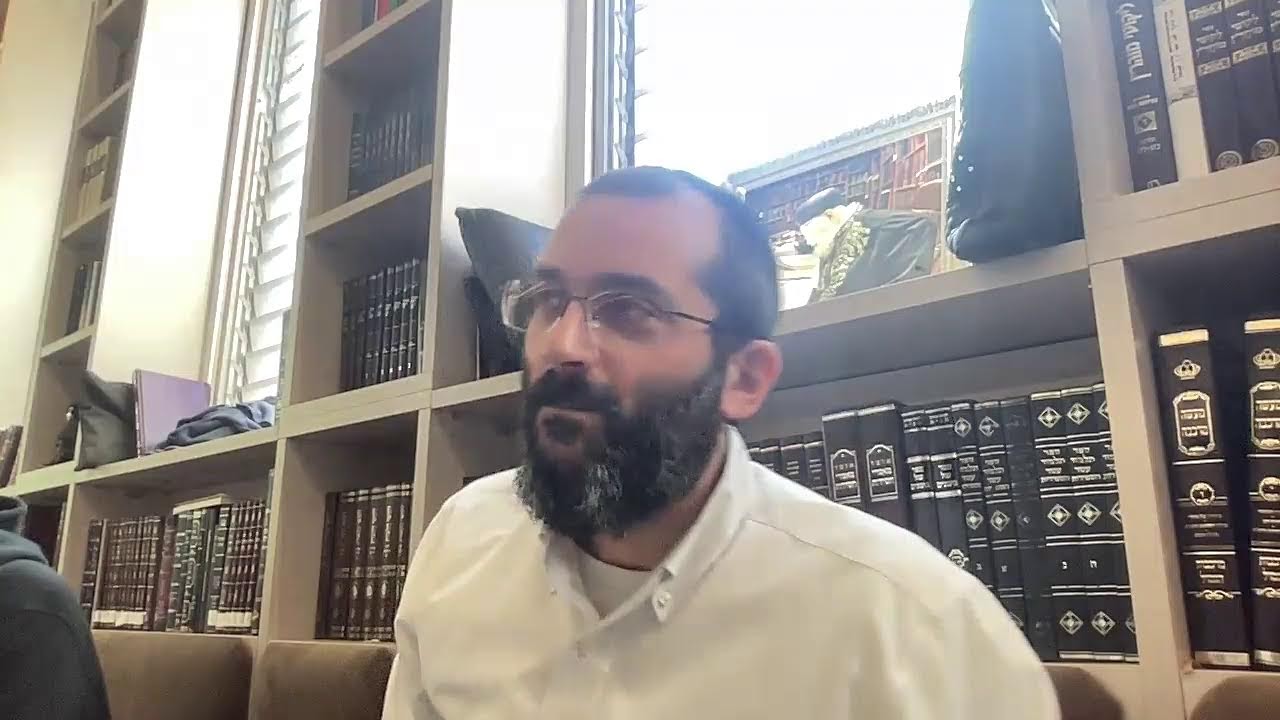
Rahel Imenou : Les larmes d'une mère, l'éternité d'un peuple
Tefila Am Israël & Actualité Histoire juive
📖 Recevoir les cours de Joy sur la Paracha : https://chat.whatsapp.com/EVEBS7oGhRN1k3e76TPI5B ✨ S’inscrire au Séminaire du dimanche : https://chat.whatsapp.com/E9k8duizjRhFa9HOXpQb2j 🇮🇱 Commander les livres de Joy en Israël : https://www.joygalam.com/boutique 🇫🇷 Commander les livres de Joy en France : https://www.judaicstore.com/361-livres-joy-galam 🤳 Nous suivre sur Instagram : https://www.instagram.com/joyeteitan.galam?igsh=MWMycnR4bTc0N2Fxdg%3D%3D&utm_source=qr 🔗 Tous les liens de Joy : https://linktr.ee/joygalam 🌸 Joy Galam Auteure & Conférencière https://www.joygalam.com/
Extrait du cours
First of all, let me thank you for hosting this class. Here you go, Barchem. I'm very happy to meet you. That's great, production assistant. Ah, well done. Okay. >> So, when I come to New York, I feel like I'm on a pilgrimage because, well, I used to live here. I got married here . Plus, I got married during the time we're living in now, during the time of Lailoua and Rachel Menenu. And we're going to talk about this month of Rjvan . We've just entered the month of Rjvan and you know that King Solomon had finished building the Betamdash in Rjan , except that the Betamikdash wasn't inaugurated in RJAN. And we waited for the month of Tisherie to open it.
Transcription6845 mots
Transcription automatique — peut contenir des erreurs.
First of all, let me thank you for hosting this class. Here you go, Barchem. I'm very happy to meet you. That's great, production assistant.
Ah, well done. Okay. >> So, when I come to New York, I feel like I'm on a pilgrimage because, well, I used to live here. I got married here .
Plus, I got married during the time we're living in now, during the time of Lailoua and Rachel Menenu. And we're going to talk about this month of Rjvan . We've just entered the month of Rjvan and you know that King Solomon had finished building the Betamdash in Rjan , except that the Betamikdash wasn't inaugurated in RJAN. And we waited for the month of Tisherie to open it.
In the month of Rjvan, he told Hashem. He said to him, "That's not fair. Why didn't we inaugurate the Betikdash during my month of month?" And Hashem reassured him and said, "Don't worry, because it will be in the month of Kjvan that Ma will come and the Betikdash, the 3rd Beta Amig, will be inaugurated and rebuilt." Okay? So it's a month like that where when you look at it on the calendar, you get the impression that it's empty, okay, that it's a little sad.
When in reality it's a month with enormous potential. And above all, it is a month with one particular date, the 11th of Cheshvan, the hilula of Rachel Imenu, whom we will discuss this evening. So Rachel is our matriarch. You know that we have three patriarchs.
Okay? Anod I don't know, don't do homework with the children as Pess approaches. So we have Arbot, we have four matriarchs and three patriarchs, and within us we have the Benel, we actually have a part of each of these patriarchs. Look how it's written.
Israel. Yud, sin rche, sorry alf lamed. Okay. And what is it for you ?
It's Yaakov etak. Sin is the sign of Sarah. Rch is Rachel and Rifka. AF is Abraham and Lamed is Leah.
Okay? So we see that even within us, the Blessed Israel, we have the imprint of our matriarchs and patriarchs. That is to say that in reality when we go into these parachats of Berichit where we discover our patriarchs and matriarchs, we don't talk about our great-great-great-grandparents times 120 times. We must understand that our patriarchs and matriarchs developed particularities, they developed strengths of character, they developed unfailing strengths that they bequeathed to us as a, if you will, spiritual legacy.
Okay? That is to say, it's as if, you see, when we talk about them, it's as if we were talking about an essential oil. Well, when you dilute it, you still have the fragrance. Who is this fragrance?
It's us, it's the B Israel. Who is the essential oil? It's our patriarchs and matriarchs. Okay?
This week, we'll draw inspiration from two characters. Rachel, who we will discuss, and also one of the heroes of the parshah of Leah that we read this week. Who is it? It's Abraham.
And you know, in Israel, there is a phrase that is said to be attributed to the Rafu, and what does this phrase mean in Hebrew? Do you know this phrase? What does it mean? It means that the eternal people do not fear long paths.
How do we see this? How do we interpret things ? Well, in reality, we say to ourselves that we, the eternal people, even if there are detours along the way, even if the path is long, we will eventually get there and we will remain on this earth to spread our message, which is a message of truth, which is a message of love, and we are not afraid. We aren't afraid of the path's length.
Why? Because we know that we are on the right track. So, this week, what we are going to see is that Abraham embodies Amansar, the Jewish people, the invincible people. That also means Nessar, the eternal people.
And on the other side, who embodies Deraruka, the long path? Well, it's Rachel. It embodies the stopping, the pain, the fact of having to stop, the sacrifice along the way, okay. Okay?
And yet, both of them, they participate in the same movement which is to ensure the survival of the Jewish people on this earth. Okay, here we go. Yeah, that was the introduction. So, we're going to talk about Abraham.
Abraham to Ivri. Abraham the Hebrew. So in this parachat , we are told that Abraham defines himself as the Hebrew, the Ivri. Ivri, what does that mean?
It means apart. He is apart, that is to say that there is the whole world on one side and then you have Abraham who is not like everyone else. Okay? And why is he not like everyone else?
What does he have? He wants to show off, uh? He's unconventional? No, in fact, we are in a time, okay, 3,000, 4,000 years ago, we are in a time when people have agreed on pre-established beliefs that suit everyone.
And Abraham, through his reflection, arrives at conclusions that go against all these certainties that are very comfortable. And so what is going to happen? Listen carefully, in the year 2000 of history, okay? So today, it is 5787 according to the Jewish calendar.
In the year 2000 of the Jewish calendar, a man intends to throw Abraham into the furnace to kill him. Okay? At that time, how old is Abraham in the year 2000? He is 52 years old.
Why? Because Abraham was born in 1948. And it wasn’t going to work. It wasn’t going to work.
He was saved. But Abraham remained an outsider . He didn’t think like the others. And he did his little khabad work.
He went from house to house. He tried to spread his message. He tried to spread the truth, the idea of one God, but it remained a secondary phenomenon. Okay?
At best, he had a few followers. The parashat arrived this week, parashat Llaha. And how old was he at that time? It was well after the fiery furnace.
He is 75 and God reveals Himself to him for the first time. God revealed Himself to him and at the time of the L , God told him to go and settle in Israel. He was in Haran, he was with his family and God revealed Himself to him and told him it was time for you to leave. Okay?
And at that point, an episode that seems a bit secondary happens right after. Abraham becomes rich, okay? He becomes incredibly wealthy in livestock, silver, and gold. Because of what?
Well, I'll keep it short. Okay? When Abraham arrives in Israel, as you know, there's >> a famine. He's going to starve to death .
There's nothing. He reaches the cabbages, sees the merchants; there's nothing in the stalls. Until one point, he says to his wife, well, let's leave. Apparently, there's food in Egypt.
So they arrive in Egypt. At that point, I'll keep it short, you may know the story. His wife is kidnapped by Pharaoh , by the king of Egypt who ultimately apologizes for what he did and, to make up for the mistake he made, gives Abraham gifts of money, treasures, and livestock to compensate for the kidnapping of Sarah. Okay?
So what happens? All of a sudden, Abraham is no longer a little outsider, he's someone who has a place, someone who has power, someone who has wealth, someone who is successful. We love this word in New York, successful, someone who succeeds. Okay?
What does that remind you of? Maybe a small country that was...Yeah, that's right, outsider, we can contrast it with others. And it's a disturbing moment because we don't understand how this country at war dares to do more than the average European country at war. But how is such a thing possible?
And so, Abraham is all the more disturbing because not only did he continue to dispense forgiveness and forgiveness, but this time, he embodies something. He has the means, he has this strength, he has this power, and now, you can no longer throw him into the fiery furnace because he has a posture. You can no longer throw the Jews into the crematoria, that's no longer done. They're going to have to find another tactic.
And so, what are they going to do? They're going to start a war. A war in which Abraham is going to have to get involved. They're going to take ratufim, they're going to take a hostage, who in this case?
Lot. And they're going to come to see him and they're going to tell him, "You know, there are kings who have gone to war, they've kidnapped your nephew, you have to do something." Okay? What year is it, ladies? I told you, it's 1948, he's 75 years old.
What year in history is it? 2023. And then, when he's told, "You're going to have to free your hostage," the word "Ivri" appears, the word "Abraham" appears, the Hebrew. Abraham's reaction.
So, let me explain, he has no chance of winning because he's going to war. He's going to take 318 warriors with him, all against a power of four nations. Okay? And what's going to happen?
Well, in green and against all odds, he's going to have a dazzling, irrational, inexplicable victory. Okay? And so what happened in this episode that was so decisive in 2023 for a country, sorry, a man who was 75 years old? And why do we call him an "Ivri," a Hebrew at that very moment?
Well, the answer is that, as I told you, since the year 2000, many things have changed. Since the moment he was thrown into the fiery furnace. Well, now Abraham has an official existence. He is strong, he is successful, he is powerful and so they can no longer attack him like before.
And so now, when they want to attack him in 2023, they need an alibi. But basically, an alibi remains an alibi. The goal is his destruction. So Libya, you can call it the kidnapping of Lotte .
Libya, you can call it the Palestinian cause. The craze, you can call it that Israel is supposed to commit genocide. You can call it whatever you want, but all that is absolutely secondary because that is not the goal. The goal is the destruction of Abraham.
Okay? And so they took his nephew hostage, why? To trap him. They say, we're going to start a war in which he'll have no chance of winning.
So we'll give him the scare of his life and that's it. We won't hear from Abraham again. So, understand that if all these powers decide to unite to trap him, to be against Abraham, it's because this little outsider is starting to cause trouble; because this little outsider is starting to succeed in everything he's doing. And since he disagrees with us so much, since he's so unconventional, since he doesn't think like everyone else, well that bothers us.
And that's why he's called an ivri. An ivri, let me tell you what an ivri is. A Hebrew, you know, there's a principle in Hebrew which is that if you want to know the definition of a word, you reverse the letters and you'll understand what the opposite of that word is. Ivri, what if you flip it over?
Riboua. Riboua in Hebrew, what does that mean, Leah? Because you started learning Hebrew. It means there are some people who do Hebrew here.
Square. Well done. Who said that? Well done!
And there you have it, you're at the top. English, French, Hebrew. Razak . So it's a square.
Now, what is ivri? It's the opposite of square. It's the one who doesn't fit into the box. It's the one who doesn't fit into the norms.
It's, uh, how do you say it? Someone who thinks outside the box. >> Unconventional. >> An unconventional one.
But it's not conventional just for the sake of being unconventional. It's that from the moment when I, through my own thinking, come to the conclusion that everything you've agreed on is false. You can tell me that this is true from morning to night, I won't budge an inch. Okay?
What he said is that he passed on to us , that we have this intrinsic strength. We Jews, you know, are capable of swimming against the current. That's why according to the rules of kashrut, for a fish to be kosher, it must have >> fins, scales, and fins. And fins are actually the only fish that have fins that are capable of swimming against the current.
The others can't. So even in our DNA, even in our dietary rules, we have this intrinsic capacity to swim against the current. Now, you should know that being nonconformist is not at all something that comes naturally and it's something that gets worse over time. Let me explain, there is an experiment that has been conducted several times in different parts of the world in different forms, but it has a generic name which is the H experiment.
Have you ever heard of the H experiment ? So, I'll explain the protocol of the experiment. We take 10 people, okay? There are nine who are accomplices of the one who is doing the research, okay ?
And these nine people, we supposedly give them a visual perception test. Okay, are you following me so far? So, we give them cards with a small stick, a medium stick, a large stick, and they have to say well that we ask them the question what is the small one, they have to show it is the small one, what is the medium one? They have to show it .
Okay? And in reality, at the beginning, the accomplices play the game properly, okay? So you have the one who is the guinea pig, showing it's normal. Then all of a sudden after 4 c's it forked and in fact the researcher said which one is the smallest?
And there you have the nine that show the largest. And then you have the guinea pig who is in a total panic and says, "What am I supposed to do?" So, ladies, you should know that at the time when H did his research, if I'm not mistaken, 52%of people conformed to the life of the majority, even though it was clearly false. >> Okay. That's >> huge.
>> Huge. Wait, wait. Annie, no, sorry, excuse me. At the time of H, excuse me, it was 75%.
75%, and the more we go on in the years, the more we reproduce H's experiment, the higher the rate of conformity becomes. >> Yeah. Yes, because society is becoming more and more conformist. >> Well, yes.
I mean, in fact, that's what I tell my children all the time; I tell them: "Hello, just because everyone says it doesn't mean it's true, just because" Everyone wears it, it's beautiful, and just because everyone eats it doesn't mean it's good. "Okay? These are things that we have to be able to go against the grain at times. Okay, you agree on that, but if I don't agree, I'd rather be like Abraham on the other side of the river.
Now, listen to something I discovered. So, why does everyone conform? There are two reasons. The first reason, what is it?
It's that out of humility, they say ," Oh, well, if everyone agrees, why would I be smarter than the others? "" And the second reason, what is it? It's actually the desire not to be an outsider. That's why when we answered anonymously in the questionnaires, okay , even if the other nine said that, well the rate dropped to 5%.
It's >> often because it's fear, fear of Iaton's camp. Often it's fear of not rallying to the cause of the majority. Okay? And so we understand in this parashah that the ivri is precisely the one who is capable of thinking for himself.
He is the one who is capable at a time of being nonconformist. Not for the pleasure of being nonconformist , okay? Not because we like being outsiders, but because in situations where you all agree on a principle, if we don't, as I told you, we won't budge an inch. Okay?
Secondly, it's What, an ivri? An ivri is assuming one's duty. Abraham, hello, do you realize that with 300 fighters, you have no chance against four countries? Of course it reminds us of the war of independence.
Of course it reminds us of the war of 67, of course it reminds us of all Israel's wars. Hello? 300 against four countries, you don't stand a chance. Abraham's response.
Yes, but if I have to do it, I do it. The sense of duty. This sense of duty. So, I...Yeah, tell me, >> you can add just one thing, which is that having a binouille at that time also separated from the otte.
>> Yes. >> Just before because their path wasn't >> and somewhere, he could have said "I have more responsibility." >> Exactly. Exactly. And besides, the way we tell him, we tell him your brother is a hostage.
And from there our sages tell us it is a praise for Abraham, it is a goat for Abraham. Why? Because even though he no longer had the same paths, okay? One was, let's say religious, the other secular, he was on the right, the other was on the left, huh, he was healthcy, the other was junk, okay?
Whatever you want. Well, regardless of the differences of opinion, political or other opinions, well Abraham is still his brother, his nephew is still a Jew, he is still his brother. So absolutely, thank you for the remark. So this sense of duty, just understand that it is this rest.
Because if we didn't have our rayalim and our reservists, sometimes really, I saw in the synagogue, sometimes they were called up for a month as reservists. They returned to home for 2 weeks, they receive a sack of money, they have to leave and the mother says: "My son, we're going to write you an apology note." No, tell them you're tired. And and the child, it's not even a child. It's, it's this, it's this, it's this man, this young adult, who sometimes has studies to do, who
is sometimes in the process of setting up his business, his company, his thing, who looks at her, who says: "But Mom, if I don't go, who will go?" There, you look at the sea and you just want, want , to give her a hug.
It's true. The Jewish people, the forgiveness, the land of Israel, it's based on one thing which is this sentence: if I don't go, who will go? And that's a legacy, it's a legacy of Abraham Avinu. Okay?
Thirdly, it's the strength of Abraham. It's the ability to transmit. You know that Abraham was chosen by Hashem to be the founder of the soul of Israel? It wasn't the fire, it wasn't the fiery furnace, it wasn't all the trials he had to go through.
While we've been lulled into all that. We've always read the stories of Abraham saying that he was chosen, he was chosen, he was chosen. But no, there was one moment in particular, he was chosen. It was a moment when God said to him, "I saw that you were a good educator." That's when he was chosen to be the founder of the Jewish people.
Understand that we are in a Western world where parents have given up on transmitting values. You are in New York, you are in the United States, so I have nothing to teach you. I think you can see it with your own eyes. Okay?
And there are still people who say, "Oh no, I still have values.""So sometimes it may not be everything, it may not be the most orthodox in the world. It may not be, okay, it's often the tkcha, the bouilleab and the and the fait tfich and all that that we mix together. Okay ? But at no time will I be wrong, I will abandon the transmission of values to my children.
You know that at the Vatican, there were Italian deputies who came to visit after or before October 7, I don't remember. It was Reliaou who told this after October 7. And so it was deputies, okay, from what the parliament in Italy says, who came to see the Vatican and who said that it was time to give the Jews back the Batamicdash utensils. And when we asked the question" But why?
"Well, the answer was because they are still the only ones who transmit values to their children. So we know that the Jewish people have a future. We know that the Jewish people have an eternity and we know that at some point or another the betch will be rebuilt. So let's take the lead and return the utensils to them.
Do you realize? Do you realize what we represent? Okay. So Abraham, that's it, he's the ivri, he's the one who set a direction for himself and who gives himself the means to get there by passing on his knowledge, by assuming his duty and by thinking for himself.
Okay? That's Abraham's strength. And as I told you, he symbolizes strength, victory, Nezzar, and he also symbolizes eternity. As I told you, it's in progress in two parts, Amedar, the Hadoka, the eternal people, do not fear long paths, who embodies the long path, that's Rachel, so tomorrow Rachel is the one who, by definition, stops halfway.
Throughout her life, she stopped halfway. She symbolizes this endless path. She was supposed to get married. In the end, she had to wait 7 more years.
She had already waited 7 years. It was from the moment she met Jacob and made this joint decision to get married, as one might say, love at first sight. Uh, she still waited 14 years. I don't know, maybe that's not called a long path.
Then, she was supposed to be Jacob's only wife and give birth to 12 children, the 12 tribes. In the end, she only gave birth to two. She was supposed to be a mother . How long will she wait to become a mother?
12 years. Once she is married, she waits 12 years of infertility before holding her first child in her arms. Uh, she has to give birth to Benyamine and ends up dying in childbirth on the road. When she was on her way to Israel, she had to do her alli and at one point the contractions come, she stops, she gives birth and at that moment she leaves this world.
And Rachel, it's as if she was telling you, " You know, I know the long paths, I know the paths where I had to stop. I had a goal but I had to stop in the middle. I know the detours, I know the dead ends, I know the labyrinths. "And Rachel, well, as I told you, she's going to give birth to Benjamin on the way and die on the way.
And then, at that moment, Jacob, her husband, is going to make a completely illogical decision. He's going to decide to let her be buried on the road. So, we're in Bethlehem. So, Bethlehem of Revron, that means where all the patriarchs and matriarchs are buried.
Abraham, Israel, Yaob, Sar, okay? Everyone is buried there. Uh, it's an hour's walk. Let's go, an hour and a half's walk.
What? You can't walk an hour to bury your wife in a place that is worthy of her. Why in the middle of the road? And Yakob, he knows by divine inspiration that Rachel, she must stay there.
She must stay in the middle of the road because in fact she embodies those who are stuck in the middle of the roads. Those who are stuck in the middle of a path. Sometimes it can be in a shalom bait where we say to ourselves" But I'm stuck, stuck, stuck, stuck like just now someone who wrote to me and said " Are you going to the rehab tomorrow?" She said pray for me. Even if at this point, I think it's no longer useful.
I But how can you send me this? How? Someone who is at an impasse in relation to a child who says to himself "Okay, come on, it's fine, the others are more or less driving. But this one, I'm giving up." Someone in the middle of a path saying, "I'll work, I'll get a job, I'll make it, I'll have a career ," but every single time, it just doesn't happen.
And they say, "What do you do for a living?" Well, no, still nothing. You see? No, I'm always stuck in the middle of the path. No.
That's what Rachel embodies. But Rachel's strength is precisely in understanding what it means to be in the middle of the path and to intercede for all those who are in the middle of the path so that they can reach the end of the path . Unlike her, who couldn't make it, she made it her mission that anyone who asks for her help, anyone who intercedes, who asks her to intercede on our behalf, this person will be able to finish their path. That's why some 1,500 years later, after the burial of Rarel on the road, she will save all of Israel.
At what point? At the time of the first exile. You know, we have to imagine that we were on our land in Judea, okay? And then we had the destruction of the first Batamikdash.
And not only that, Nebuarab decided to exile us everywhere, to disperse us. And on the way, the Jewish people, so, we have to imagine them with, well, like in Rome, see on the ark where we see them, even if it's not the same time of course, but we see them carrying burdens, with their hands clasped, following their executioners and their destroyer, and at one point, they're going to pass by Rachel. They're going to pass by Rachel's tomb. And at that moment, we say that Rachel, she stood up, okay?
Physically of course, her neshamal stood up and she asked Hashem to bring the Jewish people back to Israel. Now at that moment, you have to know what happened in the heavens in the shamai. Everyone stood up, they didn't wait for Rachel. Abraham stood up, my people, my children.
You have to bring them back to Israel. No, no. Achem doesn't listen to Abraham's prayer. Itak comes and intercedes.
You have to bring my Jewish people back to Israel. No, he doesn't listen. Meabenu, David, Amer, everyone intercedes on their behalf. And at that moment, there's a last one who speaks up and says, "I'm stuck in the middle of the road, I'm the one who sees the Jewish people passing by this road." You know, Hashem, I'll tell you something.
And here, the midrage, it's overwhelming. For those who are used to studying in Ivrite, go ahead. It's delicious, it's so beautiful. It's the midrage on Ymiou.
It says like this. She intervenes in a speech, she tells him, "You know, I had to go under the arcoupa and finally I left the place to my sister. I lived with my husband's second wife. I'm the one who left this place to her.
But that's not all. Look what she tells him. So I did this for her, okay, I did this service for her, so to speak. And what a service, but that's not where it all comes down to.
She's going to tell him, vokit, and I wasn't jealous. Farva litarelli. I who am just dust and ashes, who are simply made of flesh and bones, well, for all these years, I have been happy with what I have done. And you, and you, God who is the king, the existing God Rahman and who is merciful, you are going to be jealous of the idols that they brought into your house.
And then he says, wow, wow. Wow, wow, wow, she's so strong, she's so strong. Can I say no? And what's he going to say to her?
He'll tell her like the earth. You know , Rachel, I heard your prayer. It's okay, stop crying. You don't need to shed tears anymore because there's a reward for what you've just done.
And they're going to come home. And indeed, a few years later, not right away, it's true, but Hashem made a commitment and 70 years later, the Jewish people will return to their land. Thanks to whom? Thanks to Rachel's intervention.
But it's not just that she was eloquent, it's that she spoke from the depths of her gut. She spoke about her own story. What? I, who am made of flesh and blood , and I made this sacrifice and I wasn't jealous.
And you, Hashem, you're going to be jealous. Rachel, she's the one who in fact, you see, when she gives Benjamin the gasoline, she will never benefit from Benjamine. She will never be the mother. She will never give her a mothering job, she will never change her diapers.
She will not educate her, she will never benefit from him. Well, Rachel, this strength is that everything she invests in this world, she herself does not reap the benefits. But who reaps the benefits? It is us, it is the Jewish people.
She bequeathed to us all the profits that she did not reap. And that is why God tells her, there is a saar, it pays for what you say, it pays for what you do. Sahara in Hebrew, it is a reward but it is an infinite reward. It is a reward that is renewed.
It is a reward whose merits we can use all the time, all the time, all the time, all the time. That is the reason why tomorrow when it So it will be on the 11th of Rvan when you light a candle. I know that some people are fans of the Ralimenu seoula, but don't ask me about the details of this seoula. I'm useless at the cegoulotte, okay?
However, I received a lot of questions, but I referred them to people who are specialists in the Ralimenu segouade. But if I'm not mistaken, for 40 days in a row, preferably starting on the 11th of Ran, every day we put a candle in the one, we light a candle, we put a coin in the tedaka and we ask Rachel to intercede on our behalf for a wish, a michala, a wish. Okay? And then we commit to revealing the miracle.
Okay? That's what I know about the seoula of Rachel Imenou. Personally, I've never tried it and all my friends who have tried it have not been disappointed. Okay?
It's trying or how do you say trying or repaying. Why does Rachel have this strength? For all the reasons I just mentioned to you. Okay?
It's also the one that unifies because when we are at Rachel's tomb or when we are lighting our candle, well in fact we become her daughters again and we become her sisters again. We become sisters again, sorry. Now all of Rachel's strength is precisely this ability to pray. She has an ability that is the ability of any person who is stuck in the middle of a path.
You know that we have a tilfila in Hebrew which is called behind the prayer of people who are on the way. So know this prayer, ladies, that it is the most powerful in the world. On the day of Yam Kippur when the Cohen enters the betikd in the kodes in Kodashim in the holy of holies, he makes requests, essential requests for the people of Israel. That we do not need other nations, that there may there be abundance, okay, but very few requests because he doesn't have the eth in the kodeshakodashim, he has to go very quickly.
Among the few requests he asks , there is one that is very strange, it is the following. God, if there are people who are on the road and it is raining, do not hear their prayer. who >> rains, do not listen to their prayers, because when you are on the road, okay, and it is b outside and you do not have an umbrella, well you say to Chem:" Please, stop the rain. "And we risk hearing, risk hearing loudly the prayers of the people who are on the road and stop the rain, but the earth needs rain.
But what is so powerful about someone who is praying in the middle of the road? Well, the gad corner, it is the most formidable prayer, This is the most heard prayer. When someone feels like they are in the middle of a journey, whether it's once again in their shalom bit, whether it's with their children, whether it's in a celibacy that seems long, that seems endless, or at a time when you say," Where is the l...where am I going to arrive, when will I reach my destination? "This prayer is the most heard.
Okay? And everyone can benefit from Rachel's prayer, which is the prayer of someone who has gotten stuck in the middle of the journey. So to conclude, I would like to tell you the words of a writer, you've heard of him, named Tolstoy. Yeah, we have some educated people among you.
In Israel, we don't know Tolstoy very well, okay, but in New York, maybe we do. And he tells us like this, and look because it's just wonderful. He tells us," The Jewish people are the symbol of eternity. He was the one whom neither corruption nor torture could defeat, nor fire nor the sword of the Inquisition could make disappear from the earth.
He was the first to declaim the words of God. He was the guardian of prophecy for so long and he gave so much to the rest of humanity. The Jew is eternal. He is the symbol of eternity.
He asks the question: "What is the secret of his eternity?" So, I will give it to you. The secret of his eternity is in a photo and that is what I would like to conclude on. So, I don't know if you can see this photo, it's very small, okay? This photo is from October 7th and we have a Deudat paramedic holding a baby in his arms.
And what is the story of these babies? This is a family of parents who had twins who, when they heard the first bells ringing, went to the Mamad in the Miklat and took refuge. Except that at one point the twins were hungry and even though they knew that there were terrorists around, they were people who were defar. At one point the mother could not stand it any longer and decided to leave the Miclat to go get some milk.
At that point, she was taken by the terrorists, tortured in an unbelievable way and when her husband came to defend her, he was killed and she too. In the meantime, the twins stayed in the vault. The terrorists did not find them. They stayed for 14 hours , 14 hours without eating, and cried for 14.
And at that moment, after 14 hours of waiting, when the kyalim, the soldiers arrived at the house, they saw the bodies, at one point, they heard crying, went into the vault, and found two babies. And now, a khayal with a baby with everything we love about the kyalim, what is he going to do with it? He has no maternity ward, nothing, and has other fish to fry. I want to tell you because there are terrorists who have to go and wipe them out.
And so they don't know what to do. There are rescuers who are there, they arrive at another house to find milk and at that moment, this rescuer says that when they put the bottle in the mouths of these babies, they drank non-stop as if we hadn't eaten for a week. And at that moment, the two rescuers, because they were a man and a woman, one named Shalom Avitan and I think her name was Tal Lalou. Well, they testified that at that moment, they felt like they
were holding a piece of eternity of the Jewish people in their arms, that these babies, their great-grandparents were survivors of the Shoah and that Akfaraza, there were many victims, and that they were so happy to find these two babies in the cold room and in the vault and to be able to save them.
And in fact, I think that's what it is: understanding that there are things in the middle, paths that are stopped, parts of people who leave at the prime of life, paths, journeys where you ask yourself: "But why? She had a promising life, there was something behind it." And yet, and yet, and yet, the Jewish people have this strength to always find a continuation of their story, and I'll tell you the secret of that. And the secret is with another story that I heard and you'll see that in reality everything will become clear and we'll understand why Abraham needed Rachel and Rachel needed Abraham. This story takes place in a bunker.
Uh, in 1944, we're in the middle of Pessard and there's a son who is hiding with his father and at one point it's the Pessard ceding and the father says to his son, well we're going to try to make him ceding as best we can. And when the son is about to pronounce Manishtana, he says to his father, he says, "Dad, will I pronounce my nichana for you next year too?" And then the father has this incredible response. He said, "My son, I don't know, I
can't guarantee it, but I can guarantee one thing: there will always be your children who will say" manana "to their father, and it's thanks to your merit, thanks to your manana tonight." That is to say, there is a cause-and-effect relationship. What is the cause-and-effect relationship?
We've been saying from the beginning, "Well, the Jewish people advance despite the detours." Well, I can tell you something else: the Jewish people advance thanks to the detours. Why? Because when the path is smooth, there comes a time you no longer know where you move, what direction you take, or even where you are actually heading. But when the path is interrupted by unexpected and sometimes painful things , it challenges you and allows you to question yourself and ask yourself each time, "But what direction am I
going?" And you'll notice that as young women, when we're out on the streets of New York, we might come across other people and we might say to ourselves, "We have the same jobs, we have the same clothes , we have the same lifestyles, but we're so, so, so, so different." Why?
Because inside us, we carry all these detours. Inside us, we have Rachel. Inside us, we have October 7th. Inside us, we have the stories in the bunker.
And so that only does one thing. It doesn't slow us down. On the contrary, it speeds us up, and above all, it speeds us up in the right direction. That is the essential part, and that is what will ensure our identity, our longevity, and our eternity.
Okay? So Rachel, what does she tell you? First, she tells you to trust me, even if it takes a long time, you'll see, you'll get there. What else does she tell you?
She tells you when you're halfway there , stop and pray because that's when your prayer is the most precious. And what does Rachel tell you? She tells you that when you can't do it anymore and you can't do it anymore and you feel like you're stuck in the middle of the path, then call on her and she will be happy to intercede on your behalf. There you go, have a good Iloula of Ralimenu.
Don't forget to light candles tomorrow and tomorrow night. Tomorrow night. Yeah. >> There you go.
Production assistant is stopping us.