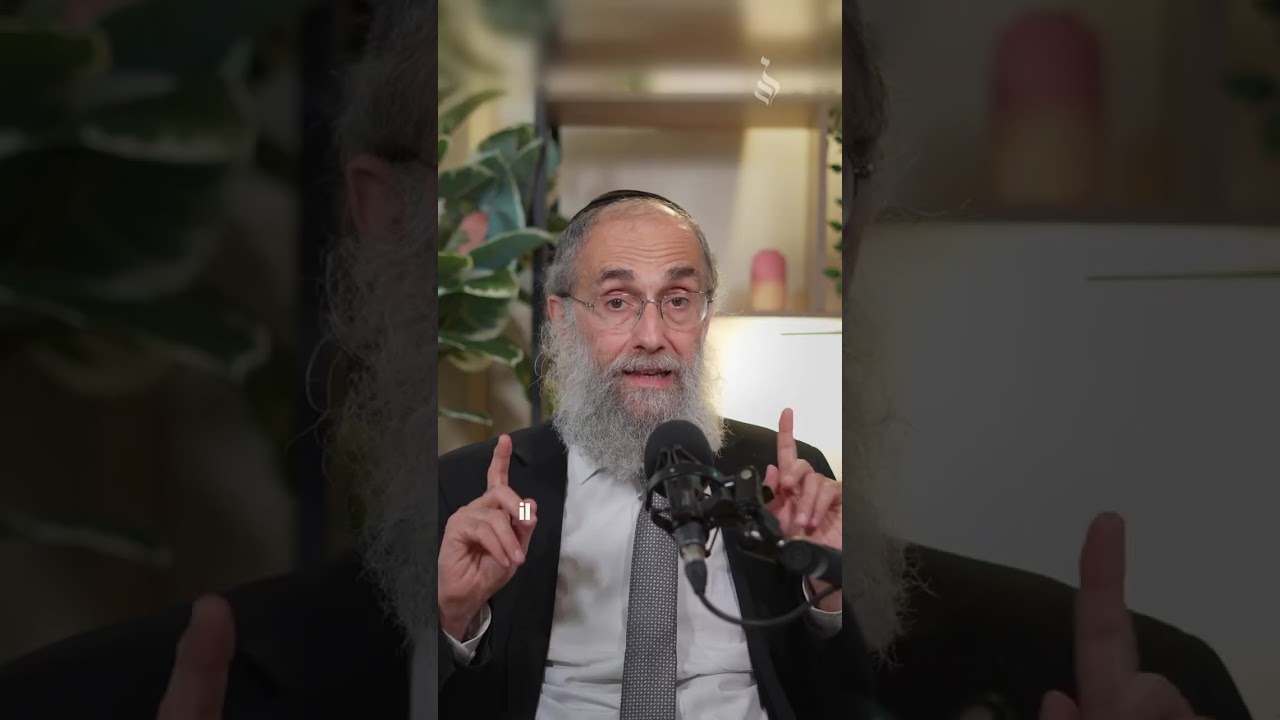

PARLONS-EN ! #4 Ce que 30 ans à écouter les autres m’ont appris sur la vie ?
Moussar
Extrait du cours
We still have a lot to talk about , >> it seems. And just a question, have you had any feedback on the first episodes in person? >> Oh, people loved it, people liked it a lot, and they found the idea very interesting. First, I thank you, you're the one who had it, >> it's not my direct idea but yes. >> All right. So in any case, people were interested as much in the concept, it's true, of a dialogue between a son and his father. and at the same time in the themes you addressed and the fact that you try to challenge me, to push me a little, to trap me. >> No, not that far, >> not that far.
Transcription17218 mots
Transcription automatique — peut contenir des erreurs.
Hello, Dad. >> Boker tov. We're on our 4th episode. >> Great.
We still have a lot to talk about , >> it seems. And just a question, have you had any feedback on the first episodes in person? >> Oh, people loved it, people liked it a lot, and they found the idea very interesting. First, I thank you, you're the one who had it, >> it's not my direct idea but yes.
>> All right. So in any case, people were interested as much in the concept, it's true, of a dialogue between a son and his father. and at the same time in the themes you addressed and the fact that you try to challenge me, to push me a little, to trap me. >> No, not that far, >> not that far.
Well, precisely, I think that today the theme of this podcast will be with much respect but, Baruch Hashem as you like to say, a few white hairs. So we can say that there are >> You have some too, by the way. I'm starting, starting. there's 30 years, at least a good thirty years of listening to others >> and we're going to try to see what 30 years can bring to life, teach about life.
But before that, I had a real question, I would like to know, we're talking about Rav Leemel first and foremost. Hm >> hm. >> In your opinion, what is the primary role of a Rav? >> It's very complex because the difficulty today is knowing what people expect.
I believe that the primary role is precisely not to try to have a role and deep down try to be in a state of listening and sharing. So, obviously, there are those who are there to state the law in very technical issues, like the laws of Shabbat, the laws of food, etc. Or for that, and even for someone who is questioned about the law, you must know that there is an expectation behind it: the expectation of being heard, the expectation of a bond being built as well. Beyond that, I think that the role of the Rav is quite simply to share and especially to be listening and not to be a preacher.
>> And when you say precisely to share, to be listening, at the same time, there is a position that exists automatically. The Rav is going to be the one who knows , who has the basic knowledge, and who will share, teach, and transmit, and so on. And it's going to be very interesting because, on one hand, you have to be in a position where you are knowledgeable since people come to consult you, while simultaneously maintaining this position of a talmid chacham, someone who is constantly learning. How do we strike a balance between saying, "OK, I am always learning and I always need to learn and discover more," but on the other hand, I am already the teacher, in a way.
I am already the authority. I hear what you are saying, but precisely, I think the first thing is that I would like for us to revisit the word "Rav" today. Nowadays, it's a bit like everyone decides to call themselves "Rav," and with all the respect I owe to everyone, there is still the necessity of having what is called "shimush," meaning having spent time with masters, having been in their close proximity. Because, let's recall what we are taught, that " Gedolah shimusha yoter me-limudah": it is through proximity to a master that one truly learns how to transmit, how to speak, and how not to speak.
Today, we are in a world where anyone— and this is not meant in a pejorative sense—who gives a lecture or provides a teaching is called a Rav. Why not? Why not? But we must distinguish between someone who sometimes settles for reproducing a teaching they have heard.
Besides, we are all at some point saying things we learned from others, and the person who can answer the problems and questions that people will ask them. Because for me, there is still an extremely important dimension here. Knowing how to talk about a subject does not mean that one has expertise in that subject and can provide answers. So, to return to your question now, yes , I believe that as the years go by, we feel even more the need to have our own masters and to continue learning.
When you start speaking, you have the impression that you have become kings of the world, and then, as the years go by , you realize the extent of the knowledge you do not yet possess. And I think that helps us—in any case, as far as I am concerned—to become a little bit more humble, while at the same time accepting that when you have had the privilege and the luck to learn, you are there to share and to transmit clearly. >> And can we know who those
rabbis were, since we mentioned the people who taught you and who essentially left their mark on you? >> Well, uh, unfortunately, I don't know if I can say that of all the figures I am going to mention, I was their student and they were my masters.
In any case, I learned things from them, that's for sure. And sometimes, even if it's only for a very short time, you learn a lot of things. So obviously, there's your grandfather, right, himself, >> who himself learned from Rabbi Frikine, who was himself a student of the Chofetz Chaim. I was in yeshiva; I was, among others, with Rabbi Rottenberg, the late Tzadik Livracha, his son-in-law, Rabbi Katz.
I also had the privilege of being in Israel alongside Rabbi Nissim Karelitz, who was the nephew of the Chazon Ish, from whom I received my Semicha. I had the chance to be able to hear and to be able to, not necessarily frequent , but at least go a few times to see Rabbi Moshe Soloveitchik, and even those meetings, which weren't all that numerous, were terribly inspiring. Rabbi Grunstein, who is his student, I am obviously forgetting some. I am obviously forgetting some, and this list is not exhaustive, because when you meet these personalities, well, sometimes just one encounter is enough to be marked by a teaching that serves you for your whole life, and I think that's mainly it.
Then obviously there was Rabbi Shapiro, there is Rabbi Weiss, well, there you go , and I think that...... >> right up until today. I...but as we go along, we tell ourselves, "Wow, how lucky we are to still have people we can turn to." Because it's an incredible stroke of luck, because first of all, I know that some days I sent certain people saying, "Go ask such and such a rabbi," and they would come back and tell me, "But he asked us, why don't you ask him yourselves?" So it was, uh... ...
>> a form of challenge. No, but he was the one telling them that. So, in a way... >> Because quite simply, it is important to know what the word of these masters still is, how we learn from them, and in my opinion, at least, it is crucial, it is fundamental; and besides, these are the people who give us the strength to be able to reflect, to be able to think , and especially to sometimes have a totally unexpected perspective on certain subjects, and that is, among other things, obviously what is fascinating.
It means that we will encounter this later in our podcast, learning from everyday people, but sometimes one might —and I can understand people who say, " Well, these rabbis, especially those who are very old, aren't they a bit disconnected?" I'm thinking of Rav Itzhak Valton, for instance. >> Is there a moment, and you say the exact opposite, actually, that these people we might think are a bit locked in their own world are the ones who will one day give you an incredible vision of... >> Beyond that, for sure, and beyond that, they speak a true word. And when I say a true word, sometimes they say things that may seem simple, but because it is them speaking, they penetrate us deeply.
It's not just a figment of the imagination, it's not just a concept, it's a reality. I'll give the example of Rav Mordechai, who is unfortunately no longer with us, whom I had met—and with you, by the way, his son—where I also studied a little bit at his father's yeshiva in Coltora. Well, when he told me, after my assaults "Light and darkness," "Light and darkness, one does not push away darkness with sticks, but rather one adds more light." Lots of people can say that, but when he says it, it's another dimension entirely. >> because there are all these people who >> Yes, it's all, it's all there.
>> At least with this introduction, we have covered the first part of what the Gemara says, "Rabbi..." But what I would like, above all... >> Can you translate, because I'm not sure that everyone listening to the podcast Understand. Yes, I understood. >> I have really gotten into the concept of the podcast, you see.
I am talking to you, I am talking to whoever it may be. I, precisely, am thinking about those who are supposed to be listening to it. So the Talmud tells us, >> The Talmud teaches us, "I have learned much from my masters, and well, it also speaks obviously of my friends, and even more from my students, essentially from my students, 'umitalmidai yoter mikulam '." "Even more than everything, I have learned from my students." Learning from one's masters, we understood, you explained how these are people who accompanied you in your life , in your daily routine. How do you see, already as a first approach, learning from one's students— people who, well, in the end, technically, you have more knowledge than, in terms of Torah, in terms of...
and yet, it's a Gemara. It's a Talmud text that tells you, sure, he is your student, so yes, I agree you have more knowledge, but what will you learn from him? >> So, that is precisely where we open up the idea of what learning is. Is learning just about having knowledge and technical expertise?
In that case, indeed, the student, well, doesn't have your knowledge since he is there precisely to learn it. But we don't just learn knowledge; we learn something else. So, in a very concrete way, first of all , a student challenges you, whether you like it or not, and in quotes, you must not lose face. So, either you give answers that muddle the issue, but at some point, you can't look yourself in the mirror when you get home because it's not very elegant.
And besides, I notice this danger a lot today, which is that students sometimes have such a wide-eyed look at the master that he could tell them anything, and they would believe it, and that is a real danger. Sometimes, when giving a lecture, I've told myself that I could tell them the Kabbalah says this or that , even though it's never written anywhere. They would all say, yes, yes. So, on that note, you still have to be able to look at yourself in a mirror.
Yes, sometimes in a Gemara class, someone asks a good question, but since you're not ready, you say, well, and at one point I start giving an answer and I say, yes, but actually, the answer I just gave you doesn't hold up. >> Exactly. >> And I explain to you why what I'm telling you doesn't work. >> Right, I interrupted you.
No, no, but it's certain because, first of all, it forces us to go all the way, because it compels us to go further in our reflection. And beyond that, we learn from them because we observe them, and I remind you that learning is not just knowledge , it's the observation of the other. So we observe masters, and we see it in their way of understanding, of living, and of being on a daily basis. What is a Torah of life?
Our study partners as well; there is a very, very true, very authentic exchange that happens, which allows us to be clearer with ourselves. And students, we observe them too, and somehow, they are for us, at least for me, incredible lessons, if only in the appetite they have for knowledge, and the efforts they make in that regard. I am deeply admiring of this movement made by those who want to learn, and I find it absolutely remarkable. So you're talking about the movement, but do you also think there is the point , if I understood correctly, that when they ask you a question, they challenge you because in a way they are questioning your fundamentals.
>> Well, that's something else, >> something that is normal for you, and one day they ask you, "Well, I'll take a cliché example, tell me, why do you actually pray?""But but >> ah yes, on that, on that, I completely agree. Sometimes we are in our habits and then they ask a really simple question, like why do women have to light the candles? And if you haven't learned, you say," Well, because I light the candles, that's why. " >> And then, you're there, a bit surprised .
So that, at that moment, is great, because I've sometimes been caught off guard by questions I'd never asked myself before, because we've always done it, or about customs, and so on, and it's fascinating because it forces you to look it up. I thought, wow, I have a similar memory. >> Sorry. >> I have a similar memory at home on a Friday night.
>> There was, when I was still a child, at your place, and I remember someone asked ...I, even today, it stuck with me: it was someone who was coming to the house for the first time in their life, or one of the first times, and in the middle of the meal they asked you:" But why do people sway during prayer? "Yeah. >> And as a child, I thought, but it's obvious, when you pray, you sway. And I said to myself, wow, actually, for him who has never seen anyone do that, since when?
When you're reading a book, do you sway? And it shocked me. Well, you answered him, but I know it stayed with me because it was my little child's perspective that didn't even understand the question. What did he want with that ?
>> Exactly. Exactly. And that is what, now that there are teachers, friends, students, and with all that, we add another factor. Time, there is time.
Time has passed since that era. Today, it's been over thirty years, as we said, that you have been listening. There is an evolution. There is an evolution in that perspective today.
I am convinced that your attitude, your behavior toward someone who comes for advice, to ask a question or otherwise, is fundamentally different than it was back then. How is it different, according to you, above all else? >> Well, the first thing is, I feel—no, I don't just feel it—I measure the importance of the question being asked of me more. I think one of our greatest difficulties is that we don't often gauge the impact that an answer or a reflection can have .
Uh, even if it might seem a little presumptuous, I think with more humility Uh, because being the center of attention is nice, but at some point, you realize you need to quietly return to your own place. There is, no, there is no nonsense. Yeah, that's it. So, >> even as we go through life, we discover that >> obviously, at least as far as I'm concerned, obviously, many things have changed for a multitude of reasons.
You have to accept at some point, well, as you were saying earlier, the gray hairs , some experience, the luck of having heard other masters, of having learned something, at least. But it's true that in the beginning, sometimes we answer a bit off the cuff and we forget to really listen to what the other person is telling us. Meaning, there is the word, and there is what lies beyond the word. And sometimes , behind the question, there is another question that is present, underlying, but which couldn't be asked.
And so I believe that on that point, there is a real evolution, at least as far as I am concerned, without any ambiguity, and a sense of caution, a real sense of caution. >> So, precisely, help me understand what you meant earlier by responsibility, realizing the impact of an answer, and that caution. Well, I can relate this; it's an amusing anecdote. Leaving a class, a young man comes to see me and says," There you go, I wanted to tell you I'm engaged.
"And I say to him," Oh , great, Mazel Tov! "and he looks at me and says," Do you think it's not the right person? "" And I look at him and say, "First of all, I don't even know who it is.""But because he—what was a form of reaction—he might have expected , maybe, 'Ah, Mazel Tov!'" And I, my head was elsewhere, I said "Oh, Mazel Tov, great," but in a somewhat more neutral way. And that struck me because I said to myself, "Wow," because if he hadn't told me, perhaps he would have gone home thinking, "So, there's a difficulty." I mean, I'm not saying the person has a difficulty, but at some point, we mustn't forget that whether we like it or not, words have an impact.
We see it in the parent-child relationship, and obviously, when we symbolically represent something to people, we must realize that the words we speak can have repercussions and be extremely careful. Advisors are not the ones who pay the price. That is the reason why, on certain subjects, I am in the habit of saying, "Here is how I understand things ." Period, new line. That is the way I perceive it.
And I use this notion of the conditional a lot, not to avoid taking responsibility, but simply because there are so many parameters to a question, one must be extremely careful and take the time to reflect. You were speaking earlier about Rabbi Srogville, my uncle, who is an exceptional person. When you ask him a question, you generally hear silence because he takes Well, that is what I try to do. Once, I called him when I was, I don't know, 15 years old or something like that, I asked him a question, and it was over the phone.
So I said, "Rabbi," and so on , I tell him my question, and I wasn't aware of this habit of his. So at one point, I was on the phone and I said, " Hello?""I thought it had been cut off. I said," Hello? Is anyone there?
"" He replied, "I am thinking.""You see, and that, it really...OK, I understood, and it did me so much good, especially as a 15-year-old child who says to himself, ' Wow, this master of over 80 years old, >> he is actually thinking about my question.'" >> And so, what you were saying earlier, to take on that feeling of importance. >> I experienced that same feeling with someone like Rabbi Moshe Soloveitchik, who operated on the same principle of taking the time to think. You could truly feel a sense of reflection as well . Something that left a mark on me.
I went to see him once, I was just a 17- year-old kid, and he walked me to the door. He waited until the elevator arrived and I was inside the elevator. Those are images that leave a mark because he was a master, a giant, but who somehow gave you the impression—not gave you pressure, but showed you that you were important in his eyes. And those are the kinds of things, you know , that are part of the lessons that aren't in words but in lived experience and that leave a mark.
And when you were talking to me about caution, it means that somewhere for you , this person coming to you might just be the 23rd question of the day. Hm >> But on the other hand, perhaps for them , what they're asking is a life-changing decision, you know. >> That's for sure. So, if it involves life choices, you have to be cautious.
>> Yes. And also, I remember mistakes I’ve made that I deeply regret. Someone comes in, explains a relational difficulty, and like a fool—and I fully own up to it, unfortunately—you’re convinced that what they’re saying is true. Even though, well, sometimes, just because you say it doesn’t mean it’s true.
It’s not necessarily that the person is lying, it’s that they have, it’s their own reading of events. And so , regarding that, experience has taught me, and I...it’s one of the things I truly...I regret, because I tell myself deep down, well, I have happened to say things, I think. Now, I dare hope that the impact wasn't too significant, but I didn't have that perspective or the necessary time to tell myself, "Wait." And so, it’s true that subsequently, I got into the habit of telling people, when
they ask me a question on the phone about a situation , for example regarding a child: "Here is what is happening," and I tell them: "Well, if what you are telling me is true," and the people get offended. I say, "But sir, I like you a lot, I respect you, but I wasn't there.""So if what you say is true, then here is how we can think about it," very, very rarely would I say, "here is what you must do." Sometimes yes, because we realize we must
have words that are...and above all , watch out for how people instrumentalize our words to use them within their own issues.
Yes, "Laura Lemel said that," and so we serve as a weapon within a relationship . Now, obviously, I know; I’ve learned it. Unfortunately, some people have attributed things to me that I have never said. No, but they'll say he said this or that in a lecture, and that's the reason why there’s nothing we can do about that.
Uh. >> And what do you tell people in those cases? You want to think? Think what?
There is a great principle: I could never stop someone from thinking on my behalf. I could never stop someone from saying, "Yes, I know very well that you're saying that, that's why." I say, "Well, listen, go ahead and think it." And better than I can. >> The only thing I can tell you is that it's inaccurate, and for a very simple reason: you are not inside my head. However, it is true that sometimes—and it both hurts and is a good thing at the same time—people have come to me because they were unhappy.
Now, thank God, it's rare. It has been extremely rare, but still, and in a way, I thank them. Because if we have...well, sometimes there are people who are aggressive simply because they are...well, that's another problem. And it's true that it allows us, sometimes, to fix something that we perhaps didn't express well, and to lead us to be even more vigilant, or to provide an explanation, a text, that helps people better understand why such and such things were said.
Meaning that now, you will pay much more attention to how people are going to understand what you have said. >> Obviously. Oh, obviously. Obviously, I try at any rate to be extremely vigilant regarding that, even in the courses, so to speak, that I would call more formal lectures.
Obviously, one must have extreme vigilance, especially today in a world where either your words are manipulated , or at some point, we... >> Everything is published, you know. >> Exactly. Where we are published or something else, you have to be truly vigilant.
So, sometimes I have absolutely incredible things happen. One day, a major community leader calls me; it was during the time of Pesach, so the Jewish Passover, and he says to me, " Why are you saying that all the bakeries under such and such supervision are not kosher?" I say, "Listen, I'll try to see how, in the past month, I could have said the word 'bakery,' and then we'll talk about it again." People sometimes make you say things— reminder of this event in French in the text, LOL, laughing out loud, but that's how it is, okay. >> You know, for the last minute, I've been thinking about that event. >> I was in the car with you.
>> I remember I was there, "Aren't you ashamed to say that this isn't kosher, this isn't kosher?" >> And you say, "But I don't even think that, you see." >> Yes, and besides, it's not my style at all to tell people what they should or shouldn't do, especially in areas like that. So, my message is that what I'd call epiphenomena isn't important. >> But >> But just to remind you of the Rav Nissim Karelitz, the nephew of the Chazon Ish, with whom I had the privilege
of being daily for a few months, every day, every day; I had an enormous amount of luck, ah, because it really is luck, I still haven't understood...Well, one day I say in Hebrew: "Chamati, she..." I heard that the Rav had said such and such a thing. He looks at me and says, "I don't know what I said yet because I haven't read the newspaper." There you go.
End of story. That says it all. >> It says a great deal, but >> which he didn't read, by the way. >> That's aside from that, >> that's a second problem.
>> And there is, obviously, also when you learn to listen to people, to hear people, a way in which you judge people differently too. Do you have more understanding, more empathy for people when they come to see you with a difficulty? Does your way of seeing the person who comes to ask you, is it still more judgmental, more demanding, or on the contrary, more understanding? Because now, you've seen a human tapestry that allows you to understand that, in the end, I find that when you are young, at least at my level, you perhaps sometimes have more judgment, okay, when someone comes to see you.
So your role as a Rav is precisely to look at people in exactly the same way >> in all circumstances. But how has your way of welcoming people evolved over these 30 years? Welcome the question. >> A complex question because it's not something I've necessarily reflected on Uh >> talking about challengers >> I don't think, or at least I feel, that by nature I'm not very judgmental.
When I say I'm not very, it doesn't mean I'm not at all. Uh but uh the When I meet someone, I generally try not to be judgmental because, simply put, you can never know who the person in front of you is. I can sometimes have a perspective not not harsh, no, because that's not my nature, but when I see people who are really putting on a show, when we see postures that often reveal impostures. But very often, I try to focus on their positive side and tell myself that if I had been them in their situation, maybe I would be ten times worse.
And since we all have imposter syndrome , and I know very well that we all have this question at some point: if people really knew who I was, would they look at me the same way? We know very well that we still have things to work on, even if we hope to have evolved a lot in some areas. So that's what allows me to have, perhaps because I am still aware of my points of fragility, things to improve So that surely helps me not to be too judgmental. And I think it's also a matter of personality.
I think I don't really have that nature because, you know, >> we grew up in a house where it was like that, and at the same time, you know, there's one person who taught me that lesson, it's your sister, well one of your sisters, Chouamite. I remember when we were in UAPE in US, I don't know if you remember that house. There you go. She got bitten by a dog.
>> There you go. She got bitten by a dog. There are a few nice memories. We had rented, you remember, a chalet with two floors and we, I think, were on the first floor, right?
Well, there was a ground floor and there was a shared garden. And when we arrived there, as we were unloading, I heard Chit, who must have been 3 or 4 years old, playing with someone in the garden. And I see, and I realize it was the person living below, their son who must have been about twenty years old, who was in Huron. Now, I don't know if you know what Huron is.
They had a crest like that, red and spiked. Well, and she, basically, he would throw her a ball, and she laughed, she was laughing. I think to myself, it's extraordinary because she, well, he has red hair like that. Okay, but that doesn't mean anything.
He tells me, basically, it's extraordinary what she is teaching me, and I have this image clearly in mind, that you don't know what's hiding behind it, one way or the other. Actually, I remember we talked a bit, apart from the fact that he played guitar and I play guitar too. Well, there wasn't much to say, which is true That image. >> There you go.
So, so, and then I think when you grew up in a family, in any case, it was at, at, at my grandparents ', where people arrived as they were, and then I discovered some incredible people, even though, at first glance, but in truth, you realize that behind either a sense of distance or, on the contrary, other things, absolutely phenomenal things are hidden. That helps a lot. Already, thank you for that. And it's, it's fantastic when you talk about people who come to see you and come to ask a question.
Do you, do you always think they are questions? Or is it much more about listening? Or is it simply having the possibility to know they've been understood? Or having...we aren't talking about technical questions, like...is it >> at such and such a time, can I or can't I?
>> But someone who comes to see you with their problem or something else. >> So, how, how did you receive it back then, and today, uh, I hear, I hear this question that is, which is >> you had mentioned on Shabbat, by the way , to first ask people if they had thought about the question. >> So, and then obviously there are several things. There is first of all a technique, and when I say technique, it is a technique because you have to learn it, you have to know it.
Uh, and how can I help you? Because sometimes people come and talk to you, and at one point you realize that it's first and foremost about listening. That's what happens. That's what happens.
That's what happens. OK. And at that moment, well, I took on this habit that I didn't have, that I didn't have, that I took, that I learned a lot from Mom, by the way. How can I help you , or what could I help you with?
And it's interesting because sometimes people aren't quite sure, and I tell them no problem, and so I realize they need >> to open up, to speak, to express themselves, to have a kind listener, which I don't always provide clearly enough. Sometimes I feel a form of impatience growing inside me, and that's a real task to work on. I truly admire some of my brothers-in-law who have a capacity and a patience for listening that I find remarkable. So that is a real task to work on.
Afterward, people come and they'll express, they'll say, "here is my question, here is why I came to see you ." And at that point, well, a continuity of exchange is established. >> This continuity of exchange, and sometimes there might not really be an answer to give them. >> Sometimes there is no answer to give. Sometimes you have to guide them.
I often refer people to those who are specialists, and that's what I try to do from time to time. Yes, what I try to do is to remind myself. For that, new technology helps a lot. I look and remember that such-and-such person spoke about a certain issue and so on, to send them a little message: "How are you?""How are things going with that?" I realize that it touches them deeply.
So, I wouldn't want them to have an inaccurate view that I'm thinking of them. But no. I mean, I sit down, I look, I think to myself, "hey, this person 6 months ago, 1 year ago asked me this," and I try to perhaps give them a few leads. "How is your child?""How is this going?" I realize that it brings a lot.
So, well , what I wouldn't want is for people to misinterpret it because I do indeed use that, but >> I think that if someone did that for me , it would touch me the same way; you send a message and not a letter, well, it's the same principle. Well, that's a little bit of what we're trying to do. >> You have two roles, in fact. You have a role regarding the subject I'd like to address.
You have a role in which you find yourself facing an audience with 20, 50 , 100 people. You've given a lecture and a second role in which you have a person who comes to see you personally. I know that there are some rabbis who, when asked at the end of a class on education, for example, >> Questions, you mean. >> Questions, what am I saying?
>> Yes. Classes. >> Sometimes, when they are asked a question at the end of a class on education, uh, they don't want to answer because they say: "I'm not going to start answering a question when there are so many elements that you can't express to me right now, which can't be contained in a single question, and which are probably decisive in being able to give you answer A or B." How do you balance the message you are going to give, because we are forced to give
messages for the general public, especially with the fact that as you go along you realize that: "Wow, if I say that, I have to be very careful, because it's very different in each specific case." I hear, I hear what you're saying. There is something called experience.
>> And also, and also generally with questions, uh, I try to use them as a springboard to convey a concept again. That is to say, the person who tells me : "Look, my child this," I will never give an answer, because that's not my model. Except, sometimes, in very specific situations where you really have to be almost in a form of guidance, but I will open a...I will lead them to open a reflection. Someone who tells me: "Look , I have a child, every Friday night he's there and he wants to argue, et cetera, how..." So, well, first, I reassure them, I say: "Mazel Tov, welcome to the club!" At home, it was the same thing.
I'm sorry, but we've been through it. >> Ah, we fought, so, and then memory by >> And then afterwards, the idea is to tell them, I hear you, but do you take the time? So I say kindly, systematically, I am not talking to you personally, so don't answer me, okay? And I say...
>> Do you take the time to think, but deep down, why does it affect you? Is it perhaps deep down the fear of not living up to the image you had of what is supposed to happen on Friday night? Is it perhaps, even if in your case that is surely not what is at play, the fear perhaps of a reaction from your wife that would lead you to, uh, want to handle things this way? And these are things that can exist, and these are things that we work on.
Okay? So, always show clearly, so that they don't see that I'm afraid of you. No. So , so, and the choice of words is extremely important.
I take the time at that moment. Do you also think perhaps that it's a symptom of a syndrome, and then give them something very simple? You know, when kids jump on the sofa, I guarantee you that at 20, they won't be jumping on the sofa anymore. So, do we really need to focus on that?
However, regarding the way they talk to each other, or the way they don't want to share. That, on the other hand, if they keep that at 20, it will be much more problematic. But be very careful not to tell people what they must do; open up a reflection, and if indeed we realize there is a real issue, then it's one-on-one. Why?
Because the question can open up something else, and that's what I try to do, in any case. But it really is, I believe, an experience, and I've made the mistakes, telling people, "But I think you should ..." or, in such a case, and so on. I quickly moved past that. I think I didn't do it too much.
In any case, I hope so, because very, very quickly, I said to myself, "What game am I playing ?" And then, the fact of realizing that we ourselves still have things to perfect in our relationship with ourselves, the world, God, our children , etc., really helps to >> quietly, and you take advantage of the person's question, so as not to give them a direct answer while at the same time making everyone think. >> Yes. To open up a reflection >> to open up a reflection that will ultimately concern everyone listening in the audience. >> Yes, well, everyone it concerns, anyone who wants to listen.
You have people who come to see you, and sometimes you can even support them, but in fact, there are people who don't want to be helped. There is the great principle which is Azov Azovimo. The Torah tells us: listen , you must help someone to put their burden back on with them, and from that , we learn that someone needs to participate. >> So, in that case, why did he come to see me?
First question. Sometimes, it's just because they were told they had to come see me, so they want to fulfill their obligation. All right. >> Checking a box, you know.
>> Exactly. Checking a box. Okay, I've seen him. Uh, it's it's very upsetting.
Well , unfortunately, sometimes we're dealing with issues that I would call psychiatric. All right. I unfortunately have people who call sometimes who just need to be in a form of logorrhea, of endless talking. And to be very sincere , sometimes I put the phone down for a moment, I listen a little from afar, but there are some cases that are truly psychiatric where the person just needs , you know, to talk, but they haven't come to listen at all.
You have to be at least a little attentive because they are in their own suffering. Someone who...uh, it's interesting, is when people come to ask you a question and then you tell them: "Listen, I get the impression..." and they say: "Oh, but I don't agree at all!" And you can really feel that, in truth, if you don't give them the answer they were expecting , you've...that's fine. I say: "Listen, this is how I understand it, there might be other parameters, et cetera." Often, they leave very angry because they were hoping to instrumentalize your words to use them within their own family. All right, well, okay.
>> Yeah, but that kind of thing is relatively rare. >> But sometimes you want to say to someone : "Listen, listen my friend, I'm happy to help you, but you're going to have to make a move." That you take control of yourself. It's nice to come see me and say there's A, there's B, there's this, it's... >> Now, I see this a lot with boys or girls , but more the boys, who say: "Well, I meet a girl, but it doesn't work out," and then the third one, and at some point you say: "But brother..." I mean...
>> The expression you use every day. >> Brother, but at some point... If you don't decide to make a move on this, I can't do anything, and it's true that I can be a bit pushy because, at some point, it's painful because they are going in circles and, somewhere, they don't want to face it. It's also very painful because I don't know their story.
Always remember one thing: let's not forget I don't know the other person's story, I don't know their traumas. uh your mother, who is much more in this world, even if only professionally uh >> she sees much more how much someone like that behind when the person starts talking to her wow the suffering, what happened, the lonely child, the loss, well, there you go, and so we reset things and we look at them differently. And that is what is extremely fundamental. People often forget to contextualize and understand that there is a whole and that most of the time, we only have a fragment of the story.
And based on that, we decide. Uh those who do that, unfortunately uh it's not very positive because the person can come out of that, shaken and deeply hurt and say to themselves, " Well, if that's how it is, I'm getting up and leaving." >> So, that is to say, you have to find the balance between, on one hand, pushing them a bit sometimes. Yes. >> And on the other hand, at the same time , having a lot of compassion, you know.
>> Yes. Compassion is felt, meaning it really hurts for them. That's it. >> It's not a form of superiority, you know >> No, but you really want people to build themselves up, to be well.
We all want that. I mean, there is no greater joy than seeing someone. And when you realize that at one point you were present in that, it's one of the most incredible joys that can fill us. It's, it's, how happy we are to say, "Wow, thank you." At one point, I must have said the word, the person says, "You said this word, that's 90%of the work," but they did it themselves.
But you did something, and how happy you are? How happy are you? And it's especially because behind it there is, there is, there is suffering, there is >> then there are people who really need a psychological consultation, really, for real, and sometimes they don't want to, and at some point you might really have to say, "Look, I don't know, but I, I don't know what to do." I'm opening a parenthesis on that. Uh you taught me that a lot and I would really like to come back to it and insist on it.
Just because I have a lot of experience, knowledge, and so on, doesn't mean I automatically become a therapist, psychologist, or psychiatrist . Ah >> not even in a dream. >> And >> you have to know your limits. And be careful because people often push you to your limits.
"No, but if it's not you, then who?" And so they make you feel guilty. Well, listen, it doesn't matter . If a couple gets divorced, it will be your fault. Or if, great.
>> Ah, you've done it already. >> Ah, that’s been pulled on me so many times. So, be very clear >> to also tell you that you have to answer now because otherwise they’ll divorce tonight. Exactly.
Or regarding children , uh, I’m more vigilant when they say, " Well, because of you, my son." Now, it’s true that it’s not very elegant of them Uh, I dare to hope I’ve never done that . I don’t think I’d say, "Well look, that’s not my problem." I dare hope—I don’t think so, and not because I’m, well, because it’s not my nature. I dare hope I’ve never fallen into that trap. I sincerely regret it.
I think sometimes I didn’t have the strength, the patience, or the desire to listen enough to help regarding children And when I lived through my own life experiences, it made me much more sensitive to that. And I try now. It’s true that right now , I have in mind, for example, the case of a mother, uh, I’m not judging her, but she’s so insistent—pardon the expression—a bit low-class, so heavy-handed, that after a while, you say, "Wait, I don’t even know if what she’s telling me is true," and then you don’t know what to do, and well , sometimes we’re just there saying, " Well look, I...I don’t know." >> You also forget that you have a life too , you know. Yes, but beyond that, yes, beyond that.
But at some point >> and I don’t know, because there are people who, if we don’t do exactly what they want—sometimes they ask us to do the job. "No, you have to, you have to call so-and-so and you have to get my child into school and you have to tell them." And I, I understand, but sometimes, well, you have to throw in the towel. >> Technically not feasible. Perfect, you have to throw in the towel.
>> Right, now we’re reaching a new stage. We talked about your students, your encounters, this trans...but at some point, all these people...I’m sure the Ravel you are today isn't the same, among other things, through the people you’ve met and. And they are the ones who participated in the transformation, or rather, one could say they are the ones who shaped the Ravel of today, with his work, his studies, his knowledge, and everything he aspires to. But they played an essential role.
First of all, do you have a memory of a person who particularly left a mark on you? Not just one being, but perhaps some encounters? >> Yes, several. I've had several.
Yes, obviously. Obviously, there are encounters that have—and I agree that this is what is a complete part of your identity—that have marked me, that have shaken me, life experiences, uh, mistakes I may have made that, in some way, have led me to reflect a lot, a lot , on many things. Clearly, on that, I think we have to be...But I have met people, obviously, a lot of people. I have several people in mind, clearly, uh, and people that I see or that I don't see anymore today because they are far away, and well, but who, whether we like it or not, shaped me, clearly shaped me, without any ambiguity, and whom I deeply admire because...
>> they have human qualities. I said wow, how I would love to have those? Uh, or an intelligence or I don't have a story, you see. That's interesting.
I don't have a story, I don't have a story in mind because it's not a single event. In any case, the way you put it, no, I don't have a story, but I've been lucky enough to have met people who really challenged me, shook me, uh, to have lived through things that helped me change, helped me transform. And it's true that I have always, at least for many people , when I see them, I am deeply admiring of who they are. Very deeply admiring of who they are, primarily for qualities I don't possess : organized, structured.
I look at them like that, I'm very...No , really. And there you go, because of the people you feel are real, who are authentic. There it is. What touches me , what touches me a lot, is when I am confronted with that authenticity, and also the people who have touched me, who still touch me, are those with a kind gaze, because too often, the gaze is not benevolent.
uh >> benevolent gaze on >> The benevolent gaze upon me, because sometimes these people who were confronted with me and perhaps weren't very happy with the way I behaved, the way I did certain things, and so on, and who showed me that, well, they didn't lock me into the fact that A, B, C, but that they truly saw the whole of my being. And this, I'm talking about things, I'm talking about years, years, years, years ago. And it's important, because I think we need in life
to be confronted with people who show us they are capable of seeing us in our entirety and not just through elements like: "Ah, you are the smartest," yadda yadda, but who somewhere aren't afraid at times to point out to you that you have things you need to...or people who see you in moments of life where you " could do better" and who, despite everything, remember that you are a being in progress, that we are beings in progress. I really like, I have very often cited, I
have also written about this, a letter from Rabbi Schneerson, who was one of the masters, one of the very, very great masters we knew in the 20th century, who was in the United States, a giant of thought, and who in one of the letters to one of his students says: "But stop thinking that the great ones have always been great." So, of course, there are figures who radically surpass us, who, well, even if they were confronted, but >> OK.
Who are in another...another...it's just that. But we have all been confronted, actually, that's what I see even when I talk with young people. I say: "Do you think we haven't been confronted with the same issues?""Do you think we haven't had the same battles?" "Do you think we haven't had the same failures?" But remember that in "lost battle," there is the word battle and the word lost. Focus on battle.
And it's true that meeting people who are capable of showing kindness, of having a positive outlook, for me, these are things that have left a great mark on me. They are not...they are relatively rare , but they are exceptional, and then also people, well, I remember courses I gave, for example, in those famous women's studies seminars, of people who came, who took the time to come, to write, to take notes. I was saying, oh, and there's no such thing as a lowly job, but these people, who often had extremely advanced higher education, took the time to listen right alongside the plumber. And there's no such thing as a lowly job, but we often think, well, someone who's studied a lot , they won't get their hands dirty.
Well no, I was saying, wow, I'm taking notes , he's with you, he's focused and >> it pays off, and it really pays off tremendously, clearly. For me, in any case, I... That, that relates a bit to your question about my students, but I think many, many people, Jewish and non-Jewish alike, have really challenged me, made me reflect a lot on myself afterward, and that, even, I think many don't know it, and to do some inner work of introspection, movement, and so on. Well , I don't think you're ever finished, but well, at some point, that's life, you know.
>> You also meet a category of people who are going through real hardships, who are suffering. >> Yeah. >> People who, sometimes, even at my little level, it's very, very hard. >> Sometimes you're listening and you end up crying on the phone for them.
>> what have they brought you? How, how does it affect you personally? Well, I feel that sometimes I have a sort of technical insensitivity that sets in >> that you're forced to put in place. It's almost a form of protection, isn't it?
Yes, meaning, but when I say technical, I mean I'm facing certain issues that are sometimes extremely heavy. I won't go into the details. You're there and you clearly feel you have a role to play now, to be by their side. And I often tell them, and this is what I tell them, I say I'm sorry, I will answer you, but I am keeping an emotional distance.
Meaning, I will ask certain questions. Well, I don't even want to talk about these subjects because they are so heavy , and if I am, if it's, if it's right here that it's happening, >> you can't do anything. So you put yourself at an emotional distance >> and afterward, we try to pray for them, and I feel like I forget. When I say I forget, I mean if I keep it in my head constantly, uh it won't work out.
It won't work out. And so, I try to do more intellectual work when faced with questions of this type. because I realize that when I...well, sometimes yes, at the moment of listening, we are deeply in the emotions , but afterwards, it's the head that must function. Yes, the emotions are there, but at some point, you have to— you have to say it.
Do you remember that Shabbat when we heard that soldier who said he arrived and needed, as the director of an evacuation post and so on , to manage a catastrophic story with wounded and casualties? >> And that since he’s the boss, he needs to show that actually everything is fine , I’m managing the situation, despite the fact that these are his friends who are wounded. >> Oh yes, it’s terrible. Yes, we are forced to—but I learned that a bit, I did some scouting and that kind of thing .
At some point, you are forced to set aside your emotions. But it’s a choice. >> It’s a choice. It’s not simple, but when we are facing someone, we must say it, or when people call us regarding situations, I say, "I’m sorry to ask you a certain number of questions." Uh...
" >> Don’t think I’m insensitive." I don’t even tell them "don’t think." I say, "Look, I’m putting that aside, I’m distancing myself from what is happening." "Give me this and that and that and that element.""What is happening?""What are the consequences?""How do you see it?" Et cetera, because first, it sometimes allows things to settle down, and at the same time, afterwards, to have the clearest vision. For, in the vast majority of cases on this type of question, I go back to the very beginning: go to my teachers and say, "Wow, how lucky we are to have figures who are capable of assuming and taking upon themselves issues that are ..." >> of such weight >> that are of such weight. >> You say that afterwards you pray for them. I try.
>> You really try, you think of all the people and you try to... >> I try. We try. You ask for the name and then you return to them.
At the moment when we are in a one-on-one listening session, once the events have taken place, yes, the emotions are much stronger. But at the moment the issue is there, you can’t. Well, I—I forbid myself to, really. I block it.
>> And you admire these people in their management? I pray every day to never be confronted with what they are living through. Uh, and I am impressed. Yes, there are also people who were, and not necessarily just through heavy trials.
Well, heavy. Every trial is difficult, but I am I am truly impressed to see that. And it also helps us put our own little aches and pains into perspective. Calm down, calm down.
>> Everything is fine. >> I just have, as you say, times where I hope that’s the worst thing that happens to you this year. >> Exactly. Yes, I can tell them that sometimes.
Yes, I tell them that. I tell them, listen, in any case, I hope that all your worries are only this. Especially over trivial stuff. However, no, what upsets me is when I see people who come with issues and I want to tell them: "I pray to heaven that life doesn't teach you that this is nonsense." And that is in family disputes and issues like, "my son didn't talk to me.
" The other person this. I want to say to people, but how old are you? I beg you, that, that for me, and sometimes I say it, I say, wait, but this >> realize what you're talking about, really. >> But but what is happening?
For the wedding and the other one, and how old are you? >> Saying, I want white flowers at my place , I want pink flowers. Yes. No.
Or things, but it's pathetic, at the same time, when we meet, we realize that it brings something else to the surface, obviously, because people aren't stupid . It brings things up, but you want to help them, to say "Put things in the right place, I beg you." But at the same time, I keep in mind, because I'm thinking of, I have a very specific case in mind where I said: " They're crazy." And when I talked to someone about it later, I said: "You who know
a little bit..." and the person told me: "No, but I'll tell you, I think there's a part of the story you don't know, not the issue itself." I understood better why something we usually take with more distance had resonated so much with people and had led them to react like that. And for that, I was very happy because I realized that it still helped me put things back in their place. >> Do you see people evolve?
>> What are the most beautiful evolutions? Are there moments you didn't expect where you see a guy who took charge and did the work? Do you have any? >> I have no expectations.
No. You see, when I try, when I share, I have no expectations. So, I'm surprised every time because I consider that nothing is taken for granted. But he says, "What am I evolving on?" Me, I fell into the pot when I was little.
Keeping Shabbat, doing the things, and so on. So yes, well, I tried to evolve perhaps in my character traits, in a different way of seeing things, but I try to imagine it and I find it incredible. I'll take a very simple example, let's get into religion. Someone who didn't eat kosher and decides to eat kosher?
Well, wait, for me, when I find myself in a town for some unlikely reason, I buy three bananas and two apples and everything is fine. And because I've always done it, but he , well, before he didn't ask himself the question, he went to the local restaurant, he ate something, and now he has to—I say I don't realize how incredible it is. So, things that seem obvious to us, we need to realize how incredible they are. And yes, it's true that there are people I really didn't expect, and then one fine day, we realize.
And besides, sometimes it's been through meeting other people, and it's a very nice life lesson that we were there, but in truth, it's the meeting with someone totally different that opened the doors , and it's great. >> I didn't exactly understand what you mean. But we met, for example, I remember someone, came to my classes and so on, and then one fine day I see him built, finally a real change, and I never say, "Oh, you've changed?" No, no , it's fine, it's fine. But somewhere, he tells me, "Well listen , I met such a rabbi, such a person, such a thing, and it helped him in an incredible way." And that puts us back a little bit, at least as far as I'm concerned, it puts things in perspective.
It means that every person will have a meeting with someone with whom things can happen and we are not >> will meet the one who will and it puts things back >> who will give him his breakthrough, you know. >> That's it. >> In these encounters, you meet all kinds of people. >> Yes.
>> Average Joes, pedestrians, let's call them. Nice, decent, a mother, a child, an adult, a dad, a teenager. I know you're also in contact with other categories of people. >> I don't like the word category, I just meet all styles of people.
We agree that we have to be careful. You said earlier about elements of language >> other styles of people >> and people, let's say, who move in other spheres, in different spheres. >> Okay. >> Uh, obviously, you meet people who move in spheres with a lot of power, uh, a lot of political might, a lot of money.
Uh, a lot of strength, no matter what kind of strength it is. How do you approach these encounters in the first place? >> Let's be very clear, at one point I sought it out. Now, when I say I sought it out, I wasn't chasing after it, clearly.
But I realized it valued me, that I felt valued by the fact that I was hanging out with people who, somewhere, at some point, could have been the object of a fantasy with a small f, obviously, because of what they represent...There you go, clearly, let's not kid ourselves . That's for sure, on that. I have no ambiguity. No, but at some point you shouldn't, well, that's for sure.
No. Yes, I know what's-his-name. You get the feeling that you've made it into the VIP section. Clearly, it took me time and a few hard slaps in the face to put things back into perspective.
Today, first of all, what's good is that for many, I discovered who they were after the relationship had begun because I didn't know who they were. Even, I remember, I won't name him, a very famous French artist who approaches me and I look at him, I say: "That guy, I know he's famous but I don't know who he is.""Then someone approaches him by saying his first and last name, I say, ah, it's him. That was a pretty impressive experience I think that at that level, I took a few slaps because, well, I think you have to keep the right distance in relation to that and understand well >> when you say slaps, that means >> that is my life. >> That is my life.
However, today, clearly, I am very happy when I meet people who represent something, and for a primary reason. First of all, because she, like others, is a fascinating exchange. Agreed. Or, sometimes less, but to pass on a message to them, to tell them:" You know, today , for a thousand reasons, you represent something in our society, you have things to say, pass on messages that make a difference.
"And obviously, and there, I will talk about strategy, so my meeting and my relationship is not strategic. I am deeply, I recently did a podcast, well, an exchange with a person, and I found the relationship very interesting . For me, I find it really brings me a lot, truly. There is a real exchange.
But at the same time, I also have this idea. These people, for many of them at some point, don't really know what Judaism has to say, what the Torah has to say. Being able to share with them what the Torah has to say on a certain number of subjects means that wherever they end up , they will also be able to share or correct certain inaccuracies. And that is, but >> for me, there are relationships.
There are relationships, obviously. Doing the work not to feel validated because we associate with person X, Y, or Z is still work that needs to be done . Clearly, that is the reason why when I am invited somewhere and it is at the end of the world, I go because I know very well that if I had been invited by X, Y, or Z, I would have gone much faster. So that is something, a real piece of work.
Yeah. Yeah, but on the contrary, I go and I say yes and I am very happy to be there because, first of all, I meet people and as you were saying, these people who are plumbers, locksmiths, artists, whoever you want, they are human beings. >> Oh no, but I'm not talking about status . No, but they are people we learn from and that, I am happy to have succeeded in doing this work because it is work that needs doing, but obviously.
>> Not confirmed for the conference, it's just, well, there you go. However, what is certain is that, at some point, we must not forget: if Hashem—because we hadn't mentioned Him—if Hashem arranges for you to have these encounters, and if Hashem ensures that, at that moment, the words you speak are given the merit to open doors, then," quote-unquote, "you must" quote-unquote "take advantage of it" quote-unquote. "That is to say, a relationship has been formed, and I have had the joy of telling certain people:" Well, you know
, it would be worth your while to meet such and such a person, "or to guide them and discover the areas where they could help, what they could do, and so That is a gift. It is a gift that God gives you; you have to accept it, but it is certain that you must be extremely vigilant.
And I tell you, I have—to put it crudely—messed up; that is, at one point, I realized that I was seeking validation through all of this. And you mustn't tell yourself stories at some point. At some point, you have to stop telling yourself stories, and some might say, over 10 years, you mustn't tell yourself stories, you are creating your own character. After a while, you just can't take it anymore.
Agreed. No, I say it because >> I believe that is a little bit the story of all of us. In any case, as far as I am concerned, you say that vigilance, in the end, in these encounters is to keep >> in Yes. to remain yourself, and above all, as the Talmud tells us, the level of investment you must have when you judge a conflict between two people involving 100 euros must be the same type of investment you have when it involves a million euros.
And that is a task, I think it is a life's work, isn't it? It is a life's work, but it is true that whether we like it or not, these encounters have all been, for me, interesting, overwhelming, and a learning experience. They have allowed me to better understand a little bit of my strengths , my weaknesses, the work to be done, the things to improve, and on that level , they are fascinating. And on that note, discovering these people who are actually observed or admired, one could say, by a part of society, whether because they're a star , or because they've made a lot of money , or because they're a politician—what has going behind the curtain revealed to you about that world?
That, thank God, there are first of all people who are exceptional, far beyond the image they project. >> Oh yeah, or— >> Oh yes. Compared to being an artist on stage. They are an artist of life on a human level.
No, on a human level, truly , I am very admiring of many things in people. Uh, generally, I haven't been able to keep relationships with people who use relational strategies, because at some point, well, it just doesn't make sense Again, I don't judge—never judge the other person when you aren't in their shoes. Well, I think it's also not simple because the relationship to power, the relationship to all that—there are many things that revolve around that. So, the idea is to try to be the best, and besides, you've met some human beings.
>> Exactly. What interests me is meeting the human behind it all, with their strengths, their fragilities, their weaknesses, their highs, their lows, and above all, those who touch me the most are those who show kindness. And kindness is sometimes also telling you certain things that will help you, even if, at the time they are said, it's not easy to hear, but at some point you say," Well, okay, thank you. " >> Do you think that helped you to deconstruct this image of super-power that is maintained today by social media , by— >> What super-power?
>> No, of the person themselves. Wow! What ? Did you really talk to the star in question?
Yes. Well, yes, or— >> You, at some point, I don't know, you can put things back into perspective a little. Yes, they are a human being who ate this morning, and yes, you have to keep that in mind. You have to keep that in mind.
But well, after a while too, and I think it's with age, you find a form of fluidity in the exchange. But it's true that I am interested, without any ambiguity, in meeting people who are indeed first of all interesting in themselves, but who can subsequently open other doors. And when I was talking and saying" strategy "15 times, even if it leads to nothing afterward, the relationship will remain the same. Right ?
I mean, it's not >> it's not relational strategy. >> At any rate, I don't think so. It might have been a long time ago, but more turned toward me, toward my ego. Let's be clear, today I have a real pleasure >> regarding values, >> a pleasure.
And then these are people who are opening up, who are often— that's what I tell them. I say, you are at a crossroads of a world. You have discovered just a little bit. If it comes through me, I am deeply happy to have the merit that the Torah has things to say and can offer a certain perspective on life.
You are in contact with an entire universe that, today, might not even know it. Well, basically, you are intermediaries , and somewhere, uh, thank you, thank you, Hashem, for giving you the privilege of being able to meet people who will open you up to others who, themselves, will be able to open up. And deep down, I think that's a little bit of what is expected. And especially, I realized that I had moved past something a few years ago, when I realized that when it was others meeting these people , but those others, I thought they were good people who would pass on beautiful messages, I am deeply happy.
What upsets me is when I see someone— and again, I don't judge—who is going to pass on messages that aren't really beautiful Torah messages, and afterward , for some people, it closes them off. For me, that is something that touches me a lot, but well, that's another subject. The fact of having several years of experience allows you to see different generations. >> Especially since today, the transition from one generation to the next is something quite fast, you know.
>> No, it's >> every 3 years. >> Yeah, it's—I think it was Rav Steinsaltz once, I had heard him say something like that. They had asked him," What is a generation? "He said 3 years or something like that.
I don't remember anymore. >> You ask boys or girls who are 20, you say," But who are these 15-year-olds? " They don't understand them. >> Yeah, you don't understand.
Do you still see that through all these evolving questions, some things repeat themselves, that we sometimes return to the same issues, to the same fundamentals? >> Yes and no. Yes and no. It’s that the fundamental questions about character building, about couples, about education , they remain.
What is certain is that I have seen a real change in society, clearly, without any ambiguity. Uh >> and how would you highlight this change ? What, what do you see in the change? Well, first we have to be sure that my perspective isn't biased.
You know, it's like when I remember, I went back one day to the apartment of people I was invited to as a child and I said to myself," It's small, "whereas in my child's mind it was huge. So we shouldn't forget also, uh >> I had the same thing at a synagogue. I went back in my head, I hadn't been back for 8 years, it was gigantic with such high ceilings. I went in, I said," It's not that big.
" >> So you have to be careful often, but what is certain is that I see character traits that were very present and that are disappearing more and more. Consistency, effort, self-transcendence , uh less distraction, all these are things, I realize, it's not a judgment, forgive me, it's a little bit of what is at play today on a societal level, uh much more on the surface. there are obviously things, we can clearly see that there have been changes , there have been transformations, clearly. >> And we wonder where all this comes from >> Well, let's not kid ourselves.
First of all, many of those who are young adults today are the children of television, meaning people who lived in an era where television, with everything it represents, was very present and therefore created models, meaning certain visions of the couple, of success, of education, of many things. It's a reality in which parental guidance was therefore much less present , that's for sure. And then it's true at the same time, we must not forget that today what we call young people are faced with colossal challenges that we ourselves were not faced with. I see it when I talk to 14 or 15-year-old boys who are, well, starting to grow up.
I tell them that the challenges we faced at your age, even though we all function on the same principle, were not at all of the same The trivialization of drugs, of what we call substances. Anyway, there are many things happening in society that obviously have a very strong impact, with new issues emerging , and that's without any ambiguity. Beyond that, the problem of the relationship with authority, or trust, that would be the subject of something very, very long. Yes, clearly, I see a difference.
And, and this difference, uh, do you still see a common thread, despite all the difficulties, etc., that there are certain points on which, in the end, whether we like it or not? Could I tell you, for example, about building a person, being honest with oneself, being true, self-confidence—is that something that is re-interpreted each time, or do you see the appearance of issues where you say" we're going to have to rethink everything "? That is an excellent question, and I'm not sure what to tell you. What is certain is that in terms of transmission models, we must reinvent ourselves.
one's message. Yes. Readapting one's message, meaning the substance remains, but the form must change. Case in point , our podcast, and then uh people get discouraged much more quickly .
Wait, when I say people, there are people >> Yes, >> but hats off to them, really. I find it incredible. Uh, people are less used to thinking for themselves. I have the impression—let's be clear, I'm putting this in the conditional.
It's it's through my own lens, and the notion of consistency in effort is also much less present because that's just a bit how the world is. So there you go. But are there specific and new issues? Yes, of course.
If we are talking here exclusively about the Jewish community, yes, obviously, the emergence—the re-emergence of antisemitism—it is clear, without any ambiguity. Obviously, it poses a problem for many, many people, young and old alike, with also, I have the impression, much more difficulty in accepting to go deeper and understand what is really going on behind it. People are much more reactive. >> And what strikes me is that I have the impression—and I’m very careful with what I say because I don’t truly know, but from what little I do know—I also have the impression that commitment is less present, that people are a bit more turned inward.
So, is it a state of mind? Is it society that dictates it? But this notion that we call in Hebrew" mesirat nefesh, " self-sacrifice, idealism, I feel, I feel is a little less present and, uh, it makes me wonder. On the other hand, you can clearly see that, well, October 7th, it’s been several years now, but nonetheless, what do you actually see in this generation that are qualities you wouldn't have expected?
I know many said that we weren't expecting to see these young 18- year-olds of the generation—I don't know what it's called now, Z or— >> Right. and who nonetheless went to do what was necessary to fight, to defend their family, to defend their country, to >> That’s something else entirely. That, that is something else. That, I think that is something else.
And I believe we need to think in a much broader way. I I don't know. What is certain is that we are, in any case, seeing an awakening, an awakening to questioning that was unfortunately generated by heavy events. The question is whether we are looking at a flash in the pan or if there will be continuity.
I am totally optimistic and, at the same time, realistic. Uh, starting points are not always the ending points. And what is needed, perhaps, is to work more on interiority, on knowing, at the core, why I am fighting for my identity : what does it represent? What does it mean in relation to others as well, how do I get my information, how do I process information?
Anyway, there are a huge number of things >> and that are there, and not existing by default, not existing because we are the ones being rejected, not just feeling we exist. What is certain is that Jewish youth today, since we are talking about them, are facing some serious challenges that are not simple. Moreover, for those who thought everything was fine, well, suddenly, they realize it’s not that simple. And above all, being confronted with the fact that we are in a world that, at some point, has many problems, and faced with that, there is no more exchange, no more discussion.
That, on the other hand, really strikes me. I mean, we are here, we are being hammered with truths, and when you try to get others to say," But maybe we can see things differently, "that no longer exists. It’s it’s worrying. >> I would like to come back to what you said, which touched me a lot.
The fact, precisely, of having experience allows you to see that there is a current event that is actually, well, to take an example in Israel, the number of young people we see with tzitzit, which are positive phenomena; the number of people who went to the Selichot...I remember twenty years ago, on the evenings of Selichot before the major Jewish holidays. Well, you had 5,000 to 10,000 people. Today, they talked about nearly 200,000 people coming, which have become real societal phenomena. And you say," OK, societal phenomena are very beautiful, but my experience says how do I, how do I support this?
"There is a need for support work. Uh, it's this expression that one of my brothers taught me about this spiritual return, which often stops at the return to religious practice and forgets the spiritual aspect along the way. Nidlak niraf ni. The person is lit, they shine, they are black, symbolic of orthodoxy.
And then after the >> the last step is like a match. >> The last step is like a match. Once the match blackens, it goes out and it becomes bent, twisted. >> Now, it's a bit of a terse formula, but I think that we obviously have a movement here.
People are clearly in search of meaning , and I think it is societal. Uh, what is needed is to support them. I believe that what is important is to accompany them and, above all, to tell people: step by step Your evolution must be an evolution. Obviously, when we perform a positive act, it has value both in our relationship with God and in our relationship with others.
Reworking on listening, reworking on depth. I believe that, and it’s not simple, but at some point our history has shown us that, in any case, logic is not always present. Since logic is not always part of the story, when one discovers their identity through the unique way others treat us, then it is an entry point. What we need is to help people rediscover depth and beauty.
Knowing that there are many categories, some people will sometimes prefer not to go too far, not to delve deeper, and to be content with a ritual, which is already very good because, well, it nourishes them and brings them something But what is fundamentally essential, what G Vina says, is: what is the inner work that we are doing? Inner work is succeeding in evolving within this life journey, not remaining stagnant, and being ready to be moved by an encounter with the other. And it is a job,
it is a long process, but I believe we are obligated to do it and, in a way, to try ourselves to begin doing it in relation to who we are, to have a much more sensitive vision of all the components and societies that we cross and encounter. Not to reduce suffering to certain categories of people, but to tell ourselves that at its core, the issue of suffering is human, and to try to understand what is behind it and what we can do about it.
It is a colossal undertaking, but at the beginning of the story, we have a man named Abraham who starts a story alone and who did not let the question of the future's impossibility stop him from building the present. It is too complicated. >> I use the impossibility of the future to avoid starting and I do nothing. And that, I think, is a bit of the mindset we should have.
Moreover, it is a text from the Mishnah in our tradition that tells us: You are not required to complete the work, but neither are you free to desist from it. We know the work is colossal. We are often a little lazy. That is not a problem.
What is important is to be in motion because, in any case, let us remember there is what we call the concept of Siyata Dishmaya, divine assistance. At a certain point, we go as far as we can, and then things will be what they will be. But at least we have told ourselves that we tried to do things first as well as possible, to eventually do them as best as possible. And I believe that is something each one of us must do.
Let us never use the excuse of difficulty to avoid starting the movement. That is crucial. People who, be careful, be realistic. When I say realistic, it means if I want to lift 150 kg, I need to start building some muscle, otherwise it won't happen.
Agreed? We don't rely on miracles. >> But how many people create impossibilities in their projects to justify their laziness? So, on that, clearly.
And what would you say to someone who is actually listening to you and says:" Okay, there's a process taking shape, there's encouragement, there's a movement present, there are all these signs that...Yes, we've been awakened, we've been shaken by antisemitism, by all these things, "and who would like to take the next step? What would you advise them? To start smiling at those they meet, to see how things are going if they are married in their relationship, what are the areas they can work on, because that work, >> I was expecting, you know, an answer like" go study a bit of... " >> That's not what you gave me there.
No, that is the starting point because it's the most complicated, as sometimes study can be an escape. Study is obviously essential, but also that they allow themselves to be moved, but [it's] inner work. Inner work. >> I cut you off mid-example.
You were saying... >> Yes, let's not forget that at times the Torah can be called a golden ring in a pig's snout. Meaning, who are we as individuals? Having a positive outlook on oneself, which will allow us to better handle the negative aspects we discover about Start doing work on yourself.
Obviously, study is fundamental. Study what nourishes us, agreed? Be ready at some point to study something more complex, but something we must confront, and above all, perhaps try to find a group, friends, people who are in the same dynamic, in the same desire. Well, after that, it's...
>> There would be a lot to say, let's put it that way. Are there any pieces of advice you used to give back then that you would give completely differently today, for example in education or in a relationship, where you think:" Wow, that can't work like that anymore "? In the relationship between a parent and a child, in the relationship of a couple , in the relationship for...You also train many teachers, in... >> So yes, regarding education, clearly without any ambiguity, we are facing children who often have the attention span of a goldfish, so today we are forced to completely reinvent ourselves >> Yeah.
No, no, we have to completely reinvent ourselves. And regarding that, obviously, what I would have said to a teacher 20 years ago and today, it's not the same thing at all. Sorry, on that, there is no doubt regarding the couple. Uh yes, I would ask people to show more vigilance and more understanding.
Uh and then uh >> why more vigilance and understanding today? Vigilance, because we are in a very aggressive world, in a very destabilizing world, in a world where we have a mindset that is starting to be:" No, but me, my well-being, my happiness ... ", which is very good. But since my well-being and my happiness, often in translation, means" I have to get up and leave, "it results in some rather complex things.
Right? Do not forget, and I often tell women this, that their husbands are confronted , they are too, but even more violently for men, with issues regarding pornography, that sort of thing and all . And that, obviously, we are in a more complicated world: social media which takes up a lot of time, influencers whom I love, except those of course who say big nonsense, as big as it gets, but who sometimes will lead us to no longer take the time to reflect. There is no condemnation, it's just" Oh, let's sit down, let's think, what is happening?
What are the issues? These are new developments. So obviously, we can't handle them the same way. Yes.
So on that, without any ambiguity regarding parents, stop being afraid of I beg you. Uh the the models today. Well, for me, that makes me jump a little. So, it's written that the child "Yes, my dear, I understand perfectly." We >> the book's formula.
>> Yeah. No, the formula, but people, children are not idiots. It's copy-paste . You're not living it.
Yeah. Well, I understand that you really wanted to, but I'm sorry, you did something very wrong. Ah yes, that's because that's what you're living. But today, people are looking for formulas, for well-being.
Something that is fundamentally important, like positive thinking, right Creating a positive vision of things. It shouldn't turn into some sappy, naive model. That is fundamental. But someone might at some point risk being in a state of delusion and lose touch with real life.
So it’s not about condemnation at all— I’m for it, obviously—but the idea is moderation. >> With measure, with measure, knowing indeed...And I think it is the responsibility of those who share—there are absolutely brilliant people sharing many things—to know how to set boundaries. People come for that, we share that with them, and from there, we help them integrate it into their daily lives. But well, the big difficulty is that too often when we talk about this kind of topic, people feel like we are criticizing them or thinking they are doing things wrong.
Not at all. It is sharing, and it’s a two-way street And I am happy when someone tells me, " Listen, I feel that on this subject, this and that,"—it’s very interesting. I say thank you for telling me. "And precisely regarding that feedback, do you think your way of living, your way of being, has changed profoundly given the experience you've had?" >> Oh clearly, obviously when I look at myself, I often tell myself, "How I wish I had listened to myself 20 years ago!" So in terms of education, obviously, you’d be the first to accept it.
The result isn't that serious. >> Yes, but, but, but... even so, obviously, obviously, and there are things I deeply regret, that I deeply regret. I think, one thing I am sure of is that what I did poorly or didn't do intelligently enough, or things I might have done, what’s certain—at least one thing that reassures me—is that I never intended to act negatively, but I didn't reflect enough, didn't know how to think , didn't know how to manage, etc.
You make up a movie, you make up a story, etcetera, etcetera, and you end up where you don't really want to be in the absolute sense. That’s at least something. And besides, that’s what I often tell people when someone says, "I'm sorry, I didn't do it on purpose.""I say" That reassures me, that reassures me. At least you didn't do it on purpose.
"It's that you didn't have a negative intention. That, I have the luck of having grown up in a family in which we were taught, so I take no credit, that we don't try to hurt people. It's just, well, sometimes I have bad reactions because I am a human being. Okay, that's really not good.
But to knowingly do something, >> that I don't know, but I was lucky to grow up in a family where that didn't So you can't invent things—bad reactions , poor handling, bad actions. Yes, that's what we call the tendency for evil and so on, all that. Yes, but a will to do wrong to cause harm, that, thank God, when I look in the mirror, I say that, I feel I don't have that. I dare hope I am being totally truthful , but that, I really think so.
But that is truly a dimension of upbringing. It's when you go out with your parents, and when they leave a place, they don't immediately talk about what went wrong, or they aren't immediately telling you, " Yes, in truth, when he did this, it was for that reason. "" Or, wait and see what we're going to do to him. That way , he'll understand, "when you haven't grown up in that.
And thank you, thank our parents for having us grow up in— it's interesting, by the way, because the first time you are a victim, and I have been a victim of not very nice people, you couldn't even imagine it. They did it really maliciously. It happens that I get annoyed, that I snap, that I do things that aren't right , because you have a body, because you have emotions. Yes, I know that, thank you.
Welcome to the club. But with a will to cause harm, when you haven't grown up in that, you can't even imagine it. And that, it's actually upsetting to discover that. An active will to cause harm, or to get revenge, or things like that.
That is—and if I may ask, what would you say to people who might be listening to us, and perhaps heard parents who were always critical, always negative, always looking at what's wrong with others, and who want to move past that? >> It's not simple. It's not simple. That is why we can never judge, because there are people who are convinced that in life, if you don't try to break others, if you don't try to pull them down, etc.
, they attribute all sorts of intentions to you. The [wisdom] tells us that whoever invalidates others is often dealing with their own issues. So, first of all, what I would permit myself to say is that you are wonderful Your parents, for reasons of their own, unfortunately, things happened that way . On the other hand, they gave you life and took care of you, so you have to put things into perspective.
But above all, don't be afraid that all the people you meet will function that way. That's why, by the way, our masters tell us: when you meet someone, honor them and suspect them. Honor them because they are surely someone very good; when I say suspect them, it's a micro-vigilance that, after a while, will disappear. Master.
I remember the day one of my masters left me alone at his house. Alone. But for me, it was a test, because I knew that if I leave you alone, it means I consider you to be an honest person. Well, honest, I don't dare say I agree.
There you go. And it's interesting, but these are things that are built, and then >> and not think that just because they had this model, the whole world is like that >> Exactly, that the whole world is not like that. And often those who are like that, it's often that there are other issues, which doesn't take away from the difficulty of the situation. On the other hand, what can really affect you is when people attribute ideas or thoughts to you that are not yours.
I want to say: I ate the chocolate thing. Well, know that it happened right here, and not, you know, too often people can attribute... And we must do the same in our relationships with others, right? Meaning?
It's, it's that, it's very upsetting, because it's: why did you decide that when I did that, it's because I am like this? Or why do I decide that when the other person does that, it's because of this? And I see that, by the way, all the issues I may have had, which, thank God , eventually calmed down in my personal relationships, were linked to the fact that there were misinterpretations, and people were convinced that—and there you are, facing judgments. Uh >> no, but I—and the people, well, poor things, because maybe they were in that place at some point in their own history .
So, so that's why. But that is only experience that teaches us to >> take things >> take things more calmly. >> When you talk about experience, I am convinced, since we were talking about masters earlier. masters who taught you certain things.
Are there any messages that you understood completely differently, or at least in their depth, after several years? Ideas you were given, that you had heard , where you said," OK, " >> and after several years, you look back and say," Wow! "" That's what they meant , actually. "That's what they meant.
But especially when we have observed, especially when we look back at what we saw and realize there were very deep things. When I say deep, I don't mean metaphysical; I mean there was real reflection, there were things, there was a real something that went beyond knowledge, there was >> there was something that you only understand much later, and you realize just how much. That is why, as we move forward, what do we regret—at least as far as I'm concerned—but not having taken enough advantage and not having spent enough time with them, clearly. >> And would that be something you would want to pass on if today you were talking to a 20 or 30-year-old?
>> You tell him," Try to find, not internet rabbis who are charming, mind you. "Who are charming. I mean, I have no problem with that. I mean, but a master is not necessarily a rabbi.
People who have life experience, who have a perspective—it's interesting to observe them, to listen, and to take advantage of it. After all these years, what do you still want to learn and discover when you see others? Every day, do you say," Wow, I'm going to discover something new again "? Well , first of all, I still want to learn many things from the Torah that I haven't learned, and so I am trying to catch up on everything I didn't have time to learn.
First of all, I’m rediscovering—even though I never really lost it—I’m finding even more today the joy of going, like, oh great, I’ve got half an hour, I can pick up the Gemara. And I am very happy to be back in that appetite, which I never really lost, but it’s something that is truly just study for the sake of study, study for the sake of study, studying to study. Uh, and that’s that, and then learning, and above all, I really like listening to others. People have an impression, but there’s listening in a relationship, but when I sit down and listen to a lecture, sometimes I’m very proud of myself.
I say, I thought the same thing, very happy, and there are people who teach me so many things. And especially when we are lucky enough , thanks to God, mom and I are lucky to have many young people come to the house for Shabbat and so on. I find it fascinating. But when I say it fascinates me, it’s not because they’re going to teach me some great intellectual fundamentals I don't know, but because I’m very admiring to see, for some of them, their maturity, their reflection, their progress.
Really, really. >> And all of this, in fact, to conclude, it gives you confidence in human beings >> Oh clearly, clearly. And we want to support them, we want to be by their side. And actually, the other day, I see one of them, I say, look, I’d like to have a chat with you because we really want to tell them, look, I have the feeling that there’s something here.
I might be wrong in my analysis, but I’m giving you some elements to help you save time. And quite sincerely, I tell myself—how many times have I said—what I would have given to listen to myself 20 or 30 years ago, about relationships, about education, about life, about oneself; it would have done me a world of good. So today, I tell myself, I made these mistakes like everyone else, I did all sorts of things like everyone else. I try to learn from them, I try to move forward; you rise, you fall, and then also to delve deeper, to study.
And you have only one desire, to say to yourself , I want to give you things we didn't have the chance—and I think it was even my generation—to hear, for a million reasons, for plenty of reasons. And so today, that’s it: sharing, giving , and there you go. And it’s—you’re very happy. You say wow, you hear yourself talking, you think what I'm saying is great, but that's because you're lucky to have received it, studied it, lived it, to have it, you know.
>> Well, the only thing left for us to do now is to make an appointment for another podcast, let's talk about it, but in 30 years if you want. Well, in good health, there might be a little cane, but hey. But I think we still have things to say to each other before then. >> Yeah, but that 30-year Ravel one, we can do another one then.
Thank you very much for this conversation.