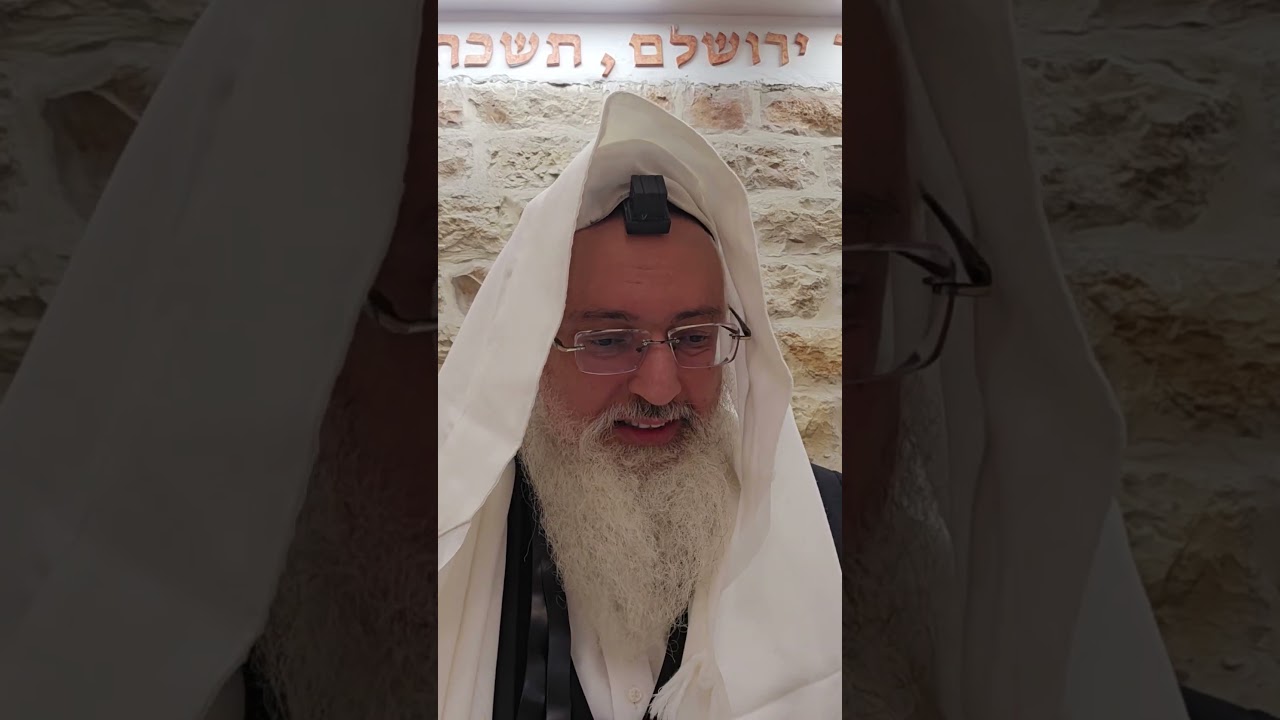

הלכה יומית/הנהגות בבין המצרים/רב דניאל בניזרי
Halakha
Extrait du cours
Because with God's help we want the Temple to be built and then we won't have to mourn, and therefore it doesn't belong to educate about a small child in mourning. Now what is the ruling? A person sees his friend. There is a law in the Shulchan Aruch that a person sees his friend after 30 days.
Transcription566 mots
Transcription automatique — peut contenir des erreurs.
antiquity. So we will continue with what we started with Atmor, with the blessing we experienced during those three weeks between the Egyptians. Now, regarding a child, a child who does not know the meaning of mourning for the destruction of the Temple, then of course it is permissible. It is permissible to give him a new life among the Egyptians and also to teach him to recite the blessing of Sheiyanu.
Because it is not appropriate, it is not appropriate to educate, it is not appropriate to educate the little one regarding the mourning of the Temple. Because with God's help we want the Temple to be built and then we won't have to mourn, and therefore it doesn't belong to educate about a small child in mourning. Now what is the ruling? A person sees his friend.
There is a law in the Shulchan Aruch that a person sees his friend after 30 days. There is a law that he must recite the blessing " Cheyenne." So here the poskim also say that this is called a mitzvah that passes. A mitzvah that passes in its time. Therefore, it is certainly possible to recite the blessing "Cheyenne" if he sees his friend after 30 days after he has committed to recite the blessing "Cheyenne." Of course he is very happy to see him, so he will surely bless our lives.
The poskim also discussed the issue of a pregnant woman. It is known that she desires something, there is a danger here. So here too, here too, the vision and the day writes that she will certainly be able to bless the life, even though she will have to bless that we have lived and sustained and reached this time that does not belong in these weeks. But since there is danger here, she is certainly allowed to bless him.
The jurists also asked about the good and the beneficial, since wine is permitted, it is permissible to drink wine. Oh, now the question is, what is the ruling regarding good and evil? The conclusion is that it is permissible. And why is it allowed?
Because they don't mention, they don't mention, the wine that we have lived and sustained for this time. Oh, by welcome, I mean well and well. Therefore, if they poured it on him, of course, according to all the conditions that he is in the meal, he should beg someone according to the conditions of the good and the beneficial. Of course, he can bless the good and the beneficial during these weeks.
Yes, regarding the haircut, according to the Shulchan Aruch, it is known that the Shulchan Aruch permitted the haircut until Rosh Chodesh. Until Rosh Chodesh, the haircut is strictly prohibited. Our Ashkenazi brothers are strict. They are strict.
They do not cut their hair at all during the three weeks, but according to the Shulchan Aruch, it is certainly permissible to cut your hair until Rosh Chodesh . Let's just say a little idea about a, about ah, free love. Free love is like when a person can't have his cake and eat it separately. The flour alone and the eggs alone should be eaten together.
So this is also a free intention to love all the people together. Only together. With God's help, we will succeed in building the Temple. Amen and amen.
artist. Yes.