רב אליהו עטייה שליט"א - ליקוטי מוהר״ן קעט - כולל נחל חיים
Likoutei Moharan
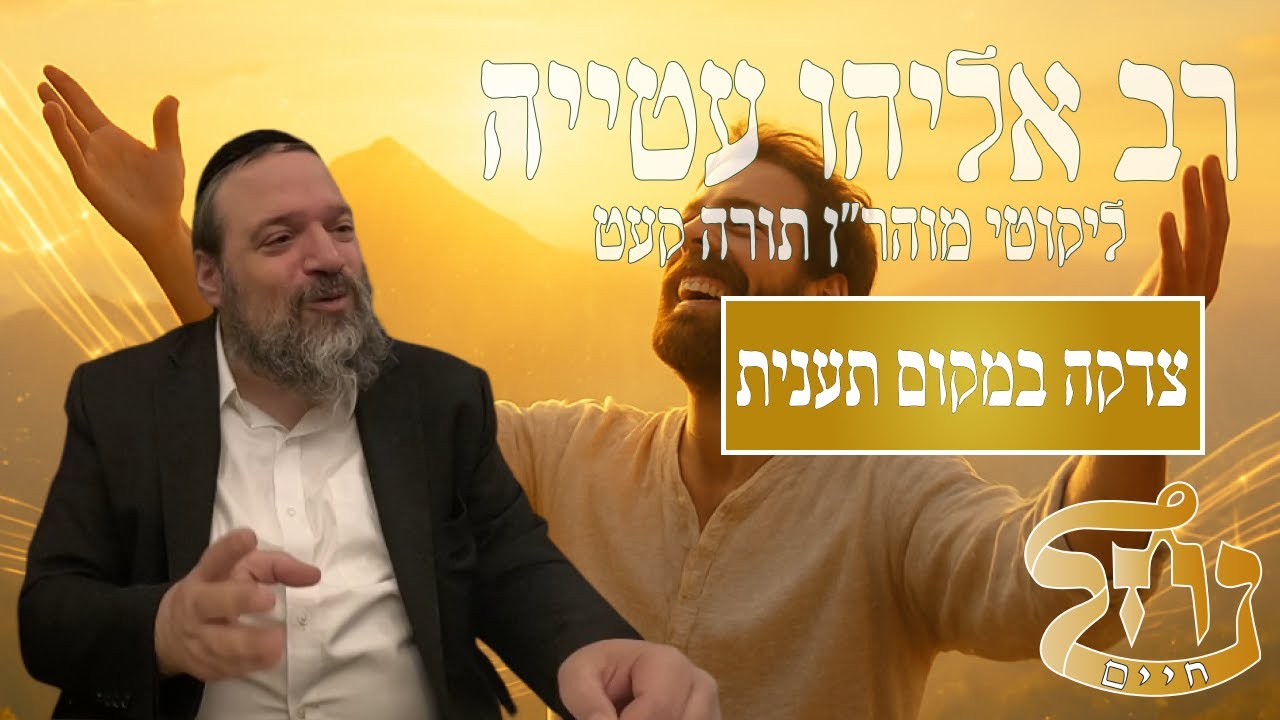
רב אליהו עטייה שליט"א - ליקוטי מוהר״ן תורה קעט - כולל נחל חיים הרב עטייה נותן שיעור של ליקוטי מוהר״ן כל יום ראשון ורבעי ב16.30 בכולל נחל חיים. הכולל נמצא בלב עיר העתיקה בירושלים, רחוב התמיד 2. #רבינחמןמברסלב #רבינחמן #ליקוטימוהרן #לימודתורה #חסידות #ברסלב #תורה #אמונה #צדיקים #אומן #נחלחיים #כולל #ביתהמדרש #כותל #רבאליהועטייה
Extrait du cours
Likuti Moran Torah Ket Rabbeinu begins, know that against all kinds of controversy and all, this Torah speaks about the matter of fasting, what is the great virtue in the matter of fasting, and in truth, this is how the work was in previous generations before the holy Baal Shem Tov, it was mainly fasting and penance. The Baal Shem Tov was the one who began to change the way of worshiping God, not through fasting and penance. And the Baal Shem Tov asked him, "Up until now, all
Transcription8372 mots
Transcription automatique — peut contenir des erreurs.
[Music] Likuti Moran Torah Ket Rabbeinu begins, know that against all kinds of controversy and all, this Torah speaks about the matter of fasting, what is the great virtue in the matter of fasting, and in truth, this is how the work was in previous generations before the holy Baal Shem Tov, it was mainly fasting and penance. The Baal Shem Tov was the one who began to change the way of worshiping God, not through fasting and penance. And the Baal Shem Tov asked him, "Up until now, all
worship of God has been through fasting, and you are saying not to fast." So he said that now that the three loves have been revealed, meaning we always knew about them but their power is love of God, love of the Torah, and love of Israel. So the Baal Shem Tov says that by these three fathers, if a person works to perfect himself in the love of God, the love of Torah, and the love of Israel, then there is no need to fast.
It is possible to worship the Holy One, Blessed be He, without suffering and penance. Now I want to say that this really is simple logic. After all, worshiping the Holy One, blessed be He, through penance is against all logic. Because we need to know that the beginning of everything is the Holy One, blessed be He, for us, Father.
Our father, our king, is our father to some extent . So our father is a father to you, it is very strong that is weak, so he is a father. Well, there's a father who wants his son to worship him whenever he's suffering, practicing asceticism . After all, all I do in life is make it as easy and pleasant as possible for my son, without making anything difficult for him.
So certainly it's not even when we look at the Torah. So the Torah also appoints one day as a fast, but when you look at the holy fathers, you look, you truly see that the worship of God was not through fasting and penance, only what at some point we learned, since the Torah saw that people sin and against the pleasure of sin, one should do the opposite of it and it was regretful to suffer. So this is the logic behind the matter of Yom Kippur. Let there be measure for measure.
Because sometimes, in order for you to internalize things, you have to let go of the pleasure you've been holding onto, and then what? So you'll make amends . This is what lies behind the logic of fasting. But again, you need to know that this is not the easy way.
And especially if we are talking about righteous people, then why do they use fasting and penance? They don't come to fast for transgressions, they only come to purify the body. So here it is even more difficult to understand why there would be such a path of fasting and penance. So really, as our holy rabbi says about himself, if I knew the steps that could be reached by what?
If I had known the steps that can be reached through solitude, then I would not have even started this matter of fasting and austerities because fasting and austerities, as we said, destroy the body. It detracts from the worship of God. A person cannot worship the Holy One, Blessed be He, as he should when he is weak and suffering, and is fasting. So we really have a bit of a problem with this matter because our Rebbe said several teachings about the great virtue of fasting, so he did mention this issue.
On the other hand, our Rebbe said in the oral Torah, as Rabbi Natan says, very much, how much one should only engage in solitude, in the love of God, in the love of Israel, in the love of the Torah, and not engage in this issue of the austerities of the body. Our Rebbe was mistaken, as it is written at the beginning of the Mishibat Nefesh, that I had a beautiful and good body, and it is a pity that I destroyed it and spoiled it with fasting
and austerities. That is, our Rabbi himself regretted that he had started on this path of fasting and penance. So if so, in fact like this, in fact maybe we should say before we study the Torah, let's say what the halacha is in practice, in fact and in practice?
Actually not charging. But if a person has a specific sin that he knows is wrong about something specific, then our Rabbi did say that if there is a specific sin, then he is held accountable, but the fast should be done in such a way that it does not interfere with the rest of the worship of God. If, for example, during this fast you will be in bed all day and will barely worship the Holy One, blessed be He, then it turns out that you will be rewarded with your great loss. There is only really a difference between obligatory fasting and fasting that a person obligates himself to due to reality.
When a person decides that they want to fast now, they fast for something, even naughty ones that charge and some that don't, it's your decision. It's not like you have four bones to claim. You must fast the Gedaliah fast, you must fast the Ten Days of Tevet. When I have to make excuses and I don't really feel the need for fasting, even though I know, yes, the destruction of the Temple, you know, but you don't live it, then you really have a hard time.
But when a person, God forbid, has fallen into some sin and he really really wants to fast to atone for the sin and he does it voluntarily, from the will of his heart, it is his will, he cancels his will for the will of the Holy One, blessed be He, as we see, then the fast is very easy and I have actually heard from people - I have never done such a thing - a two-day fast, but I have heard from people who decided that they
would fast for two days and they told me that this fast was, you can't say, easier, but not so much, not like twice Yom Kippur or not like twice a regular fast. And why? Because I fasted out of what? Out of a great desire.
When a person has a desire to do a certain thing, then he also has expectations. So that's why if a person can fast in a way that no one will notice him, he comes to a regular kollel and everything is fine, no one notices him and he has some sin that he knows is wrong, God forbid, let's say he has a desecration of Shabbat that was a little intentional. Today, God have mercy, there are also such things or other offenses that a person wants to end with. So he will fast for this purpose in a way that no one will feel sorry for him, and he himself will not feel it either.
And this is indeed advisable to do, both according to the opinion of our rabbi and according to the opinion of the Baal Shem Tov. But fasting and penance are not practiced among us today because it is really lacking in the service of God, of Torah, of prayer, of peace at home, of all things, so it is not worthwhile. After the introduction, we will learn what the virtue of fasting is, at least. So our Rabbi says this: Know that against all kinds of disagreement, there is nothing in the physical, nothing in the spiritual that cannot be prayed for.
I mean, what is called a disagreement in spirituality? That he cannot pray as he wants or do what is necessary in serving God because everything in general is a dispute that people disagree about. This means that a brother is hiding something that disagrees with the person and does not let him do in the service of God and wants to cancel his mind and will what he wants to do. In order to cancel the disagreement from whatever point of view it may be and make peace about it, you need a condition.
This means what is the opposite of a disagreement? Peace? And if I want to cancel the disagreement that I have, whether physically or spiritually? And again, let's talk more about spirituality now because we will also understand this better.
That is, I have difficulties in the service of God. I really feel that everything disagrees with me. I want to study, but I do n't get along with studying. I want to pray, but I don't get along with prayer.
This means that there is a disagreement between me and prayer. A disagreement between me and studying. Understand, then I need to make peace with the Torah, peace with studying, peace with friends. I need to do something, so it is useful.
Fasting. So, as is our Rabbi's custom, before explaining the logic, he explains the source, and once you understand the source well, you can also understand the logic. So he says this, and this is what our sages of blessed memory said . He who increases charity increases peace.
When a person increases charity, he increases peace in the world. And why? [Kahakhag] Because as soon as I receive charity, they don't argue, they don't shout, they don't fight, and everything is fine. So he is very peaceful.
Charity is a form of fasting because the essence of fasting is charity because our rabbis said, Zel Agar, the simple meaning of fasting, tzedaka, the simple meaning in the Gemara. The Gemara says that the essence of fasting is that after everyone has given charity, the collector goes and collects charity from the people in order to buy a meal to break the fast for the poor. When they talk about the poor, the poor are lazy. They have nothing to eat.
Now, on a normal day, he works a little, brings a few cents home and eats. This is what is called hand-to-mouth. They are lazy. You work with your hands and eat.
When someone is sick, one of the mitzvot is visiting the sick. It is a waste of nothing to visit him so that he has something to eat. Because a sick person does not work that day. What will he eat?
It is not like today. Every house has a storehouse for a month. Before you close the house for a whole month, you still have something to live on with what is in the house. Maybe not milk, but boxes of broken bread.
There is flour. Thank God, there is plenty. But then, most people are living from hand to mouth. So those who have money then have money, but those who don't have money then spend the whole day in the synagogue, sitting praying, carrying things, not working, so what would they eat, so what would they do?
They would collect charity from those who have some money in their pockets and thus buy the meal for the end of the fast. And this is what the Gemara reiterates in blessings and page 2. The main reward of the fast, that is, what the Holy One, blessed be He, takes from all the fast. Fasting is especially important.
Of course, fasting is very important. The giving of charity at the end of the fast is for the meal for the poor. And in this we see how much the matter of charity is so great today. There is less of this thing because giving charity to a person who has nothing to eat is almost difficult.
The reality is so expensive that they say that there is indeed a poor person and they keep him poor from year to year in a hedge so that it is possible to give gifts to the poor who, God forbid, will not go beyond poverty. Okay, so this is what it says: The reward of fasting is righteousness. So if so, fasting is a test of righteousness, since the essence of fasting is righteousness. So if so, fasting is a test of righteousness.
Now, what is a dispute? The examination of the dispute is another will that is being challenged to cancel its will. So let's define the controversy. I want it this way and you want it differently.
You want not only different, you want to cancel my will. A man wants his son to study at a particular Talmud Torah school, and for some reason his wife thinks she understands better and wants a different Talmud Torah school. And what does she want? Cancel your desire.
So there is currently a disagreement between you and what should you do? To reach some kind of peace to end this dispute. So any dispute is an attempt to nullify my will. I want to understand the Gemara, and the other person wants me not to understand the Gemara.
So she disagrees with me. I want to pray with intention from the beginning of the prayer to the end, and the guard wants you not to pray. So she disagrees with you . But the virtue of Lent was in its radiance.
In fact, on this day you will torture your souls. Again, this is the fast written in the Torah, Yom Kippur. The scapular of fasting is to subdue the heart forever by chanting the rosary to the Holy One, bless him. So he says what does fasting do?
Fasting subdues the heart. What is it? Subduing the heart? In the heart, there is a dwelling place for two passions.
So right now I will talk about the evil inclination. What does the evil inclination want? It wants all kinds of nonsense. It wants all kinds of confusion.
And what do I do with it? It subdues it. When does the evil inclination want bad things? So the evil inclination wants bad things.
It is written when it is strong. It is written in the Gemara: "Brakhot Lev" and other Gemaras. The Gemara says: When does the evil inclination growl? Yes, there is no comfort from a sack of straw, but from a sack of meat.
I told you once, Harry, give him a sack of hay to eat, he'll eat quietly because he's hungry, but give him meat, any minute, he'll hear you're hurt. Look, I eat meat. So when does the evil inclination become stronger in a person? From his food and drink.
But once you fast, you no longer have the evil inclination for anything. I don't want anything. Submission is her heart. What do I want?
I want the Holy One, blessed be He. Fasting subdues the evil inclination in the heart. And then the good instinct awakens anyway. Then what do you want?
Only the Holy One, blessed be He. Again, once you've prepared the heel of your brother's secret , his desire for bad things, then it's already getting stronger anyway, right? The good will of the good instinct. good.
[Snorting contempt] So it is that by fasting and being weak, a stage is set and all his other desires are canceled from the will of the Holy One, blessed be He, forever, in its call, "Deliva in the Holy One, may you be blessed" to attach the heart's desire to the Holy One, blessed be He, and therefore by this, the dispute is canceled, which is the aspect of other desires that are not according to His will, meaning not according to His will, may He be blessed, or
as if not according to my will. If so, I have a certain desire, as our rabbis said in their blessed memory, "Cancel your desire from His will." If you canceled your desire from the will of the Holy One, blessed be He, then what would be this virtue so that his will would cancel the will of others from your will? So if so, there is already a virtue here for peace in the home. Does a person have a dispute at home or a dispute with his friends
or a dispute with his parents or a dispute with his friends?
So what does he do? Cancel your desire from His will, and then the Holy One, blessed be He, will cancel the will of others from your will. Because the moment you canceled your desire for the will of the Holy One, blessed be He, then right now, what seems to be just wanting? Only what the Holy One, blessed be He, wants.
And then [snorts of contempt] The Holy One, blessed be He, says, "Oh, if you have canceled your desire to do only what I want, I will also cancel the desire of the other person, who will also want only what I want." Then we will find that desire. Once again, the will of the Holy One, blessed be He, is one will. But what is the logic behind this? The moment I canceled my will against the will of the Holy One, blessed be He, then what do I want?
I want the will of the Holy One, blessed be He. Says the Holy One, blessed be He, I will also give you a reward: I will also nullify the will of the other, so that there will be only my will, and then from me it is that will that nullifies the dispute. That's the simplicity. It's not as simple as if you cancel here, I cancel here.
No, these are the same cancellations to reach that same will that we changed, we will obey the will of the Holy One, blessed be He, then everything will be fine. So they ran in order to nullify the run, and why does a dispute sometimes arise for heaven's sake? Because sometimes I really want to go to heaven and you really want to go to heaven. We only have two ways of serving God.
And so sometimes it doesn't help that I cancel my will for the will of the Holy One, blessed be He. Because the will of the other is also the will of the Holy One, blessed be He. It is just a different way of serving God. Therefore, a dispute for the sake of heaven will eventually be resolved.
Because again there is no black and white. These are two types of white. [Laughter] There are just a few ways to worship God. That's a very beautiful depth.
It is good to understand this and by fasting, one's will is already nullified because of the will of God, blessed be He. Likewise, the will of others is nullified because of His will and the dispute is nullified and peace is made. As the more charity, the more peace. And this is what our rabbis, may their memory be blessed, said.
The fourth fast, that is, the fast that occurs in the fourth month, which is Tammuz, and the fifth fast, which occurs in the fifth month, which is Av. What occurs in the fifth month, Tisha B'Av? So we are talking here about the 17th of Tammuz and the 17th and the 9th of Av, and the seventh fast, which is again, this is Tishrei, the Gedaliah fast, and the tenth fast, which is in the tenth month, which is the month of Tevet. Yes, it is very interesting that the verse lists the months in which the fast occurs and not the days of the fast, but this is how it is written: "Let there be strife and joy." What is the continuation of the verse?
And the truth and peace are loved. So if so, the fast of the Rabbi, why do I mention the fifth part of the verse? You will understand in a moment what it means to fast and what it means to fast. Except when there is no peace, fasting means when there is no peace and there is dispute, then it is a fast because and so on.
So I want to explain first. The Gemara The Gemara in simple terms is not clear. The Marsha explains there what the Gemara is asking. What the Gemara is asking is, namely, fasting and being a lesson for joy.
So the Gemara says that this is a contradiction. One moment you call it fasting and the next you call it a lesson for joy. What do you want? It was fasting and death, and now they have been expanded to be lessons and joy.
Is that true? What is the Gemara's question? The Marsha says that the Gemara's question is whether Zechariah prophesied in the first verse. And if he was born in the first house, then he is saying that petitions are truly destined to be abolished and when the second house is built, they will be a season of joy.
But we see something else, that afterwards they once again returned to fasting. That is, the cancellation that you said was for a fast for joy has not been completely canceled because it is still called what fasting is, and on this the Gemara continues that the teaching is from the continuation that the verse explains the author from what is written, "Truth and peace have loved," meaning that whatever will be "thou shalt love and joy" is on the condition that there will be peace, meaning that there will
be no war, that there will be no destruction of the Temple. But if we destroy the Temple, then truth does not exist, and what is not from Abu, because the Temple is destroyed, then in any case the situation of "sassot" does not exist. This is how the author explains the question and the excuse.
So if so, according to this, what is happening here? So we have a fast and we have peace. If there is peace, there is no fasting. And if there is fasting, it is a sign that there is no peace.
That is, when there is a dispute, one should fast. And what is the benefit of fasting? Fasting is beneficial so that there may be peace. This principle has been discussed many times.
Our Rebbe says in the Torah, 67 Tanina. This is a principle that we do not fast today on the ninth of Av for the destruction that occurred 2,000 years ago, because what was was, but mainly what we fast for is for everyone who mourns for Jerusalem, is justified and sees the building. This is how it is written in the Gemara, in Taanit, page 30, meaning the fast. He himself causes the building of Jerusalem.
So here too, our Lord says, our Lord says, the fast is the one who brings the peace that abolishes the fast so that it will not need to be broken, because with the help of God we will merit redemption. So through fasting we make peace. And then when there is peace, there is joy and happiness, because through fasting we build a level and a life of joy. So we saw in the previous lessons that there is a test in the Torah, that there is a test of the level of joy, that you need to rejoice from head to toe, that your entire body will go through joy, not heavy in the legs, not heavy in the hands, but joy in the whole body.
So that's all the joy and happiness. Because the virtue of fasting awakens and revives the dead. We are the days that passed in darkness, return them to holiness. That is, the days that passed in darkness and sin, God forbid, and have no life, must be returned to holiness.
And here we see something reciprocal between time and the commandments or sin. And always to explain it here he does not bring this brilliance, but there is brilliance regarding Abraham our father, and Abraham was old and came of age, and God blessed Abraham with everything. Thus in Parashat Chai Sarah, Chapter 24, then and Abraham, an old man, came in days seeking the Zohar, came in days, came in his entirety, daily, brought all the days in their entirety, where else but God, blessed be He, was Abraham
our father? What does it mean when a person, God forbid, sins, then in addition to committing a sin, he burns and spoils the time of that day, meaning if a person sinned one day, then he took the animals of the time that was given that day and threw it into the fire.
So what makes a person bleed is what? This is the day itself. Our Master will later bring the written days of his creation, and not one of them. Not to him.
What are the days of creation? All days of the year and not one of them. The Holy One, blessed be He, has one day in them. What is this one day ?
It's Yom Kippur. Yom Kippur is equal to all other days. And why? Because when I fast on Yom Kippur, I manage to give all the days of the year the animals and milk that were missing from them because of the sin I committed.
This is the innovation for Yom Kippur. Therefore, our Lord says in Likutei Moran Torah Tanina and in Sefer Hamidot Teshuvah, part 2: The matter of Yom Kippur is above time, and the day a person makes Teshuvah is above time. What is the logic? Because I need to correct the time now.
The time has already passed. Where will I get to it? But if in terms of above time, which is the cancellation of time, the moment you reach a time that is above time, you can also correct yesterday. You can also bring yesterday's.
Now our rabbi explains that this is the whole basis of my Yom Kippur and fasting. Because you're fasting, now we'll understand the logic. When I can't eat today. Well, how are you living?
You didn't eat. How do you live? You live on yesterday's food. That is, when you fast, what do you do?
You take what I ate yesterday. The animals of yesterday and brings them to today. Now, when I fast and do penance and I live off yesterday's food, then it means that I am correcting yesterday's animals. Because again, all I have alive today is from the strength of yesterday.
Because today I'm a gift and can't eat. So now that I do good things with the power of yesterday's animals , that itself corrects yesterday. But if I sinned last week, I'm in trouble. So I need to do a fast that will bring back the last week.
So I need maybe two days of arguments, because then you're already living off what you ate last week. Therefore, it is best to do the answer immediately. [Laughter] Now go and bring up a day from two years ago and get involved with it. And our rabbi says that according to this, a person must literally dismantle the body and fast until he reaches his childhood.
Until he reaches the point where he literally lives off of suckling milk. This is now the explanation of what is good. We need to do it in other ways. But in any case, first let's understand the logic of what is written here.
Well, then he says like this. So when he takes this day, then he says, he explains everything himself. So he says like this. And when he does good deeds and good deeds in this day, this day enlivens him, he continues to give him great life and abundance from above.
Again, you do good deeds, you enliven the time of the day. Brothers, God forbid, if he does not do a mitzvot in it, then abundance does not descend upon him from above, because in a very great reduction, only to live. The meaning of his life in a reduction. And when he gives this day and does evil, not only does he not do a mitzvot that gives him so little to live, but he does a fool, God forbid, this one takes away and sucks and sucks the little abundance that is in this day.
Because again, a person who has committed a sin, not only has committed a sin, but instead of the time to do a mitzvah, you have committed a sin. So if I didn't do a mitzvah, I didn't learn Torah, I only gave animals in moderation. And when you commit a crime, you also go and take the animals in this reduction and give it to a brother. Until it even sucks the very life that today has in itself, besides the abundance that comes from above, something comes every day.
Because every day is a creation and has life itself, besides abundance. And he also sucks his own life, peace. Our Rebbe comes and says, not only do you take the abundance given to the day by the few mitzvot you do or by your true self-vitality, but you also suck out the self-vitality of the day. This means that the Holy One, blessed be He, has determined for each and every day a certain abundance.
Until these days remain dead carcasses. Like the parable of the baby suckling from its mother's field. As long as she has milk, she will suckle the milk. And when the milk stops, God will preserve the suckling of her blood and life.
This is the greatest torment for the mother, but through fasting, he awakens from the life of these days, and everything is according to the fast. As he explained, it must be understood in a physical sense, because when one fasts, he finds that he has no vitality and strength from today until tomorrow, when he does not eat or drink, and yet he works for God, he finds that he works for God with the strength he had from yesterday, because without it, there is no strength. After all, if I worship the Holy One, blessed be He, without eating, then by your strength I am working with yesterday's strength. It is found that today one works with the strength of yesterday.
Therefore, he brings his life. Animals on the same day as yesterday. If I am now working with yesterday's strength, which I did not do yesterday, then I am currently bringing to my work of the Name the vitality and holiness of eating that was there yesterday. And then when you fast again and it doesn't have enough strength from yesterday because the body has already weakened, I have already used the strength of yesterday and had to use the strength of the previous days to prevent further disruption, which is found to bring life and awakening to the first days [like a fast] that fell and died again.
I take strength from 100 days before and a thousand days before, and why, because in a continuous fast of two or three days, like the fasts that Harry Zell arranged, the cold really tears you apart and tears your body apart. Again, we're not actually talking. Until it is possible to be so tortured that he will have to use the power of the days bestowed by his mother's breasts. And this gives life and light to all days.
Because for the first time, you use one mitzvah that you do now on a day of fasting. You illuminate and revive all the days that have passed until now. And therefore, through fasting, we build the level of joy, which is the sister and point of all the commandments as an introduction in another place and here, as Rabbi Natan immediately said, this is not a matter of the Bible, but the intention is that the level of joy is parallel to both the level of your body and the level of time, and in any case, the more days you live, the more you liven up your body. If we also take the time since you were born until today, this is also a complete level, which is time.
There is the day of birth and then there are the first years, and each time you grow and grow more and more. Once you have used all the powers that exist in every level of time, then you have already used an entire level of power. And in any case, parallel to this is the level of joy and you give joy in our trust, our trust in us every day and day that you transform it from sadness that you gave suck to a secret to a brother
to joy, then you have completed the level of joy, so Rabbi Nathan says, this is the matter, not explained, mainly by the hand of the covenant, by what finds the strength of each day and day that has passed and puts it into the service of God, it revives all the dead days that were flawed. This is how the joy is built, as it is written in our trust as it is given in the language of fasting, meaning that the joy will be as much as the
fasting, because as the days of fasting, the more one fasts, the more one lives the first days in his mitzvot and good deeds, and so the joy is built, as our rabbis said, " When there is peace, when there is peace, that is, the fasting has become that you do not need to fast, that there is joy and joy, because when there is peace, we were by fasting, by this, that there is fasting and joy, as in terms of our trust, as if with us as
the days of fasting, yes the joy is now here, as we said in Golmi Raor.
Your eyes and all the days will go out, and not one of them, every day is a creation in itself, in truth, every day in itself is a whole building, a creation in itself, a day in itself, that you need to fix this day, we always fix whole days now, and not one of them is Yom Kippur, as Rashi explained there. And why? What is connected with Yom Kippur? Yom Kippur is a fast that revives all the days.
That is, what is the day that revives all the days of the year? Yom Kippur. The Gemara also divides this. The Gemara says on page 20 that Yom Kippur is the first day of the year.
Satan in the gematria is 354. And there is one more day that he does not have permission to control, which is Yom Kippur. And the interpretation is that by Yom Kippur we are forcing back all the days that Satan ruled. That is, this is also implied in the Gemara.
This is because the whole of Yom Kippur is the totality of all the days. And it is said that on this day you will torment your souls. What does it mean? You will torment your souls?
A soul is a desire, meaning the desires, as it is written in the Zohar, to please the whole body and soul and to fix it. In the fear. That is, what do we do on Yom Kippur? Then we include the body and the soul.
Because the moment you fast, you make the body like a soul, like a soul. It does not now eat and enjoy, but it is also holy like the soul. And to fix the fear and see it as a blessing. Through this, their desire in the holy place will be in your blessing.
Because the soul is a form of will and the main thing is to subdue the will and it is actually this day through the internal self of the day that is included in all the days, you will fast your souls. So this is the intention in this day itself, the self of the day and the intention that what you come and eat on Yom Kippur takes strength from the whole year. So according to this, a good question was asked. There is a mitzvah to fast and
eat on the tenth day and whoever fasts on the ninth day, then it came to him that the scripture should be as much as possible on the tenth day and the shir according to the Torah of our Rabbeinu until Rabbi it was the other way around.
I would come and say that it is better not to fast, not to eat on the tenth day. Maybe I don't know, you should fast, but in order for Yom Kippur to be attractive, what about the other days? So the answer is that really Yom Kippur does not need this work so much. To subtract all the days from the power of all the days that preceded.
Because as in reality, if a person only fasts one day, he does not need to take from a long time before, certainly not even from the week before, but in truth, as we explained earlier, Yom Kippur has this wonderful power that is above time, and since it truly is above time, then it includes all the days, that is, even though in physicality what our rabbi said does not take place, and it must be understood in physicality on Yom Kippur, and when I do not eat on
Yom Kippur, I do not take place, at most I take place from yesterday, but not from the week before, certainly not, but only from the days that are nearby, at most, in any case, it atones for an entire year, because Yom Kippur is not in physicality, but on Yom Kippur it is in spirituality, which is an examination of what is above time. So let's explain this a little. It is written in Genesis, " God created the heavens and the earth." The Holy Zohar says what is
in Genesis, Genesis, that time itself is a created thing. We would think that time is a virtual reality.
That is, like the ticking of a clock, it does not need to be now. A clock that ticks so that time passes, but time passes, passes, time passes. That is why we cannot understand that there can be change, there cannot be a shorter day and a longer day. Why?
The reality is that time always passes equally and that is it. And if so, there has always been time and there will always be time, this is the simple opinion, but the Zohar and this is how most of the Rishonim say, and our Rabban in the animal talks about this, and the Ramban and the Rashba in the Teshuva and the Rambam all mention and come to this conclusion that time itself was created, meaning that before the Holy One, blessed be He, created time, there was no
building at all for the creation of time, therefore where can one ask what was the beginning, when will the beginning be, of something, because before I created time, there was no time, so you cannot ask what you have, this itself is difficult to understand, but this is a definition now, since time is a created thing, so I am now beginning to understand that this created thing, you need to animate it, because there is generally everything that is created in the world, it needs to have life,
even a stone, it needs to have life, we do not know what the life of the stone is, but we know that it has life, what is the problem? Today we know that the main [snoring [Booz] All the atoms that make up everything in the world are empty. The vast majority of the atom is completely empty.
Everything is empty. Just what? There is some rapid rotation of electrons around the nucleus of the atom and they create the filling like a plate, like a fan that rotates quickly, it looks like there is a plate. But you know, it's because there are only a few wings like that in all of creation.
So if so, even in a stone, the Holy One, blessed be He, needs to give power all the time in order for this rotation to occur. No one knows why there is this constant rotation. One of the laws in physics is that there is no movement without energy. A fundamental law in physics.
If there is no energy that causes the movement, there is no reason for the movement to be alone. And no matter how many have tried to make all kinds of patents to achieve uniform movement, there is no such thing. But in any case, in nature, there is, in the simplest atom, there is this thing in it, the Holy One, blessed be He, requires it. This is the life that the Holy One, blessed be He, gives to everything and everything in creation.
There are some things even within the physical world whose explanation has no natural explanation, only spiritual. One of the rules is that many times, every Something that the eye cannot control, so many times the explanation for its physical behavior can only be a spiritual explanation. So an atom is one of the things that is considered to be beyond the eye's control. Until they invented the electron microscope, they couldn't see an atom.
It's just a new thing of the last generation that allows you to see an atom at all. So okay, it's called something that the eye cannot control. And really the explanation for these things are just spiritual explanations that the Holy One, blessed be He, gives power to. Yes.
Certain energies that He gives to everything and everything that have no other source than what is spiritual. And therefore also time, that time has a healthy reality is because time receives life from the Holy One, blessed be He Yom Kippur is truly considered in terms of being above time and because it is the root of this very day, as our rabbi says that the selfhood of today is the one that gives life to all of this day, so in fact on this day you will fast
your souls, it is the one that gives life and life to all of the days. Therefore, the moment I fast on Yom Kippur, it really means that I have fasted all year long. The meaning of this is that I took animals from the entire year because Yom Kippur includes everyone and now every defect of transgression our Rabbeinu explained that I used today's animals to give it to the next day but as soon as Yom Kippur arrived which includes all the days of the year and I
sanctified it because Yom Kippur I am who from morning to night I am an angel I am only in Torah and prayer and holiness and fasting even when I sleep I am fasting so what did I sanctify?
Every moment and moment of Yom Kippur I sanctified every moment and moment of the entire year and this is what Rabbi says The decree of a day of expiation I mean it is now the one who disagrees on it says specifically if it is a condition and read it a holy reading because in any case you have to do some kind of fasting act this is so by the way the halacha but you need to know that although the halacha is like the sages who disagree
on the rabbi and believe that there is no fasting itself of a day of expiation without repentance and that you read it a month but there are times that they rule as if in retrospect or as if they rule as if on the opinion of an individual like the halacha of a rabbi from his friends sometimes then also there are people that the Holy One blessed be He gives They have this privilege that the middle of the Day of Atonement, such as babies who were taken,
which we are now in a little while in the celebration of the Chazon Ish, Chazon Ish, one of the great innovations of the Chazon Ish, the celebration that the Chazon Ish considered one of the great innovations of the Chazon Ish is not according to the interpretation of any rabbi, but that is how they accepted it as a law in the generation of the heathen, that babies who were taken are also those who are among Jews who are Torah and mitzvot-observant, not according to the interpretation of
the Gemara, but taken in their minds, because that is how they were raised. They also have the distinction of a baby who swore, and for babies who were taken, they do n't even do Yom Kippur because they are so deep in their error without any knowledge at all, so even for them there is the matter of the middle of the Day of Atonement. Again, the Chazon Ish did not say that the Chazon Ish said that babies who were taken, you can desecrate Shabbat on them, even
though there is always a morid, a, not an a, nor a morid. This means that apparently you cannot desecrate Shabbat on such a person, but what because there is another law of a baby who swore, you do desecrate Shabbat on him, all kinds of things.
In which the Chazon Ish says something about the halacha and that is how the halacha actually ruled like the Chazon Ish in the last generation, everyone, even though the Chazon Ish himself is a huge innovation against the simple simplicity of the Gemara and the Rishonim and all, but the Holy Spirit that was in the Hazooni Ish is what the Holy One, blessed be He, wants the halacha ruling to be. There are several things that we need to know that the Holy One, blessed be He, sometimes
gives the Holy Spirit to the posek and he decides on a particular halacha even though until now the simplicity was not like that and why because that is how the Holy One, blessed be He, wants the leadership to be from now on and from now on, the leadership is like that. In our generation, everyone unanimously accepted the Hazooni Ish ruling with all the difficulties and necessities. Therefore, they desecrate the Sabbath for babies who were taken, and the Chazon Ish greatly expanded this concept.
I add that it is not written in the Chazon Ish that this consideration of the decree of the day of atonement of the Rabbi also applies to them. Even though we, according to the halacha, do not rule like that. We rule only if you are fasting and only if you have read it from the Bible. Holy.
But people who are considered as infants who were taken have the consideration of fasting on a day of atonement. And this is very important to us because the atonement of sins that will be for the whole of the people of Israel takes away from our guarantee. Because when you have a guarantee and the guarantee is for everyone who is called a Jew, everyone who still remains in the name of Israel, did not leave the people of Israel, did not convert to Christianity, did not convert to
Islam, he is still in the people of Israel, you have a guarantee for him. Well, think that today we can say that most of the people of Israel have not yet been able to keep the Torah and the commandments, not to mention even those who keep the Torah and the commandments, they have many counterfeits, everyone counterfeits.
So if so, what will happen? Rather, it is a great grace whose own fast atones for infants who were taken. This is a great grace for us because if not we will suffer from the guarantee that we have. Therefore, the Holy One, blessed be He, says this point and there are those who do not even call themselves holy, who do not fast on a day of atonement and this is the matter that does not have to be only in the physical, as we explained earlier that
you, Luke, are taking from the power in the previous waters Because if that were the case, there would be no mitzvah to eat on the ninth, but it would have to be the other way around, so that you don't eat on the ninth, you eat families so that you carry over from as many days as possible from before.
But in spirituality, our Rebbe explains that the matter of Yom Kippur is like an hour above time. It includes all the days of the year, so I don't care what I absorb from the previous days or don't absorb from the previous days. And this is one of the profound things in our Rebbe that you need to know. He sometimes breaks a rule in the middle of the Torah.
Until now, he has gone through the process and brought you in. Yes, all the time, like here, we really do take from the previous days during the fast, and suddenly he talks about Yom Kippur, and Yom Kippur is a completely different issue. And he will put it in the same Torah, and he expects you to delve deeper and look into it and understand. I talked about two topics here.
There is a connection between them, but there is also a very big difference between them. That is where he will bless us.