רב אליהו עטייה שליט"א - ליקוטי מוהר״ן קעז - כולל נחל חיים
Likoutei Moharan
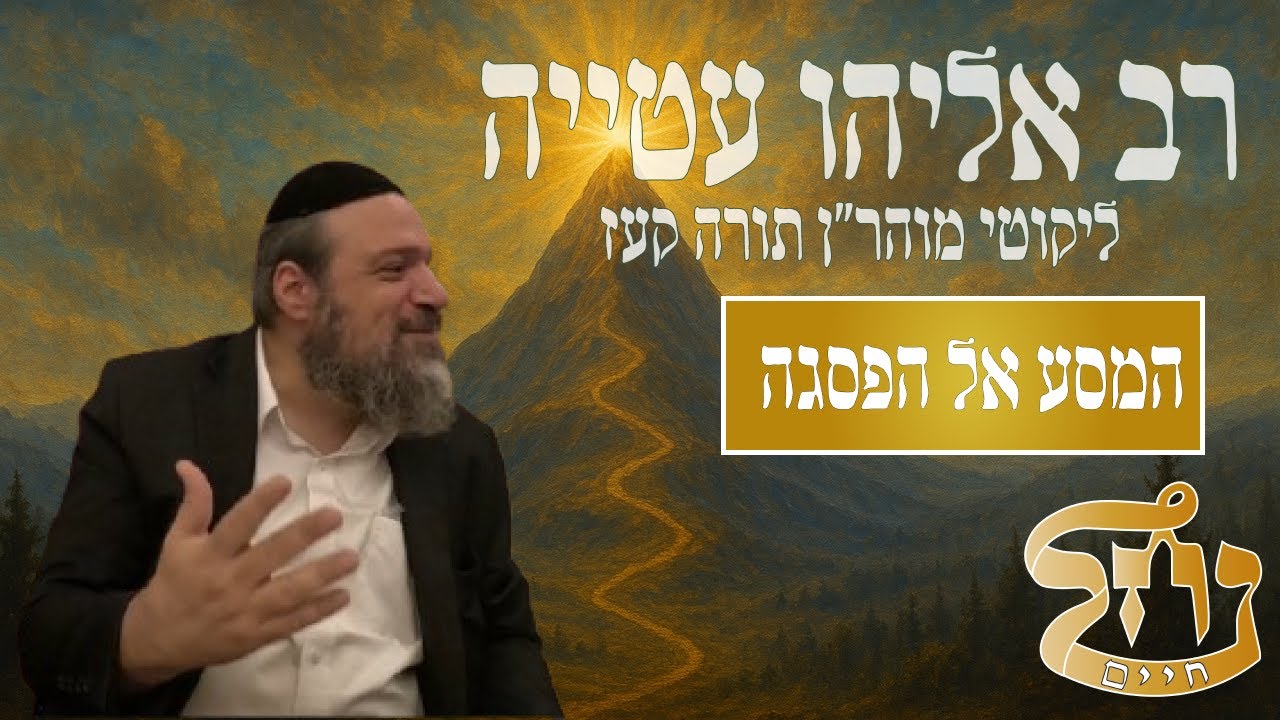
רב אליהו עטייה שליט"א - ליקוטי מוהר״ן תורה קעז - כולל נחל חיים הרב עטייה נותן שיעור של ליקוטי מוהר״ן כל יום ראשון ורבעי ב16.30 בכולל נחל חיים. הכולל נמצא בלב עיר העתיקה בירושלים, רחוב התמיד 2. #רבינחמןמברסלב #רבינחמן #ליקוטימוהרן #לימודתורה #חסידות #ברסלב #תורה #אמונה #צדיקים #אומן #נחלחיים #כולל #ביתהמדרש #כותל #רבאליהועטייה
Extrait du cours
Likuti Moran Torah Keez and interesting This Torah was recited in the Shabbat Noach of the year of Teksa So that's how we really study it. We'll see in Teksa That is, some 221 years ago this Torah was recited and this Torah was recited on Shabbat Shabbat The groom was at the wedding of his daughter Miriam and our rabbi was really happy, very, very great joy at every wedding He was very happy at weddings and danced a lot and said all these Torahs out of great
Transcription8676 mots
Transcription automatique — peut contenir des erreurs.
[Music] Likuti Moran Torah Keez and interesting This Torah was recited in the Shabbat Noach of the year of Teksa So that's how we really study it. We'll see in Teksa That is, some 221 years ago this Torah was recited and this Torah was recited on Shabbat Shabbat The groom was at the wedding of his daughter Miriam and our rabbi was really happy, very, very great joy at every wedding He was very happy at weddings and danced a lot and said all these Torahs out of great
joy Here this Torah is really divided into two because there is one part that is almost impossible to understand because it is only the beginnings of the chapters What is the meaning of the beginnings of the chapters Oh sometimes our rabbi would write for himself to remember He would write for himself abbreviations abbreviations abbreviations and sometimes we don't have exactly the entire Torah only his handwriting this abbreviation The first part of this Torah is a regular part that he recited and Rabbi Natan wrote and arranged
So let's start with the first part The verse says And the Lord said I have sent you according to your words The acronyms of my cup So if you pay attention to the words And the Lord said I have forgiven you according to your words Then these are the acronyms of my cup Very interesting That this verse was said after the sin of the spies, yes also 20. You can see by the appearance a place in Numbers 14:20. This means that it is Parashat Shelah immediately
after the sin of the spies.
And the Gemara in Berakot Lev demands this verse as well after the sin of the spies. Yes, there is no mention here in Shemot Lev because it is not found there, even though in Shemot Lev the whole story is not written. Then and the Lord said, I sent according to your words, it is said after the sin of the spies. And in the Oral Torah we have received that the same [snort of contempt] verse is exactly the same words, the Holy One, blessed be He, said, I sent according to your words, even after the sin of the calf.
And our Rabbi uses here the acronyms, the acronyms, the acronyms, the cup, and the word, because your words. He also divides its root, which is the word, the acronyms, you slept in the main body, and now he explains the two hints, the word, the cup, and the word of Dishnata in the main body. He says so. For there are true righteous people who have the power when they drink wine sometimes, that is, in times of joy, to forgive sins by it.
That is, by drinking wine, they are freed from sins. This is something that needs a lot of explaining. Because our sages said that Zen has two tests. [Snorting contempt] He won, he became the head.
And when the head is made, it is a kind of brain, by which it can excavate sins, as it is written, "And a man of womb excavates it." And the Lord said, "I have forgiven you, as you have said, for you have said the words of the initials, you have slept in the oil of the head, which is a kind of completeness of the brain, which is a kind of holy anointing oil, in terms of the good oil on the head, as is well known. So this point first, perhaps we will mention, with the help of God, we will get to it. On the daily daf, we are exactly in the middle. Yes, but on page 2, the Gemara there says that the priestly garments excavate.
What does it mean that the High Priest's wearing the priestly garments has the power to atone for minor sins. It atones for slander. It also needs to be covered with blood. It is necessary for minors to cover up slander.
The Gemara there says that each garment of the priestly garments is atone for what? It is simply atonement for sins. In simple terms, the matter of atonement for sins is a vow to the Holy One, blessed be He. The Holy One, blessed be He, is the one who can atone for sins.
But there is some sermon here on a verse by a wise man excavating. That is, there is power for a person who is wise, wise, righteous, that he can atone for sins. So, yes, there is this point, and as is explained in the Holy Zohar in Parashat Achari, and there is an incident told of Rabbi Abba, who met a Jew, may God have mercy on him, who had committed a transgression, and he did so, which is an effort and everything. And in the end, Rabbi Abba, it is written in the Zohar, atoned for his sin by force.
Of course, there was an awakening of repentance here, but whoever made the atonement, the foreigner, says explicitly that Rabbi Abba did it. So, we see this in several sources, and also Hari Zell speaks of the fact that a righteous person has the power to atone for sins. But how does it work? In particular, when we look at the verse here and He says, "I will forgive according to your words," meaning, "I will forgive because of your words." What is your word?
Simple. As you asked. As you asked, so I forgave. But this is the simple simplification of the verse.
But in fact, whoever made the forgiveness, it was what it was, apparently, from the simplicity of the Holy Verse, blessed be He. So the explanation is this: Our Rabbanu says in Lakuti Moran Torah 4: A very great foundation. There is some kind of The point is that Moses our Lord says to the Holy One, blessed be He, that if you are not able to serve the people of Israel, then here is your book that you wrote. Then the question is asked, as if someone who reads the verse and what we are children, establishes this issue in us, and blessed be God, by the Rebbe it was settled.
It is as if an ultimatum: if you are beaten by them, it is okay, and if not, I am not, then erase me from your book. This is a bit of what is meant. There must certainly be a complete connection between what Moses our Lord comes and says about forgiveness from your book that you wrote and this matter of what the sins contain. So our rabbi says an innovation, indeed it is an innovation, something called something so brilliant, very, very brilliant, and he says it like
this: He says there is a verse and commits a crime to the remnant, what is the verse and commits a crime to the remnant, then the Gemara demands that the Holy One, blessed be He, commits a crime to the remnant, whoever puts himself as a lamb on Rosh Hashanah, so what is as a lamb that he is completely tied?
Moses our rabbi was sure that he was truly the most tied man of all people, and if I am so tied, then there should be a test of committing a crime to the remnant, and if I am not able to ask you to forgive them, or if I myself am their mother, or let's get into it for a minute, if I am not able to do this action, the meaning of the matter is that Moses our rabbi says that I am not tied enough, if I were enough of a rabbit, then there would certainly be a case of committing a crime to the remnant. So Moses found a brilliant piece of advice. He says, how can I be more polite? Why don't I have enough of a tie?
Apparently because every verse in the Torah that says, "And the Lord spoke to Moses," the entire time it says "Moses, Moses." So after all, maybe it gives me some kind of shock, some kind of feeling of it. If so, that's why I'm probably not wearing a tie enough. So I have advice and the genius advice of Moses our Lord, let's solve this problem now, and yes, here is a number that you wrote, and through it I will truly reach a level of greater humility, and then you will surely forgive them. This is a gauntlet.
It is really, really brilliant and beautiful. And this is how our Lord explains that this is the negotiation between the Holy One, blessed be He, and Moses. I mean, between Moses and the Holy One, blessed be He. That is, it is not a sermon.
That is, it is what was there. That is, the Holy One, blessed be He, says to the Holy One, blessed be He, I want to reach a situation where I can forgive the people of Israel. That is, the goal now. If for this you need to be more generous, then I have advice, and he comes.
Not, God forbid, an ultimatum, not, God forbid, a harsh and painful speech like that. But the point is, and then the Holy One, blessed be He, says to him, "No, whoever sins against me, my mother, is from my number." That is, it has nothing to do with you, even after writing your name, then you can, but really, the very fact that Moses our Lord accepted, took upon himself this thing. This brought him to the perfection of humility that the Holy One, blessed be He, desired. I mean, in truth, sometimes you can only reach a level of what?
By the desire I so want. The fact that you so much want your name to be removed from the book of God, blessed be He, from the Torah for this purpose, is in itself unparalleled humility. So, I mean, yes, so we reached the goal without performing the task, I mean, we don't have to, so everything is fine. So it really is very beautiful.
Both the abamina and the conclusion are the same thing and this is even more profound for our holy rabbi that really what Moses asked for is really what actually worked this thing but there is another explanation in this why there really is a connection between humility and the forgiveness of sins what is the order humility is the most beautiful and highest level but why does it go over a crime to the rest that it is as if there is some condition that there should be humility
specifically for the forgiveness of sins but the simple so that a person may be entitled to all sins the interpretation of a thing that he needs to be a chariot for the Shekhinah with the help of Hashem now in this parasha we start the next parasha and Abraham ascended above him so above Abraham then it is explicitly written the fathers there is no chariot what is the simple that by means of which a person is so entitled to reach complete nullification to Hashem blessed then he
is a tool for inspiring the Shekhinah and in any case it is no longer a Kamina this is Moses contained it is all the same as long as I have God forbid an entity then my entity separates me from the Holy One blessed be He then there is me as it were and there is the Holy One blessed be He and there is no connection but the moment you are null and void to Hashem May God bless you and literally all of you are just a
cancellation for Hashem, may God bless you, this enormous cancellation that a person deserves to be separated from the Holy One, blessed be He, so now everything is settled and He said, "I have sent" as you said. "I have sent" on whom in the end the righteous one can determine to be the one who is contained and why because it is actually the Shekhinah, the mouth of justice, this is the mouth of the Shekhinah. The Shekhinah speaks from his throat. What is the Shekhinah speaking from his
throat?
It is simple that he is so canceled that the Shekhinah speaks from his throat. So if so, everything is one, then it is also settled. How does there exist such power for the righteous one and also settled. This point itself is that I have forgiven, as you said.
But there is another thing that is sometimes necessary when a person, blessed be He, is still a slave, then he enters a little into the mind of the little things and why? Who am I, what is my life? And in truth I am beginning to be who I am, my life, and here, as our rabbi says in Likutei Moran Torah 22, one must walk between the drops, giving what it is to walk between the drops, on the one hand to know who I am, to know my greatness, and on the other hand to be the greatest humble and lowly. How is it possible to walk between the drops, that is, to know his greatness?
The petition on the other hand. So the true path is truly Moses, because the question is always asked, after all, Moses himself, how is it possible that he would be the most evil of all the people on earth? I know, thank God, that I received the tablets. We have talked about this question several times and it is something that should always be discussed.
After all, I received the tablets, I gave them to the people of Israel, I am the Rebbe of all the people of Israel, the hardest thing for you to do is to come close to me and judge. He truly has the power. Certainly, Moses our Lord. But the matter of true humility is to know correctly [as a virtue].
But it is not mine. It is all the Holy One, blessed be He. Everything belongs to God Almighty. That is, I know that what I am wise is God Almighty.
Everything that I am rich is God Almighty. God Almighty gave me money. Not only to say it, we all say it, but to live it. To live it in such a strong and clear way that there is no other reality but a real living person.
I am nothing. Because what am I? It is just what God Almighty gave me. When you truly live it, you do not hold any kindness to yourself at all.
And that was the enormous power of Moses our Lord, who understood that every step or level that is in it is there, but when you reach humility in this way, then you will notice that it is humility from a mind of greatness. Again, there is humility that comes from lowliness and it is not good humility. And what does it mean by "out of humiliation"? That I really am screwed and that's what I put in my head and by doing so I also act with humility and lowliness.
But this is humility that our Rabbi calls bad humility. It's a complete mess, even though it's really not worth it now. He's also struggling with this humility. He won't do much in serving God because I'm screwed and can't and don't understand and don't know who I am and what my life is like.
This is improper humility. This is humility that comes from the evil inclination. This is the humility of a petty-minded person. That she is competent in it is a matter of law.
Yes, humility also has a shell. Yes, that is the shell of humility. But there is a humility that comes from being prepared for greatness. vice versa.
The more I know, the more there is something worth in this body. I intentionally don't want to say the word "I" because it's contradictory. [Snorts of contempt] That there is something worth in this body, so what can I say? To be truly humble.
I mean, sometimes when a person succeeds in doing something very big, and when he does this very big thing, he comes to his senses, wait, can I do that? I could do that. Sometimes a person, thank God, does a very great deed, saves a lot of lives, or does all sorts of things that you see people do great things, what are called larger than life, huge things. Now, among us, one person can do this thing, but what do you immediately understand?
There was a huge heavenly council here that you could be at a crossroads. You can think for a moment that I deserve the honor. Yes, just like we have some kind of president like this. Everything is his.
Everything is everything. It's until it's disgusting. Everyone laughs at him. So okay, if that's what he needs at the age of 80, then let him have it.
But that's what a human being is. Everything can fall apart a thousand times. Everything is a heavenly council. Even a Gentile has a heavenly council.
He has many rights. So he has a heavenly council. But don't feel sorry for yourself. Because really, it's not yours.
It's only the Holy One, blessed be He. So if I'm thinking these bigoted things, I'm the opposite. The more I appreciate what I've done and I want to say what was done by me, I can be even more humble. It's very, very good to think like that.
Because then I'd rather not lie to myself that I don't know the entire Torah. I know, says Moses our Lord. All the Shas. All the Babylonian and Jerusalemite.
And everything that the old student is going to renew. I know everything. But between us, how? My brain can know all this as a gift from the Holy One, blessed be He.
So what do I have to be proud of? When does a person boast about his own special thing? And when a person works on this thing while he talks to himself in solitude and begins to work with it? All these huge and beautiful actions that have passed through you are only from the Holy One, blessed be He.
So if we find here something that everything connects, especially by preparing greatness, that you truly know what has passed through you and you truly understand how great this thing is for you and does not belong to you. You can reach the greatest humility. So that is what our rabbi now begins to connect all the things here in their depth and says something like this: You slept in your head because there are true righteous people who have strength when they drink wine sometimes. And what is the point of drinking wine?
Wine brings a person to greatness in the brain. You only need to know the amount. Sometimes you drink too much, so that turns a person into that. There are things about doses as well as food.
If I ate [as a ration] a meal as good as necessary, I am strong. And healthy. I ate a little more. What do I need?
Hot food requires a bed. You fall right off. Well, I ate. I need to be strong.
Not that you eat a little too much . The same thing with everything. When you take more of something than you need, it's really harmful. So the same thing with wine.
Some people have a glass, some people have a glass, but between a glass and a glass it can bring a person to a state of mental confusion. It's no more than that, but it's the reality that the human body controls the minds. In particular, wine that is clean and good, not some kind of hammered wine of all kinds. It's not just substances, it just drives the mind crazy.
But really good things can control a person's mind. And even more, you see you're sharper. You feel sharper, you remember better. When you speak, speech flows and everything.
It's called a state of mental confusion and you're happy and you also have the strength to hear everyone and understand them. It's good, but sometimes and why is everything that is a lot of it wasted in the end? That's why you need to know that there are times for that, times of joy, Shabbat, Yom Tov, wedding, not now, just in the middle of a sabbath day. I drink what you drink, we don't drink, nothing.
There is one who needs it for medicine, he drinks a glass at lunch. That's fine, he's already used to it, it doesn't confuse him, but basically it's normal, it's just this. That's why the Rebbe emphasizes the word sometimes, and then what does he say? To forgive sins by it.
Because our rabbis, the late, said that there are two tests. He won, we will become a head, and when we do, what does it say? The wine is called Tirosh. But how is Tirush written in the Torah?
Without V. And since it is written in the Torah without a "V", the Gemara requires that the name in the Yom and also in the Sanhedrin be a page of "E", which is the page of wine. The Gemara says there are two, it can be a head, it can be a head, it can be a poor root, and it is a poor root, it is a small one, so a person who is drawn to wine not as he should be, then he really becomes poor like all drunkards or again, the drugged. It is the same story, the same lust and the same confusion.
What he becomes, he becomes me. It is a small one, he becomes a root, and why because he takes what he should not take or wine, he takes more than in other things. It is forbidden to take even a drop, but wine is a matter of taking a little good. Or we become a head.
When we become a head, he is a kind of root. Through this, he can atone for works. So as we explained, it is precisely through the root that you can discover all the good things that are in the greatness. You understand how much you are worth, but not how much I am worth.
The Holy One, blessed be He, has put in this body things that are worth, and you only praise the Holy One, blessed be He. In the framed article, someone who understands this well has no question about Rabbi Nachman praising himself with the most terrible praises that can be, because again, it was not a story at all that he praised his own self. Just praise the Holy One, blessed be He, and a man who is so completely free from this personality thing can then speak the saddest praises in the world. Now why do n't people understand this because they are still proud?
They feel that if I say about myself that I am wise, I am proud. But if I can say that I am wise and such a great genius and truly all I am is just alive, it is not me. It is the Holy One, blessed be He, who gave me very, very special wisdom here. Just praise the Holy One, blessed be He, has nothing to do with me.
It is humility. And as we learned in the Moran Torah 17, right at the end, the Rebbe brings the Gemara in Sotham 44, page 2, where the Gemara there says, "Do not give love," said Rav Yosef, "Do not give humility." So when he answered, "Yes," so everyone asks. I also told you what Shiloh did with it. I remember when I had a siyum, I once did a siyum of a tractate as a young man, and the grandfather was Rabbi Zafrani, and the way I read it, he said, "Straight up, it's just the question." So I didn't know our rabbi's answer.
I told him the answer of the Marsha, which is there. But the main thing is that our rabbi's point is that who is the darba? The truly humble person is the one who can say "Karan, don't give me humility, give me a piece of cake." That is, he understands so well that all praise and all that is not related to him that he can say "Kana" and there is no gap of pride in it, but only pure, pure praise to Hashem, blessed be He. This is a level and this is what we should strive for.
Everyone can reach this a little and a little and we reach this because again we are in a problem. I may appreciate this a little because it is truly one of those things. This point of pride is eating pork. It is the same thing.
There is no me and he can be in the same section. And the love of Hashem is there. Everyone has already given their heart about what to do. They respect you.
So you swell up a little and feel like, "Oh, so what do we do about this?" And another question that we always ask is, "How is it possible that there is a halacha in it that one should respect the rabbi? What is there a halacha that one should give the rabbi a piece of bread? God forbid, something else? Why, why are you?
Why are you tripping him up? So there are those who have erased this sign from the Shulchan Arukh and decided that no one is respected and everyone is equal and everyone calls them by their first names and so on. We know these groups and this is not the way in the Shulchan Arukh. It is not written like that and our rabbi says in the Parshah.
In the Book of Virtues it says that if someone is called a rabbi, you should respect him even if he is younger than you, but since people respect him because of his wisdom, even if he is younger than you, what does that have to do with it? And I always say that. I say one of the things I learned from my father is immense wisdom. My father calls all of us, my brothers, all of the brothers, Rabbi Eliyahu, Rabbi Yitzchak, Rabbi Benny.
He calls them that way. He never gets confused. There is no such thing as him calling us by our first names without first, because we are all together. [Laughter] Nothing happens and so much happens.
But what did he do with this wise thing that we respect each other and it really worked? If my father calls my brother Rabbi Yitzchak, I can respect him. [Laughter] He is a father who respects him so much. I will not respect him.
This is wisdom. Now you know that this is wisdom that, with God's help, will last for days and years and forever. And that is really the point. Even there, you are greater than all of us and have us all in your pocket.
But okay. But today, there are true scholars, thank God, so respect them. That is what should be done. But now we will ask the second question.
But how do you fail him? With pride, but what is the answer? When you are a scholar, it is obligatory on you that you have done the work of God, and the work of God is to understand that if you know Torah, it is from Him, and if you know Mishnah, it is from Him, and if you, blessed be He, know how to teach it and live it, then what are you praising me for? You are only praising the Holy One, blessed be He, and it is possible to reach that point alone.
All the praise is already passing you by. And once [snorts of contempt] Yes, let's even say what happened to me. Many times, people ask about the same light. How did you do it?
How is it? I tell him. You understand that I can't do it either. I agree with you.
I can't do it. The Holy One, blessed be He. So I was. You're fine.
Okay. Type. You agree. I know how to type.
So I typed. [Laughter] You really have to live this thing that you type. Why do I say this word? Because our Rabbi says that all the achievements that a person achieves should not be proud of them, but should not be proud of them, but are like a pen in the hand of a righteous person.
That's how he says there in the Book of Virtues. You will feel humility. I am typing. [Laughter] Okay, blessed be He, that's good too.
So this is. He says by this he can, yes, we no longer know, so oh, as a preparer, by this he can atone for sins, as it is written, forgetfulness of atonement, and this, and the Lord said, I have sent according to your words, because a word is the initials of anointing with oil on my head, so what is anointing with oil on my head, this oil is a preparer, Like . That is, when he is wise, then really pay attention that two conditions are needed
in order to forgive our father, to be the greatest humble, to commit a crime for the rest, and to be the greatest wise, and we will add that there will be no contradiction between the two things. This is as we explained, and the word "dishnat" means "we came through fire and water and you brought us out to be satisfied." So we really came through fire and water and we came out to be satisfied.
This is exactly the story of wine. So what does wine do? You drink water, as if wine is basically water, but what happens? He brings you, makes you a fire of heroism, you warm up, yes?
How do we start the meal in winter? With a sweater and a scarf and so on, you drink some glass and start taking off everything you can. why? Because the body warms up.
Why do all the cold countries drink so much? Because they lied. That's the reason. Okay, so this is the fire.
She was with the calf, and he burned the calf and scattered manna on Haman's face. So here our Rabbi comes and gives another hint. Because what's the story of the calf? Moses did two things there.
What were the two actions? On one side resin, on the other side water. So we came through fire and water. That is, Moses our Rabbeinu made the examination of wine in the correction of the habit.
He didn't actually drink wine. It turns out that he wasn't drinking wine at the time, but what did he do? Do the repair what the wine does. What does wine do?
Doing the fire and water thing, as if mixing the graces and the prowess together. And this is the power of wine, that it controls the mind. Because what is the mind? The mind is where there is no kindness and no heroism in peace.
So if you drink a little wine it clears your mind. And why? Because wine also works on the one hand, benevolently. This is the water part of it and also the fire part of it, this is the part of heroism.
And when it's in this class, it increases what? the page. How did Moses actually do this? When he burns the calf in fire and scatters it on the water, he alludes to both fire and water for the overcoming of the mind.
This is the hint that the Rebbe is saying here. good. Is it true that now it is silent in me, here begins the main chapters, and here is the first. We'll explain what we can a little bit, we'll explain what we can't, but we'll be friends, but something.
Is it true that the mute who is made of art is mute, who has no speech to boast about, because we need to make speech for the mute who can boast above, and then we will become from the mute, we will become God, because the word is mute, if we pay attention, if we add more to them, then from the mute we will become God, what is missing? You have the name of God, mute, then because the smitten will rise, and this depends on keeping the
covenant, because the tribes will be the testimony to Israel about the defect of the covenant, so to relate it a little to the subject like this, the whole thing about humility says Harry Zell, which depends on the letters, when a person, God forbid, is proud, where does he blemish the letters, the most beautiful hint in the world, pride rises, 15, 3, and you noticed, 15, says Harry Zell, this is the defect, and Ari Zell says like this, all the offenses that you commit, God forbid, where
do you blemish the letters, and when you blemish the letters, you are already blemish where in the letters, dear, you take away God's blemish and remain mute, and so that you can boast, on the one hand, we came and said, yes You need to brag, but when you brag, it has to be an art of how to brag, so make a speech about art that will be a speech to glorify art, but in such a way that all the bragging will be in the name of
the yuck, and then you take the mute. So the simple thing is, as long as you don't know how to brag properly, keep quiet. What are you even talking about?
Don't speak so you don't sound arrogant. But when you have the art of speech, meaning that you know how to understand that all the things I do artistically, I can only glorify the Holy One, blessed be He, so what did I do? I added "Yekelem" so it is God so it is here what is written like this in very very very in this and now our Rebbe says and the condition for this is keeping the covenant because our Rebbe says " tribes of testimony to Israel"
why are we called "tribes of Yhwh" so Rashi says there in Parashat Pinchas what are "tribes of Yhwh" which my brother Anochki added to say that they heard the covenant so the maiden spoke walls and reigned her kingdom now the Rebbe explained a little the intentions of the Kaddish. So kingship is a form of honor.
So first of all, her majesty is a matter of honor. What we discussed now, as it says, "The glory of your kingdom," means that there is certainly a connection between glory and kingdom, and it is a matter of will. That is, kingdom. All kingdom is a matter of will.
That which I have a will for and my will is done is a sign that I am a king, meaning that there will be a scent of contention with Hashem. The Holy One says, " I have spoken, and my will is done." I mean, how do I express that I am a king? I want something and I will do it. How does a man reign in his own house?
By making what he wants something and what he wants it to be done, then he is king. But if not, then we always say that with the first letters it is written, you know the first letters of Haman, what was written in the Gemara that there would be all torment in his house, he speaks according to the language of his people, these are the first letters, so it is written full of first letters, there would be no resurrection, so the Gemara says there, what even a
person you know who ordered to do the most despicable work in his house is a king, so I told you almost a year ago he said [snorts of contempt] Well, remember that he simply said, we are ahead of time [laughter] If Haman had issued the first letters today, they would have said that it is a decree of the public that can be worked on [laughter] Well, that's for the joke, well, so it is in any case when you want something and it is done, it is
a test of kingship, as it is written, the glory of a king, and it is a test of will, because a person's will is his glory, and when a person is satisfied and submits to the will of God, blessed be He, only as He, blessed be He, wants, I want, this is what you want, the Holy One, blessed be He, only what you want, and to live this thing, what is it that you want, excellent, I am what you want, I want, and to truly live
this, this is A very beautiful and high level, not so difficult to achieve in the lower parts, the higher parts when you are challenged when it is already very difficult, but in everyday life, even if there are a few things here and there, a person can live very well. This is the will of the Holy One, blessed be He. So this is the will of the Holy One, blessed be He.
You can live like this. And it is worth buying this level only as He, blessed be He, wants. Then He will reign over her kingdom, because the main part of the kingdom is from the will. And this is what He spoke about in the virgin.
What is this? He called her according to His will. This is the interpretation of the species. Then He will reign over her kingdom.
This means that in the virgin, whom I created according to My will, so since My will is done there, then there is the kingdom, because the name of the kingdom is from the will. But when they are driven by some other will besides the will of the Lord, God will think after you. Through this, other kingdoms of the wicked will be made. God have mercy.
How can a person increase the kingdom of the Gentiles by wanting a will other than the will of the Holy One, blessed be He? Because when the kingdom of the Holy One, blessed be He, completely rules, then there is no place for the Gentiles to reign. This is not Either I am a king or you are a king. So if the Holy One, blessed be He, is the king, then the Gentiles are nothing.
They are null and void. Well, who determines? If I do the will of the Holy One, blessed be He, then I make the Holy One, blessed be He, king over me. So then the Gentile cannot reign over me.
He will jump. But as soon as I do my will, then I give power to that Gentile to do his kingdom. May God preserve him. Then by doing this, we will make the kingdoms of the others of the universe.
And according to the other will, we will make which kingdom for which universe. That is, you are strengthening yourself in this matter because a person must completely cancel his will against the will of God, blessed be He, that he may have no other will, only as God, blessed be He, may He not have wealth and children, He has no mercy and peace, and so on. All other desires, he will not want any other will, only as God, blessed be He, may He do. So here we
are accustomed to saying the matter of Rabbi Elimelech of Lizansk, who said, " Pasht Adir, by the will of the many, will do, and their Sabbaths are served." Rabbi Elimelech asks, "Pasht Adir, by the will of the many, will do, and their Sabbaths are served." It says here what then he explains it I told you this once according to what is written in Parashat Toldot it says that Isaac was already 60 years old and then he prayed for 20 years he was married to Rebecca he
didn't even pray so Rashi explains he waited 10 years he waited until she knew better pray what is the problem why he didn't pray and in particular as the Gemara says in the early generations they would give birth at the age of seven at the age of eight that means you have to wait until she is 13 years old also at the age of seven years the early generations gave birth so what is the point why did Isaac not pray so Isaac his measure was bravery
and bravery this is truth this is infinite self control if the Holy One blessed be He didn't give me sons then of all things he doesn't want and I want so much only what the Holy One blessed be He wants and anyway he couldn't even pray for himself any prayer because if I want something i.e.
I want children right now but the Holy One blessed be He didn't give then a sign but the Holy One blessed be He also wants you to be fertile. So what do we do? says Rabbi Elimelech of Zhansk, The will of God will be done. The Holy One, blessed be He, makes those who fear Him will.
What is God? The measure of the highest. Isaac was very eager and what? He has no will except the will of the Holy One, blessed be He, lived this so much.
So there are sons, there are no sons, and there is no sign. What the Holy One, blessed be He wants is what I want. There will be then there will be a sign that this is what He wants. But the Holy One, blessed be He wants him to pray.
This is what the Gemara says in Yevamot Sad. The Gemara says that the whole thing about the fathers being displaced is because the Holy One, blessed be He wanted to multiply you all, wanted that He wanted us to pray, so if so, yes, there is this thing, so what does the Holy One, blessed be He, do? He gave Isaac a supernatural will for children after 20 years, suddenly he is not different in himself, he wants children, so what to do, so he started praying, so this
is a great will, he will do, and then their Sabbath will be heard and observed, they do not pray at all, they pray, and sometimes there are such righteous people who do not pray. Never about their will and the Holy One, blessed be He, does want them to pray, so he brings them all kinds of stories.
It comes to him that he has fallen and God forbid he lacks a paranus. If I, I don't want only what the Holy One, blessed be He wants, okay, but there is a Jew here who is currently having a hard time with paranus and he certainly needs to pray for him. This is now. I don't come to his story.
If he is at a high level, he only wants what the Holy One, blessed be He wants or not. There is a Jew who lacks something. He needs to pray for him. There is no wisdom.
It is certainly the physicality of the friend. My spirituality. You need to remember this sentence. Yes, you will not do it now to your friend that he will be reduced.
He will be content with little. This is my work. For my friend to have all seven in the world. I do n't need to do the work with him.
This is his work. So this is the matter of the will of Rav Yosef. Good. Grow and be sanctified.
Many. So now I return to the first sentence. Grow. So it is already in Ari Zel.
Tell me. There is here. If you take the word "mina" and divide it into two, it turns out that it is two words that are opposites of each other. Tagi is a crown.
Tagi. Yes, how is it written? The Gemara that is covered or used the tag replace yes or shet The Gemara in Sandrin 2 where the Gemara there says a rotsva this is Malchut HaBli Tag all Alouf Malchut HaB then Tag Tag is a crown and indeed also the tags of the letters it is called Ketrei Aitovit Rabbi Akiv Rabbi Akiva where in Menachot 29 then it is a matter of crowns of letters so it is Del which is a Tag Ketrei but Del is seemingly the
opposite in the aspect of Jacob which is Eqab In the aspect of Del Jacob it is as if he had the building this matter as well in himself therefore it is the best example because on the one hand it is Israel which is Lir Rosh Li Rosh this is a crown and on the other hand it is what is Jacob in the name of the heel his whole name is the story of Eqab yes Dash in his heels which is humility and in the aspect of
Israel it is a Tag Kosherit with God yes Li Rosh this is a later sermon therefore our Rabbeinu will not bring this even though there are places that he brings but what he brings is a verse because you have sarit with God which is the essence of the name Israel now and sanctified this is also Taq Shadi and this is the holy name of his prorbo Because the word "peror" and "rabbo" is the filling of the name "shedi" how is such a thing? So I'll pay
attention.
You can grasp it in a moment. Sheni, then what is "sheni"? We'll just take the filling and then you have "d" then this is " let" this is "430" and "vi" this is "vad" this is "10" so how much does it come out to be 500 exactly? What is the gematria of "prorbo"?
Prorbo is also 500? What is the name of the fertility and four? I am "el shedi" parora. A full verse in the Torah.
I am "el shedi" proroba. The name of the covenant " shedi" which is "fer" and it is so beautiful that the filling is just a packaging for these secrets. The filling of "shedi" is itself what is itself the matter of fertility and multiplication? So in the word "vet" you have the "tek" shedi and what is "tek" shedi there [snort of contempt] "shedi" in the filling and truly it is a matter of consecration and why is it written that " you are holy" and "you sit in
the praises of Israel" and what is the simple meaning that the Rebbe says in the words of "lektai" Moran Torah, "when you are the holy one, you sit in the praises of Israel." The more there are praises from Israel, the more people of Israel who are violating the The Holy One, blessed be He, then this is how holiness multiplies.
So truly the word and sanctification is done, this is how the holiness of the Holy One, blessed be He, multiplies in the world. As it is written again, the name is many thousands of Israel. When Israel was two tens of thousands and 21, God forbid, some dog came, yes, from many, stood up and fell, and some woman was not found who removes the Shekinah from Israel. As is well known, Rabbah, turn the word Rabbah into a well, it satisfies every living desire.
It is already a little complicated to understand this, and already, Rabbi Nathan reassures us, do not worry that you did not understand all these things. They were not written from them as the beginning of chapters, because when we said these terrible things, we did not deserve to return to them well, as is always the custom, only the Lord quickly hinted in the way and hinted to us all the intentions of the Kaddish that are explained in the intentions of the names of his memory, for the
blessing and the Kenel, and I know with us how far the explanation of these things is. So truly in the last medura, I saw that there is only a third edition or about each time in the last medura, so we really did work to see how the intentions of the Arizel are hinted at in the name of B. At that time, and I was happy about it because the first book that my father published on the subject of Kabbalah was called Sefer Kaddish, a series of
books by Mordechai, maybe 12 books.
So the first, Part 1, is about Kaddish, and my father was always like that, teaching the intentions of Kaddish for many years. We studied the intentions of Kaddish with him 30 years ago. He always said that it is a page like this, how all the intentions come up, how they come up. He once told me a story so that maybe it would be worth knowing this story.
He told it. There was a great rabbi in the community of the Sari Zion of the Chalabim. There in the United States, they called him Rabbi Yaakov Katzin. He was a tremendous, tremendous scholar.
Until the age of 40, he was here in Israel. He spent days and was one of the geniuses of Kabbalah. He also studied with Rabbi Shaul Doek. Everything.
And then he went to America. And then they don't know him that much because he was there within his community. He also didn't write that many books anymore, something small and everything. My father once, when he went to America, once, they talked because my father always learns his words.
His words were printed from what He wrote it at the age of 40. It's been 50 years since then. So he said, I'll tell you the truth. When I came to be a rabbi here in America, we made a contract, and since it was impossible to make a contract for less than two years according to the law, we made a two-year contract, but we made a note and everything, that I'm only a year away and I'm returning to the Land of Israel just to set up the community and everything [laughter] says I've been here for 50 years [laughter] This is America.
That was one thing. The second thing was that my father told me that he got it from his grandfather about this great rabbi, that once he was like this on the seashore and resting like this, you know, thank God, like all the righteous who would go out to breathe fresh air, without any book and without anything. And then he did it by drawing all the intentions of the Kaddish in a form. And every time we want to learn the intentions of the Kaddish, we start with his drawing because he arranges all the intentions, all of them, step by step, without any book.
He wrote all the intentions and everything. My father told me just so you can see how great this rabbi is. You should always tell the righteous. May God bless us.